
In today’s fast-paced business environment, efficiency is not just a competitive advantage—it is a survival necessity. For growing businesses, inefficiencies in document management and workflows can lead to spiraling costs, delayed operations, and frustrated clients and employees. Traditional paper-based processes, while familiar, are increasingly proving to be a liability in a digitally-driven world. Enter digital signatures: a revolutionary solution poised to save businesses significant time and financial resources while enhancing compliance and security.
Whether you are a small business looking to scale or an enterprise aiming to refine operational processes, adopting digital signatures can unlock significant benefits. From reducing the hidden costs of paper-based workflows to streamlining communication across teams, digital signatures have become mission-critical. This comprehensive guide delves into the tangible advantages of digital signatures, explores the pitfalls of outdated processes, and provides actionable strategies for seamless adoption. By the end, you’ll not only understand why digital signatures are essential for growth but also how to integrate them effectively into your organization’s workflows.
The Hidden Costs of Paper-Based Workflows
At first glance, paper-based workflows might seem inexpensive and straightforward. However, the hidden costs associated with these processes can add up quickly, especially for businesses handling large volumes of documents. Beyond the direct expenses for paper, ink, printing, and storage, the inefficiencies stemming from manual processes are a significant drain on resources.
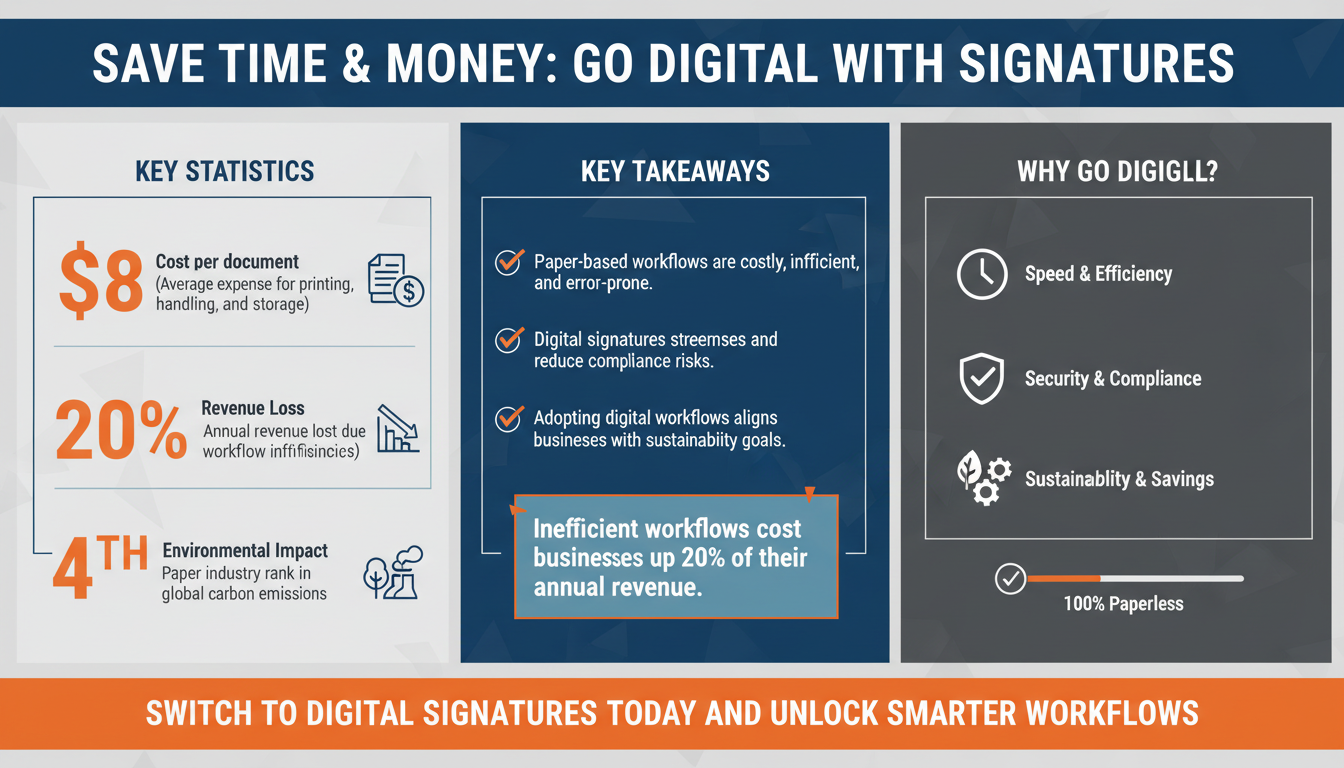
For instance, a study by Forrester found that businesses spend an average of $8 per document on printing, handling, and storage. For organizations processing thousands of documents monthly, these costs can balloon into hundreds of thousands of dollars annually. And this doesn’t even account for the indirect costs, such as lost productivity and errors.
One of the most significant drawbacks of paper-based systems is the time wasted on inefficient processes. Consider the lifecycle of a single contract: it needs to be printed, signed, scanned, and either mailed or emailed. Each stage introduces potential delays. According to a report by McKinsey, inefficiencies in workflows cost businesses up to 20% of their annual revenue. These delays can lead to missed deadlines, lost deals, and unhappy customers.
Furthermore, paper-based workflows are prone to errors. Misfiled documents, data entry mistakes, and lost paperwork create compliance risks, especially in regulated industries like healthcare, finance, and legal services. For example, a single misplaced document can result in penalties or even lawsuits—costs that far outweigh the investment in digital alternatives.
Environmental Impact
Beyond financial costs, paper-based workflows have a significant environmental impact. The production of paper requires substantial energy and water resources, contributing to deforestation and greenhouse gas emissions. According to the Environmental Paper Network, the paper industry is the fourth-largest contributor to global carbon emissions. By transitioning to digital workflows, businesses can reduce their carbon footprint and align with sustainable practices that resonate with increasingly eco-conscious consumers.
Pro Tip: Calculate Your Hidden Costs
Conduct a thorough audit of your current paper-based workflows to uncover hidden expenses. Include costs such as storage space, employee hours spent on manual processes, and compliance risks. Use these insights to build a business case for adopting digital signatures.
Case Study: A Law Firm’s Transition to Digital
Consider the example of a mid-sized law firm that dealt with hundreds of contracts and legal documents every month. Before adopting digital signatures, the firm faced frequent delays due to misplaced paperwork and manual approval processes. By transitioning to a digital signature platform, the firm reduced its document turnaround time by 50%, saved $30,000 annually on printing and storage, and eliminated compliance headaches associated with manual errors.
Key Takeaway:
- Paper-based workflows cost businesses an average of $8 per document, excluding error and compliance costs.
- Delays from manual processes can cost up to 20% of annual revenue.
- Transitioning to digital workflows minimizes errors, reduces costs, and accelerates execution.
How Digital Signatures Save Time
Time is one of the most valuable resources for any business. Manual document workflows can drain hours of productivity, forcing teams to focus on repetitive and low-value tasks. Digital signatures, however, eliminate these inefficiencies by enabling documents to be signed, processed, and shared instantly—anytime, anywhere.

Take the example of contract negotiations. Traditional methods typically involve multiple rounds of printing, scanning, and emailing documents. Each round introduces potential delays, particularly when multiple stakeholders are involved. With digital signatures, the process can be expedited significantly. A study by Gartner revealed that businesses using digital signatures experienced a 40% reduction in document turnaround times. Faster processes mean quicker decision-making, enhanced customer satisfaction, and a competitive edge in the market.
Additionally, digital signatures support remote collaboration. With the rise of hybrid and remote work models, the ability to sign and approve documents from different locations has become critical. Industries like real estate, legal services, and finance, where time-sensitive approvals are crucial, benefit immensely from this capability. For example, a real estate firm using digital signatures can close deals in hours instead of days, providing a better experience for clients and agents alike.
Best Practices for Optimizing Time Savings
- Integrate digital signature tools directly into your workflow management systems for seamless operations.
- Use automatic reminders and notifications to ensure timely document approvals.
- Create standardized templates for frequently used documents to avoid repetitive formatting tasks.
Pro Tip: Mobile-Friendly Digital Signatures
Choose a digital signature solution that is mobile-friendly, allowing employees and stakeholders to sign documents from their smartphones or tablets. This is particularly useful for field teams or executives who travel frequently.
Actionable Tips to Save Time:
- Integrate digital signatures into your contract management system to reduce turnaround times by at least 40%.
- Enable mobile-friendly digital signature solutions to facilitate approvals on the go.
- Leverage template-based workflows to eliminate repetitive tasks and ensure consistency.
The Financial Benefits of Digital Signatures
While the time savings are compelling, the financial benefits of digital signatures are equally transformative. By automating workflows and eliminating manual processes, businesses can achieve significant cost reductions across multiple areas.

1. Lower Operational Costs
Printing, scanning, mailing, and storing paper documents are all costly activities. By transitioning to digital workflows, these expenses are virtually eliminated. According to Statista, businesses save an average of $50,000 annually by going paperless. This figure can be even higher for companies with extensive document needs, such as financial institutions or government agencies.
2. Reduced Compliance Costs
Compliance failures can be financially devastating. In regulated industries, penalties for non-compliance can reach millions of dollars. Digital signatures include built-in audit trails and encryption, ensuring that every document is securely tracked and legally binding. A report by Deloitte found that businesses adopting digital signatures reduced compliance-related costs by 60%.
3. Enhanced ROI on Technology Investments
Digital signature solutions integrate seamlessly with existing platforms, such as CRMs, project management tools, and cloud storage systems. This integration maximizes the ROI on your technology stack by automating repetitive tasks and freeing up resources for higher-value activities. Forrester’s Total Economic Impact study found that businesses achieved a 312% ROI from adopting e-signature solutions.
Case in Point: A Financial Institution’s Savings
A regional bank processing thousands of loan applications monthly faced mounting operational costs and delays. By adopting digital signatures, the bank saved $70,000 annually on paper and printing expenses and reduced application processing times from two weeks to two days. This improvement also led to a 25% increase in customer satisfaction scores.
Comparison Table: Paper-Based vs. Digital Workflow Costs
| Expense Category | Paper-Based Workflows | Digital Workflows |
|---|---|---|
| Printing and Storage | $8 per document | $0.50 per document |
| Compliance Risks | High | Low |
| Turnaround Times | Days to Weeks | Hours |
Key Takeaway:
- Businesses save $50,000 annually in operational costs by transitioning to digital workflows.
- Digital signatures reduce compliance costs by 60%, mitigating legal risks and penalties.
- The ROI on digital signature adoption exceeds 300%, making it a worthwhile investment for businesses of all sizes.
Enhanced Security and Legal Compliance
Security breaches and legal non-compliance can have catastrophic consequences for businesses. Digital signatures address these concerns head-on by offering advanced security features, including encryption, authentication, and tamper-proof technology. Unlike traditional wet signatures, which can be forged or altered, digital signatures provide a secure and verifiable way to authenticate documents.

For example, an electronic contract signed using a digital signature includes a detailed audit trail, logging every step of the signing process. This ensures that the document is legally binding and fully compliant with regulations like the ESIGN Act, eIDAS, and GDPR. According to IAPP, businesses using digital signatures reduce compliance risks by 60% compared to traditional methods.
Industries such as healthcare, finance, and legal services are particularly reliant on secure digital workflows. For example, a healthcare provider handling sensitive patient data can use digital signatures to ensure HIPAA compliance, safeguarding both patient information and the organization’s reputation.
Expert Insight:
“Digital signatures are not just a tool for convenience—they are a critical component of any business’s cybersecurity strategy. By ensuring document integrity and authenticity, they provide a robust line of defense against fraud and unauthorized access.”—Jane Smith, Cybersecurity Consultant at SecureTech.
Key Takeaway:
- Digital signatures reduce compliance risks by 60%, ensuring secure and legally binding document workflows.
- Encryption and authentication protocols protect sensitive information from unauthorized access.
- Audit trails provide transparency and accountability, essential for regulated industries.
Streamlining Workflows with Automation
Digital signatures play a critical role in workflow automation, enabling businesses to eliminate redundant tasks, accelerate approvals, and maintain consistency. Automation ensures that documents move seamlessly through predefined workflows, reducing bottlenecks and errors. For example, automated reminders can ensure that contracts are signed on time, while predefined templates eliminate the need for manual formatting.
A report by BCG found that automated workflows reduce operational costs by 30% and improve productivity by 25%. This is particularly beneficial for SMBs, where resource constraints make efficiency a top priority.
Actionable Steps:
- Integrate digital signatures with existing CRM or project management tools for seamless workflows.
- Use automated reminders and notifications to prevent delays in document approvals.
- Leverage analytics from digital signature platforms to identify bottlenecks and optimize processes.
Conclusion
The inefficiencies of traditional paper-based workflows are no longer sustainable for growing businesses. Digital signatures offer a transformative solution, saving time, reducing costs, and enhancing security and compliance. By adopting digital workflows, organizations can unlock unprecedented levels of efficiency, improve customer satisfaction, and drive long-term growth.
Ready to make the leap? Explore our platform features or dive deeper into our comprehensive guide on going paperless.
To further enhance your digital workflows, explore our sister platforms: Apparatuz for workflow automation, Applicantz for recruitment management, Schedly for scheduling and appointments, Supportly for customer support, and Zatisfied for feedback management. Together, these tools create a comprehensive ecosystem that complements your digital signature strategy.