
In today’s fast-paced and interconnected business environment, managing contracts efficiently is more than just a convenience—it is a necessity. Small-to-medium businesses (SMBs) and enterprises rely heavily on recurring agreements, such as vendor contracts, subscription renewals, and service-level agreements (SLAs), to sustain their operations and growth. Yet, the traditional methods of handling these agreements often prove cumbersome, time-consuming, and prone to human error. Enter electronic signatures (e-signatures), a modern tool that revolutionizes contract management processes.
E-signatures streamline workflows, offering unparalleled speed, accuracy, and security. They eliminate the reliance on manual paperwork, reduce administrative overhead, and ensure compliance with legal and regulatory frameworks. This article dives deep into how electronic signatures simplify contract renewals and recurring agreements, offering detailed insights, real-world applications, and actionable advice for SMBs and enterprises navigating the challenges of 2026 and beyond.
The Challenges of Manual Contract Renewals and Recurring Agreements
Historically, businesses have relied on manual processes to manage contracts. While sufficient in simpler times, these approaches are increasingly unsuitable for today’s dynamic and globalized business environment. Here are the key obstacles organizations face with manual contract management:

- Time-Consuming Processes: Manual contract renewals involve repetitive tasks such as printing, signing, scanning, and mailing documents. These steps can cause delays, often stretching timelines from days to weeks, and slowing down business operations.
- Human Error and Oversight: Mistakes like missing deadlines, misplacing documents, or misinterpreting contract terms can lead to legal disputes, financial losses, or damaged relationships with stakeholders.
- Lack of Scalability: As businesses grow, the volume of contracts increases exponentially. Managing hundreds or even thousands of agreements manually becomes an unsustainable burden on resources and personnel.
- Compliance Risks: Contracts often contain legal and regulatory stipulations that must be adhered to. Paper-based systems make tracking compliance difficult, exposing organizations to fines, penalties, or reputational damage.
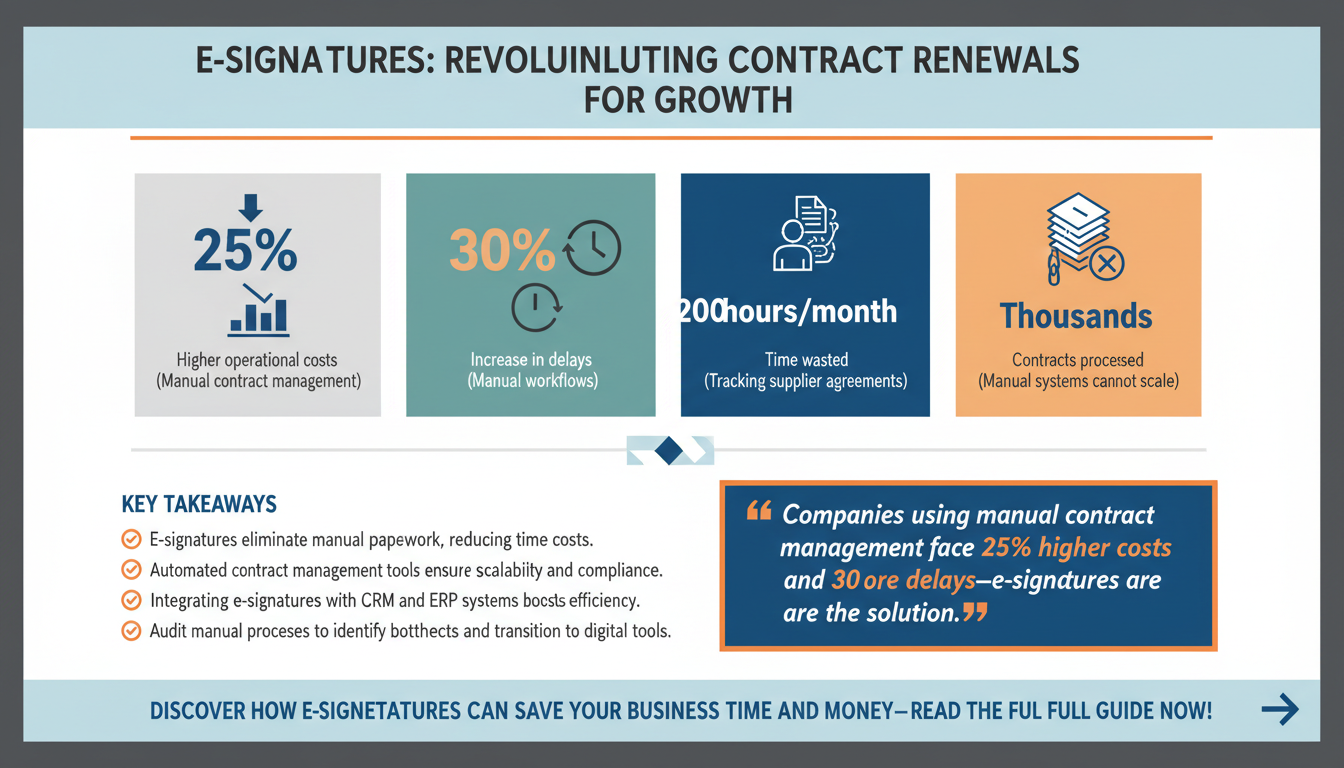
According to a Forrester Research study, companies relying on manual contract management experience an average of 25% higher operational costs compared to those utilizing automated solutions. Additionally, Gartner reports that manual workflows can lead to a 30% increase in delays during contract execution. These statistics underscore the urgent need for businesses to transition to digital tools like electronic signatures.
Operational Inefficiencies in Manual Processes
Manual workflows often fail to integrate seamlessly with other business systems, leading to inefficiencies. For example, contracts managed using paper methods require manual tracking through spreadsheets or email, creating silos and redundancies. This fragmentation not only increases the risk of errors but also consumes valuable employee time.
Consider a scenario involving a growing e-commerce company. Without automated tools, the company’s legal team spent over 200 hours per month manually tracking and renewing supplier agreements. This time could have been better allocated to strategic initiatives or customer-facing activities. E-signatures can eliminate these inefficiencies by integrating directly with Customer Relationship Management (CRM) tools, Enterprise Resource Planning (ERP) systems, and contract lifecycle management software.
Pro Tip:
Audit your existing manual processes to identify bottlenecks. Look for areas where delays or errors are most frequent, such as signature collection or compliance tracking. These are ideal starting points for implementing automated solutions like e-signatures.
How Electronic Signatures Work: A Step-by-Step Guide
Understanding how electronic signatures work is critical to implementing them successfully. At their core, e-signatures leverage digital technology to authenticate signatories and ensure the integrity of signed documents. Let’s explore the step-by-step process:

- Document Preparation: The sender uploads the contract or agreement to an e-signature platform, identifying fields where signatures, initials, or other inputs are required.
- Recipient Notification: The platform sends email notifications to recipients with a secure link to the digital document.
- Identity Verification: To ensure security, recipients may verify their identity through multi-factor authentication (MFA) methods like SMS codes, email verification, or government-issued identification.
- Signing: Recipients electronically sign the document using a mouse, stylus, or pre-saved digital signature. Some platforms also allow for touch-enabled signing on mobile devices.
- Audit Trail: Once signed, the platform generates a tamper-proof audit trail, recording key details such as IP addresses, timestamps, and user actions for legal and compliance purposes.
- Document Storage: The signed document is securely stored in the cloud, accessible to authorized users at any time. Organizations can integrate storage solutions with their existing software for seamless access.
Advanced Features of E-Signature Platforms
Modern e-signature platforms offer advanced capabilities that extend beyond simple signing. For instance, many tools provide automated reminders to ensure signatories complete their tasks promptly. Additionally, geo-location tracking and biometric authentication add layers of security, making these systems suitable for high-stakes agreements in industries like banking and healthcare.
Some platforms also support bulk signing, allowing businesses to send and process hundreds of contracts simultaneously. For example, a real estate firm that needed to finalize agreements for 500 tenants used DocuSign’s bulk send feature, completing the process in under 24 hours—a task that would have taken weeks using manual methods.
Pro Tip:
When choosing an e-signature solution, prioritize platforms that offer integrations with your existing tech stack. Seamless integration with tools like Salesforce, Microsoft 365, or Google Workspace can significantly enhance productivity.
Benefits of E-Signatures for Contract Renewals
Adopting electronic signatures offers numerous benefits for businesses, especially when managing recurring agreements and contract renewals. Let’s examine these advantages in detail:

1. Speed and Efficiency
Electronic signatures eliminate the need for physical paperwork, enabling contracts to be signed in minutes rather than days. Turnaround times are reduced dramatically, allowing businesses to respond quickly to opportunities. According to a Gartner report, organizations using e-signature platforms experience a 75% reduction in contract processing time. For example, a marketing agency that adopted e-signatures completed client agreements within 24 hours, compared to the previous 7-day average.
2. Cost Savings
Paper-based workflows incur costs for printing, shipping, and storage. Transitioning to digital processes eliminates these expenses. A study by Deloitte Insights found that organizations save an average of $20 per document with e-signature technology. For a business processing 1,000 contracts annually, this translates to $20,000 in savings—a significant impact on the bottom line.
3. Enhanced Security
E-signature platforms offer robust security features such as encryption, digital certificates, and tamper-proof audit trails. These safeguards ensure the authenticity and integrity of documents. For industries like healthcare and finance, where data protection is critical, e-signatures provide a reliable solution to mitigate risks.
4. Improved Compliance
Regulated industries often require strict adherence to legal standards. E-signature platforms simplify compliance by automatically maintaining audit trails and meeting legal requirements like the ESIGN Act and eIDAS Regulation. Businesses can avoid penalties and ensure peace of mind.
Expert Insight:
"The key to unlocking the full potential of e-signatures lies in their integration with compliance monitoring systems," says Sarah Johnson, a legal consultant specializing in contract management. "This ensures real-time tracking of regulatory changes and reduces the risk of non-compliance."
Real-World Applications: Case Studies in Contract Renewal Automation
To illustrate the impact of electronic signatures, let’s explore real-world examples:
1. SaaS Subscription Renewals
A mid-sized SaaS company faced delays in renewing customer subscriptions due to manual workflows. By adopting e-signatures, the company automated its renewal processes, reduced churn rates by 30%, and generated an additional $1.2 million in annual revenue.
2. Retail Vendor Agreements
An enterprise in the retail sector struggled to manage vendor contracts across its supply chain. Implementing e-signatures reduced turnaround times by 50%, enabling the company to comply swiftly with new regulatory requirements.
3. Healthcare Provider Agreements
A healthcare organization automated recurring agreements with insurance providers using e-signatures. The result was a 40% reduction in administrative overhead and improved accuracy in contract management.
Checklist for Success:
- Identify high-volume contract workflows suitable for automation.
- Choose an e-signature platform tailored to your industry needs.
- Train employees to maximize adoption rates.
- Monitor metrics such as turnaround time and error rates post-implementation.
Proprietary Framework: The “SURE” Model for E-Signature Success
To maximize the benefits of e-signatures, businesses can follow the “SURE” model:
- Simplify: Streamline workflows by digitizing document preparation and approval processes.
- Utilize: Leverage advanced features like multi-factor authentication and automated reminders.
- Review: Regularly audit e-signature processes to ensure compliance and identify areas for improvement.
- Expand: Scale e-signature solutions across departments and use cases.
Following the SURE model ensures sustained success and maximizes the value of e-signatures.
Pro Tip:
Use analytics provided by e-signature platforms to identify patterns in contract renewals. Adjust workflows based on data insights to improve efficiency and reduce delays.
Conclusion: The Future of Contract Management
The adoption of electronic signatures is set to accelerate as businesses increasingly recognize their benefits. By simplifying contract renewals and recurring agreements, e-signatures empower SMBs and enterprises to save time, reduce costs, and improve compliance. For organizations aiming to remain competitive, leveraging e-signatures is no longer optional—it is essential. To explore how Zignature can streamline your contract workflows, visit our comprehensive features or contact our team for a personalized demo.
To further enhance your digital workflows, explore our sister platforms: Apparatuz for workflow automation, Applicantz for recruitment management, Schedly for scheduling and appointments, Supportly for customer support, and Zatisfied for feedback management. Together, these tools create a comprehensive ecosystem that complements your digital signature strategy.