
As climate change continues to dominate global conversations, businesses are finding themselves at the forefront of the sustainability movement. Companies are increasingly expected to contribute positively to environmental goals while maintaining operational efficiency. Among the myriad of tools available to meet these demands, digital signatures stand out as a powerful yet often underappreciated solution. Not only do digital signatures streamline workflows, but they also significantly reduce carbon footprints and promote eco-friendly practices across industries. In this article, we delve into five transformative ways digital signatures contribute to sustainability, backed by statistics, expert insights, and actionable advice for businesses looking to make a difference.
1. Eliminating Paper Usage: A Direct Path to Sustainability
Paper production is one of the most resource-intensive industries globally. From deforestation to water consumption, its environmental footprint is staggering. According to the World Wide Fund for Nature (WWF), manufacturing just one sheet of A4 paper requires approximately 10 liters of water. Additionally, paper production contributes to greenhouse gas emissions due to energy-intensive processes and transportation. By transitioning to digital signatures, businesses can drastically reduce their reliance on paper-based workflows, directly contributing to sustainable practices.
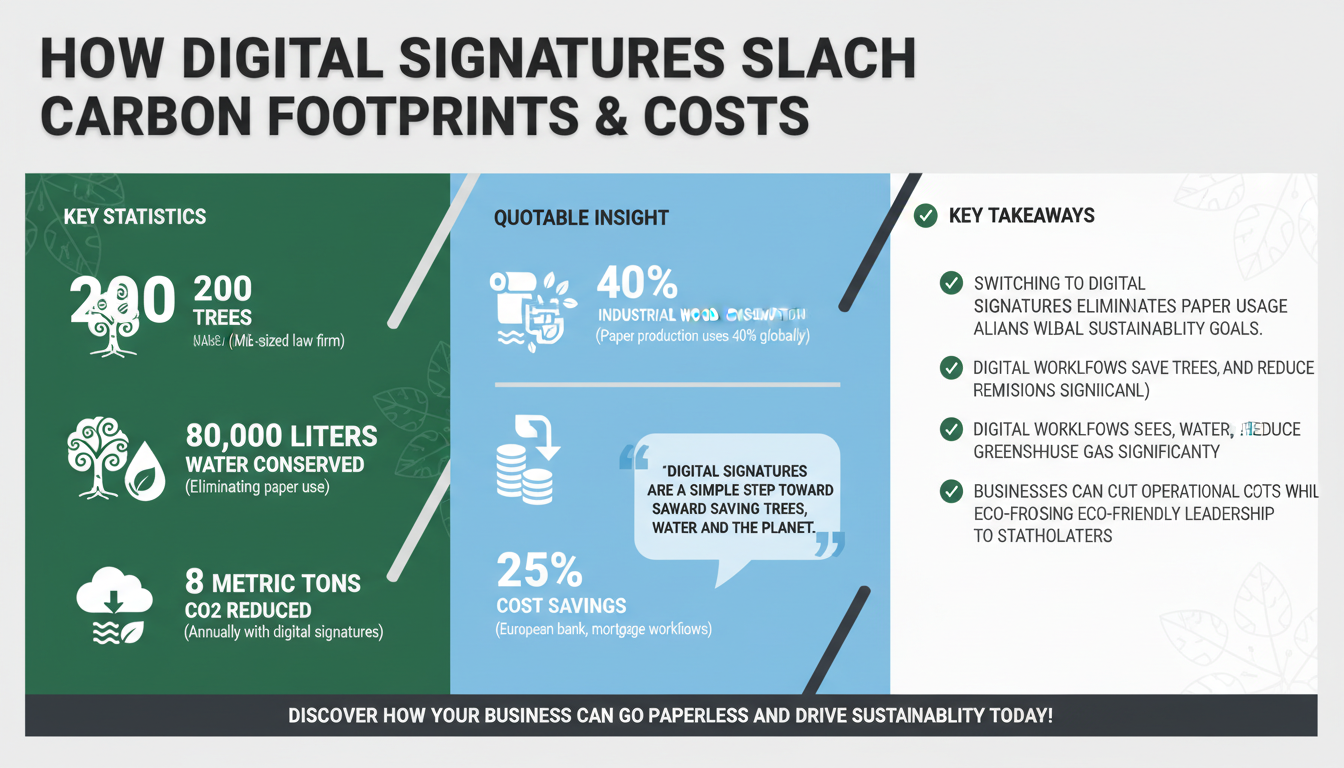
Consider the example of a mid-sized law firm that processes 20,000 pages of contracts annually. By switching to digital signatures, the firm could save over 200 trees, conserve 80,000 liters of water, and cut its carbon emissions by 8 metric tons annually, according to a recent sustainability study. These savings not only benefit the environment but also reduce operational costs tied to paper procurement, printing, and storage.
Moreover, the environmental benefits align with global initiatives such as the Paris Agreement, which aims to limit global warming and reduce deforestation. Businesses that adopt digital signature solutions can proudly showcase their commitment to conserving natural resources, strengthening their reputation among eco-conscious stakeholders.
The Environmental Cost of Paper
Paper consumption is a major contributor to deforestation. According to the Food and Agriculture Organization (FAO), up to 40% of all industrial wood harvested globally is used for paper production. This deforestation not only diminishes biodiversity but also exacerbates climate change by reducing the Earth’s ability to absorb carbon dioxide. Digital signatures present an opportunity to disrupt this cycle by removing the need for paper entirely.
Case Study: Paperless Success Stories
The banking industry has seen significant changes with the adoption of digital signatures. For instance, a large financial institution in Europe reported saving 1 million pages per year by implementing digital signing solutions for mortgage contracts and loan agreements. This transition reduced their paper costs by 25% while aligning their operations with sustainability goals.
Actionable Tips:
- Audit your current paper usage and identify workflows that can be digitized.
- Invest in a reliable digital signature platform that integrates easily with your existing systems.
- Educate employees on the environmental benefits of going paperless to encourage adoption.
Pro Tip:
Start small and scale your paperless initiative. Begin by digitizing high-volume processes like contracts or invoices, then expand to other workflows as employees adapt to the change.
Key Takeaway:
- Transitioning to digital signatures can eliminate thousands of pages of paper annually, saving trees, water, and energy.
- Adopting paperless workflows reflects a company’s dedication to environmental sustainability.
2. Reducing Carbon Emissions from Document Transportation
Traditional document workflows often involve significant transportation logistics. Whether contracts are mailed, couriered, or signed in person, these processes generate a considerable carbon footprint. The Environmental Protection Agency (EPA) states that the transportation sector accounts for 29% of all greenhouse gas emissions in the United States. This includes emissions from delivery vehicles used to transport physical documents.
Digital signatures eliminate the need for physical document transportation entirely. Contracts and agreements can be signed and shared electronically in mere seconds, bypassing the need for couriers or postal services. For example, a multinational corporation that processes 1,000 contracts monthly could avoid over 15,000 miles of courier travel annually, reducing CO2 emissions by approximately 5 metric tons. This shift not only saves time and money but also supports broader sustainability goals.
The Role of Remote Work
The remote collaboration enabled by digital signatures is particularly beneficial in today’s hybrid and remote work environments. Employees no longer need to travel for in-person document signing, further reducing transportation-related emissions. Remote work has become a cornerstone of modern business operations, and digital signatures ensure that sustainability goals are not compromised in the process.
Industry Example: Real Estate
In the real estate industry, digital signatures have revolutionized operations. Agents and clients can sign contracts from anywhere in the world, eliminating the need for physical meetings or couriered documents. One real estate firm reported saving over $10,000 per year in courier costs while reducing emissions by 3 metric tons annually through the adoption of e-signature technology.
Actionable Tips:
- Implement digital signature software to reduce reliance on physical couriers.
- Encourage remote collaboration across teams to minimize unnecessary travel.
- Highlight your reduced transportation emissions in sustainability reports to showcase progress.
Expert Insight:
"The transportation savings achieved through digital signatures are often underestimated. By eliminating courier services and in-person meetings, companies can make a significant environmental impact while streamlining operations." – Dr. Emily Green, Sustainability Consultant
Key Takeaway:
- Digital signatures eliminate the need for courier services, reducing transportation-related emissions.
- Remote signing capabilities support sustainable business practices in remote and hybrid work environments.
3. Minimizing Energy Consumption in Office Environments
Office environments can be energy-intensive, particularly when reliant on devices like printers, copiers, and fax machines to maintain paper-based workflows. These devices consume significant electricity and contribute to electronic waste. According to the International Energy Agency (IEA), office equipment accounts for approximately 7% of total commercial electricity consumption worldwide.

Digital signatures reduce the need for such devices, enabling paperless workflows that drastically lower energy consumption. A 2025 report by Gartner revealed that companies adopting paperless workflows experienced a 30% reduction in energy costs associated with document management. Furthermore, the reduced reliance on printers and copiers also minimizes electronic waste, addressing a critical issue in the global e-waste crisis.
Energy Savings Breakdown
Beyond direct energy savings, eliminating printers and copiers also reduces the need for consumables like ink and toner, which have their own environmental costs. For example, producing one toner cartridge emits approximately 4.8 kg of CO2. By adopting digital workflows, businesses can avoid these emissions entirely.
Case Example: Healthcare Industry
A healthcare organization transitioned to electronic patient consent forms, eliminating the need for paper-based processes. This shift reduced their annual energy consumption by 15%, saved $20,000 in operational costs, and enhanced the patient experience through faster document processing.
Actionable Tips:
- Conduct an energy audit to identify high-consumption office equipment that can be replaced by digital workflows.
- Encourage employees to adopt paperless habits to reduce printer and copier usage.
- Dispose of outdated office equipment responsibly by recycling or donating.
Pro Tip:
Consider investing the savings from reduced energy consumption into renewable energy solutions for your office, such as solar panels or energy-efficient lighting systems.
Key Takeaway:
- Reducing reliance on printers and copiers can lower energy consumption and operational costs.
- Digital signatures contribute to the reduction of electronic waste, supporting a circular economy.
4. Enhancing Document Lifecycle Management
Managing physical documents involves multiple stages, including printing, distribution, storage, retrieval, and disposal. Each of these phases has a sizable environmental impact. For instance, the Environmental Paper Network estimates that half of all printed pages are discarded within a day of being printed. This wasteful cycle contributes to deforestation, energy consumption, and landfill clutter.

Digital signatures streamline the document lifecycle, allowing businesses to store and retrieve documents electronically without the need for physical filing cabinets or off-site storage. For example, a healthcare organization that transitioned to digital patient consent forms reduced its storage space requirements by 70%. This not only freed up valuable office space but also cut down on paper-related waste.
Improving Security and Compliance
Digital documents are easier to track and audit, reducing the risk of misplaced files and enhancing security. This efficiency supports compliance requirements while promoting sustainability. For example, industries with strict regulatory requirements, such as finance and healthcare, benefit from the ability to securely store and manage digital documents while minimizing environmental impact.
Checklist for Transitioning to Digital Document Management
- Identify paper-heavy workflows, such as contracts and invoices.
- Choose a secure cloud storage solution for digital document management.
- Train employees on new systems and workflows.
- Develop a backup and recovery plan for digital documents.
Key Takeaway:
- Digital signatures simplify the document lifecycle, reducing waste and improving efficiency.
- Electronic storage eliminates the need for physical filing cabinets, saving space and resources.
5. Supporting Corporate Sustainability Goals
Sustainability is increasingly becoming a core component of corporate strategy. Stakeholders, including customers, employees, and investors, prioritize companies that demonstrate environmental responsibility. In fact, a 2026 survey by Deloitte found that 73% of consumers are more likely to support businesses with robust sustainability initiatives.
By integrating digital signatures into workflows, companies can showcase their commitment to reducing paper usage, cutting emissions, and minimizing waste. For example, a real estate firm that adopted e-signature technology highlighted its eco-friendly practices in marketing campaigns, leading to a 15% increase in client acquisition. Such initiatives resonate with environmentally conscious audiences and help businesses stand out in competitive markets.
Aligning with ESG Goals
Environmental, Social, and Governance (ESG) criteria are increasingly used by investors to evaluate a company’s long-term viability. Demonstrating a commitment to sustainability through digital solutions can attract socially responsible investors and enhance a company’s reputation. For instance, a tech company that adopted digital workflows reported a 12% increase in ESG fund investments.
Actionable Tips:
- Include digital signature adoption as part of your corporate sustainability report.
- Use eco-friendly practices as a marketing differentiator to attract customers and clients.
- Collaborate with stakeholders to identify further opportunities to integrate digital solutions into business operations.
Pro Tip:
Use analytics tools to quantify the environmental impact of your digital signature adoption and share these metrics with stakeholders to highlight your progress.
Key Takeaway:
- Digital signatures help companies meet corporate sustainability and ESG goals.
- Eco-friendly practices can attract customers, employees, and investors who prioritize sustainability.
FAQs: Common Questions About Digital Signatures and Sustainability
1. How do digital signatures reduce carbon footprints?
Digital signatures eliminate the need for paper, printing, and transportation, significantly reducing the carbon emissions associated with traditional document workflows.
2. Are digital signatures legally binding?
Yes, digital signatures are legally binding in most countries, including the United States and the European Union. They comply with laws such as the ESIGN Act and eIDAS Regulation.
3. What industries benefit the most from digital signatures?
Industries such as legal, real estate, finance, healthcare, and technology benefit significantly from digital signatures due to their high volume of document processing and need for compliance.
4. Can small businesses afford digital signature solutions?
Yes, there are affordable options tailored for SMBs. Platforms like Zignature provide scalable solutions that cater to businesses of all sizes.
5. How secure are digital signatures?
Digital signatures use advanced encryption and authentication protocols to ensure security and prevent tampering. They are more secure than traditional handwritten signatures.
Conclusion
Digital signatures are more than a convenience—they are a game-changer for businesses aiming to promote sustainability and reduce their carbon footprint. By eliminating paper usage, reducing transportation emissions, minimizing energy consumption, streamlining document management, and supporting corporate sustainability goals, digital signatures empower businesses to make a tangible environmental impact. As we collectively work toward a more sustainable future, integrating digital signature technology is not just a smart operational decision but a moral imperative.
Ready to take the next step toward sustainability? Explore Zignature’s industry-leading digital signature solutions and start your journey to a greener, paperless future today.
To further enhance your digital workflows, explore our sister platforms: Apparatuz for workflow automation, Applicantz for recruitment management, Schedly for scheduling and appointments, Supportly for customer support, and Zatisfied for feedback management. Together, these tools create a comprehensive ecosystem that complements your digital signature strategy.