
In today’s business landscape, sustainability is no longer a luxury or a niche concern—it’s a necessity. As climate change accelerates and environmental degradation becomes more evident, businesses are under increasing pressure to adopt practices that minimize their ecological footprint. Among the many digital tools redefining workplace efficiency and sustainability, digital signatures stand out as a game-changer. They not only streamline operations but also significantly reduce environmental impact, offering a practical path toward greener practices for both small-to-medium businesses (SMBs) and large enterprises.
This guide dives deep into the environmental benefits of digital signatures, exploring their role in cutting paper waste, reducing carbon footprints, and supporting corporate sustainability initiatives. With detailed insights, actionable tips, and real-world examples, this article equips businesses of all sizes to harness the power of digital signatures for a more sustainable future.
The Environmental Cost of Paper-Based Processes
For decades, paper-based workflows have been a cornerstone of business operations. From contracts and invoices to memos and reports, organizations have relied on paper for documentation and communication. However, what often goes unnoticed is the staggering environmental toll of these processes. The global paper industry is one of the largest contributors to greenhouse gas emissions, accounting for approximately 9% of all manufacturing-related emissions, according to the Environmental Paper Network.
The production of paper is resource-intensive. It takes approximately 10 liters of water to produce a single A4 sheet of paper. Meanwhile, the energy required for cutting trees, transporting raw materials, and processing them into paper results in substantial carbon emissions. Deforestation linked to the paper industry also contributes to biodiversity loss, soil erosion, and water cycle disruptions. On top of that, discarded paper fills landfills worldwide, where it decomposes and releases methane—a greenhouse gas 25 times more potent than carbon dioxide.
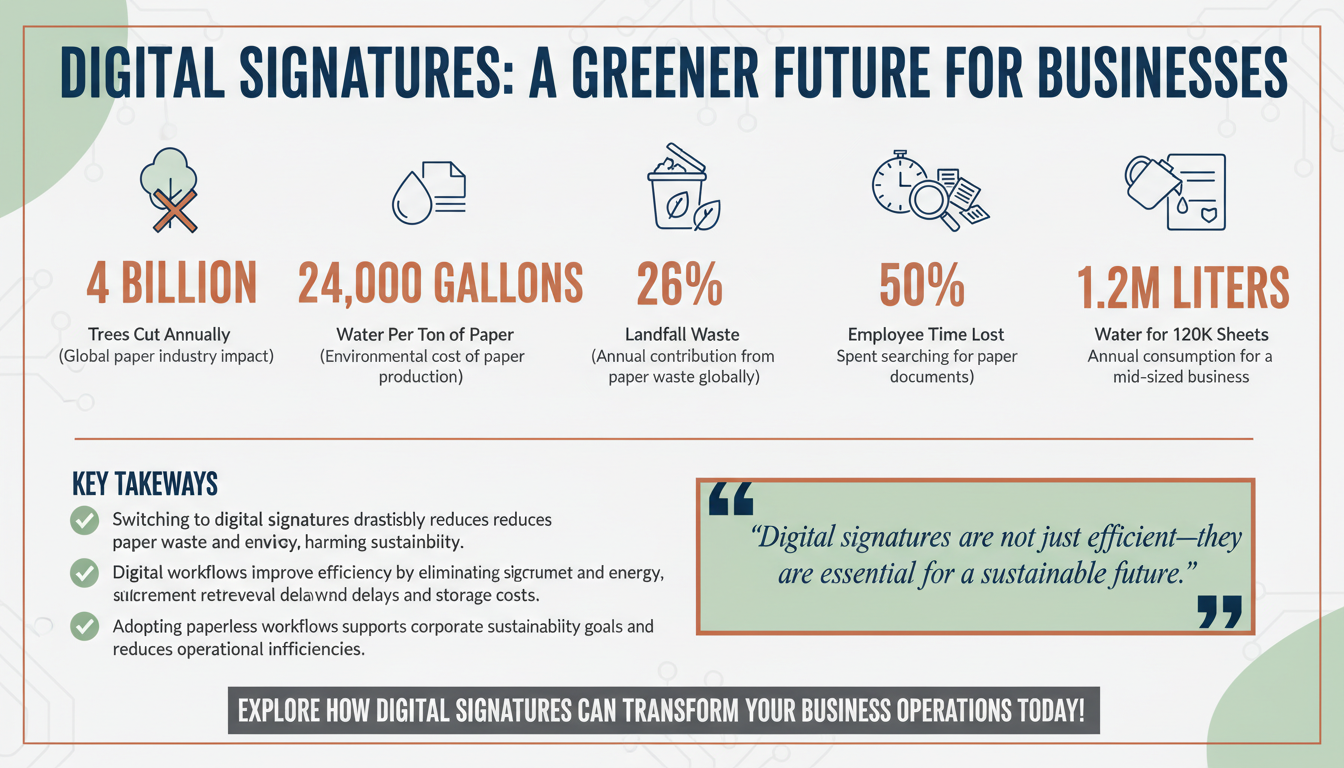
For example, a mid-sized company that processes 10,000 pages of paperwork monthly consumes nearly 120,000 sheets annually. This equates to roughly 1.2 million liters of water and significant energy input, not to mention the waste generated when these documents are eventually discarded. By transitioning to digital signatures and electronic workflows, businesses can drastically cut down on paper usage, contributing to a more sustainable ecosystem.
Key Statistics
- The global paper industry is responsible for 4 billion trees being cut down annually.
- One ton of paper requires 24,000 gallons of water to produce.
- Each year, paper waste accounts for roughly 26% of total landfill waste globally.
Expert Insight: Hidden Costs of Paper-Based Systems
The environmental costs of paper production are just the beginning. Businesses often overlook the hidden financial costs of paper-based processes, such as storage expenses and inefficiencies in document retrieval. According to a study by PricewaterhouseCoopers, employees spend an average of 50% of their time searching for paper documents, which leads to productivity losses and operational delays. Digital workflows eliminate these inefficiencies, saving both time and money.
How Digital Signatures Enable Paperless Workflows
The concept of a paperless office has long been viewed as a futuristic ideal. However, with the advent of digital signature technology, this vision is now a practical reality. Digital signatures enable organizations to eliminate the need for physical paper-based workflows, drastically reducing waste and improving overall efficiency.
Consider the traditional process of signing a contract. It typically involves printing multiple copies of the document, mailing them to involved parties, waiting for signatures, and then either scanning the signed document back into a digital format or storing the physical copies. Each of these steps not only consumes resources but also takes time. Digital signatures eliminate these inefficiencies entirely. Documents can be digitally signed, shared, and stored within minutes, all without a single sheet of paper being used.
According to a Gartner study, businesses that adopt paperless workflows can reduce operational costs by up to 30% while cutting document processing times by 50%. The time savings alone can have a ripple effect across operations, allowing employees to focus on value-added tasks instead of administrative burdens. In addition, digital workflows are inherently more secure, offering encrypted storage and detailed audit trails to ensure compliance with legal and regulatory requirements.
Actionable Tips for Paperless Transition
- Start small: Implement digital signatures in a single department, such as HR or procurement, before scaling up.
- Choose the right tools: Platforms like DocuSign and Adobe Sign offer user-friendly interfaces and robust security features.
- Educate employees: Conduct training sessions to familiarize staff with digital workflows and their benefits.
Step-by-Step Guide to Paperless Adoption
- Audit your current processes: Identify areas with heavy paper usage, such as contracts or invoices.
- Select a digital signature provider: Research platforms to find one that fits your business needs.
- Migrate documents: Convert paper-based records into digital formats using scanning tools.
- Train your team: Offer workshops and tutorials to ensure smooth adoption.
- Monitor progress: Use analytics tools to measure paper savings and environmental impact.
Reducing Carbon Footprint with Digital Signatures
The environmental impact of paper-based processes extends beyond paper production. Transportation and storage of physical documents also contribute significantly to carbon emissions. Couriers delivering contracts, trucks hauling reams of paper, and climate-controlled storage facilities all add up to a substantial carbon footprint.
Digital signatures eliminate the need for these emissions-heavy processes. By enabling electronic document sharing, businesses can cut out the transportation step entirely. This is especially beneficial for industries like legal and finance, where contracts and documentation often need to travel between multiple parties. According to McKinsey, digitalization initiatives, including the adoption of digital signatures, can reduce carbon emissions by up to 45% in document-heavy sectors.
Moreover, storing documents digitally requires far less energy than maintaining physical records. Paper archives often need to be stored in air-conditioned facilities to prevent deterioration, whereas digital files can be securely stored in cloud systems that operate with energy-efficient technology. Companies that switch to digital archives can further reduce their energy consumption, contributing to long-term sustainability goals.
Key Benefits
- Transportation savings: Electronic delivery cuts emissions from document shipping.
- Energy efficiency: Digital storage requires less energy compared to climate-controlled physical storage.
- Scalability: Digital workflows are easier to scale without adding to your carbon footprint.
Pro Tip: Renewable Energy-Powered Cloud Storage
For businesses looking to maximize their sustainability efforts, consider using cloud storage providers that operate on renewable energy. Companies like Google Cloud and AWS have committed to powering their data centers with 100% renewable energy, ensuring that your digital documents are stored in an environmentally responsible manner.
Enhancing Corporate Sustainability Goals
For businesses aiming to meet ambitious ESG (Environmental, Social, and Governance) benchmarks, digital signatures offer a tangible way to demonstrate environmental responsibility. Sustainability has become a crucial aspect of corporate reputation, influencing not only consumer preferences but also investor confidence.
By integrating digital signature solutions, companies can show measurable progress toward reducing their environmental impact. For instance, detailed analytics provided by platforms like Zignature allow businesses to track metrics such as paper savings and carbon reductions. These insights can be used in sustainability reports, bolstering transparency and accountability.
Beyond environmental benefits, digital signatures also intersect with social and governance goals. They improve accessibility, allowing employees and clients to sign documents remotely, fostering inclusivity. Additionally, the audit trails generated by digital signature platforms enhance governance by ensuring compliance with legal and regulatory standards, reducing the risk of fraud and errors.
Case Study: A Corporate Example
A global logistics company recently adopted digital signatures as part of its sustainability strategy. In the first year, the company reduced its paper consumption by 2 million sheets, saved 20,000 gallons of water, and cut its carbon emissions by 15%. The move also streamlined operations, reducing contract processing times by 40%, which enabled faster client onboarding and improved customer satisfaction.
Checklist for Aligning Digital Signatures with ESG Goals
- Track paper savings and carbon reductions using analytics tools.
- Incorporate digital signature metrics into sustainability reports.
- Communicate progress to stakeholders through transparent reporting.
- Ensure compliance with e-signature regulations to strengthen governance.
Cost Savings and Environmental Benefits for SMBs
Small- and medium-sized businesses often operate on tight budgets, making cost efficiency a top priority. The good news is that digital signatures not only help SMBs save the planet but also their bottom lines.
Traditional paper-based processes come with hidden costs, including expenses for paper, ink, printers, storage, and shipping. For example, a small business spending $500 per month on printing could save up to $6,000 annually by transitioning to digital signatures. Over time, these savings can be reinvested into growth initiatives, such as hiring new employees or expanding product offerings.
Environmental benefits go hand in hand with these financial savings. By reducing resource consumption and waste generation, SMBs can position themselves as eco-friendly businesses, appealing to increasingly sustainability-conscious consumers. According to a Nielsen study, 73% of millennials are willing to spend more on sustainable products, underscoring the competitive advantage of green practices.
Practical Steps for SMBs
- Leverage free trials: Many digital signature platforms offer free trials, allowing SMBs to test the technology before committing.
- Start with high-impact areas: Focus on digitizing contracts, invoices, and other frequently used documents.
- Monitor ROI: Track cost savings and environmental metrics to measure the impact of digital signatures.
Comparison Table: Paper-Based vs. Digital Workflows
| Aspect | Paper-Based Workflows | Digital Workflows |
|---|---|---|
| Resource Usage | High (paper, ink, storage) | Low (cloud storage) |
| Processing Time | Slow (manual handling) | Fast (instant sharing and signing) |
| Environmental Impact | Significant (deforestation, emissions) | Minimal (digital processes) |
| Cost | High (ongoing expenses) | Lower (one-time software investment) |
Overcoming Common Challenges in Adoption
Despite the clear benefits, transitioning to digital signatures is not without challenges. Common barriers include resistance to change, upfront costs, and concerns about data security. However, these obstacles can be overcome with the right strategies.
One effective approach is to start with a pilot program. For example, a company might implement digital signatures in one department, such as human resources, to handle employment contracts and onboarding paperwork. This allows the organization to identify and address any technical or operational challenges on a smaller scale before rolling out the solution company-wide.
Employee buy-in is also critical. Providing training and highlighting the benefits of digital signatures—such as time savings, cost reductions, and environmental impact—can help build support among staff. Additionally, choosing a reputable platform with strong security features can alleviate concerns about data protection.
Quick Wins
- Run a pilot program: Test digital signatures in a single department before scaling up.
- Provide training: Educate employees on the benefits and usage of digital signature platforms.
- Choose trusted providers: Opt for platforms like DocuSign or Adobe Sign that prioritize security and compliance.
Expert Insight: Addressing Security Concerns
One of the most common concerns about digital signatures is the security of sensitive data. To address this, businesses should opt for platforms that offer end-to-end encryption and multi-factor authentication. Leading providers like Adobe Sign and DocuSign comply with international standards, ensuring that your documents are secure and legally binding.
Measuring the Environmental Impact
Quantifying the environmental benefits of digital signatures is essential for tracking progress and showcasing results. Modern digital signature platforms offer analytics tools that enable businesses to measure metrics such as paper savings, energy reductions, and carbon footprint decreases.
For example, Zignature’s platform provides a dashboard that displays real-time data on environmental impact. A company can use this information to create detailed sustainability reports, which can be shared with stakeholders to demonstrate commitment to green initiatives. These reports not only enhance corporate transparency but also strengthen brand reputation in an increasingly eco-conscious market.
Metrics to Track
- Paper savings: Measure the reduction in paper usage compared to previous workflows.
- Carbon emissions: Track decreases in emissions from transportation and storage.
- Energy consumption: Monitor energy savings from reduced reliance on physical storage facilities.
Pro Tip: Use Data to Drive Sustainability Campaigns
Leverage the analytics from your digital signature platform to create compelling marketing campaigns that highlight your environmental impact. Share data-driven results with customers and investors to boost engagement and demonstrate your commitment to sustainability.
FAQs: Common Questions About Digital Signatures and Environmental Impact
How do digital signatures reduce paper waste?
Digital signatures eliminate the need for printing, mailing, and storing physical documents, significantly reducing paper consumption and waste.
Are digital signatures legally binding?
Yes, digital signatures are legally binding and compliant with regulations such as the ESIGN Act in the U.S. and eIDAS in the EU.
What industries benefit most from digital signatures?
Industries such as legal, finance, healthcare, and real estate benefit significantly due to their reliance on document-heavy workflows.
What is the ROI of implementing digital signatures?
According to Forrester, businesses can achieve up to 300% ROI by adopting digital workflow solutions, including digital signatures.
How can SMBs get started with digital signatures?
Platforms like Zignature, DocuSign, and Adobe Sign offer cost-effective solutions tailored for SMBs, with easy onboarding and robust support.
Conclusion
As businesses navigate the dual challenges of improving efficiency and reducing environmental impact, digital signatures emerge as a vital solution. By eliminating paper-based processes, cutting carbon emissions, and aligning with sustainability goals, digital signatures offer a win-win scenario for organizations and the planet.
Implementing digital signatures is not just an operational upgrade—it’s a statement of commitment to a sustainable future. Whether you’re an SMB looking to cut costs or a global enterprise aiming to meet ESG benchmarks, digital signatures provide the tools to achieve your goals. Start your journey toward a paperless, eco-friendly future today.
To further enhance your digital workflows, explore our sister platforms: Apparatuz for workflow automation, Applicantz for recruitment management, Schedly for scheduling and appointments, Supportly for customer support, and Zatisfied for feedback management. Together, these tools create a comprehensive ecosystem that complements your digital signature strategy.