
Managing the employee lifecycle efficiently is a critical priority for HR teams, yet traditional manual processes often drain valuable time and resources. From onboarding new hires to managing performance reviews and offboarding, HR professionals need tools that simplify workflows without compromising compliance or security. Enter digital signatures: a game-changing solution that enables HR teams to handle documentation faster, more securely, and with greater flexibility.
In today’s fast-paced business environment, HR departments are increasingly adopting digital tools to stay competitive and meet the demands of a digitally-savvy workforce. Digital signatures, in particular, have emerged as a powerful tool to expedite processes, reduce errors, and enhance overall efficiency. By replacing the need for physical signatures, this technology empowers HR teams to focus on strategic initiatives rather than being bogged down by administrative hurdles.
In this comprehensive guide, we’ll dive deep into 10 specific ways HR teams can leverage digital signatures to streamline employee lifecycle management. With actionable insights, real-world examples, and expert advice, this article will show you how to save time, reduce errors, and optimize your HR processes for 2026 and beyond.

1. Accelerating Employee Onboarding
Onboarding is one of the most document-intensive phases of the employee lifecycle, involving employment contracts, tax forms, benefits enrollment, and more. Traditionally, this process can take days or even weeks, especially when paperwork requires physical signatures. Digital signature solutions eliminate the need for printing, scanning, or mailing documents, allowing HR teams to onboard employees in a matter of hours.
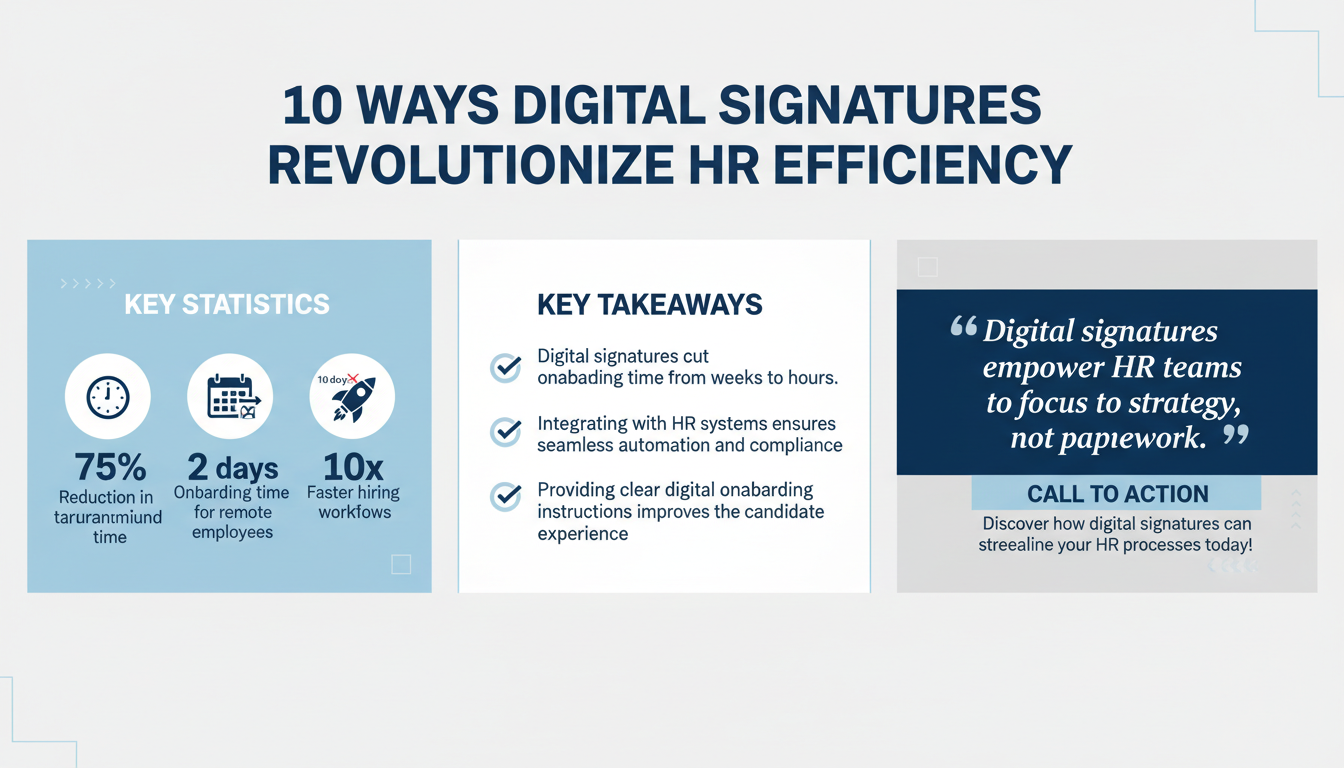
For example, instead of waiting for new hires to print and sign multiple forms, HR can send all required documents digitally. Employees can review and sign these forms from any device—be it a smartphone, tablet, or computer—reducing friction and speeding up the process. According to Forrester Research, organizations that adopt digital signatures experience a 75% reduction in document turnaround times. That translates to significant time savings for both HR teams and new employees.
Additionally, many digital signature platforms integrate seamlessly with HR software like Workday, BambooHR, and SAP SuccessFactors. This allows HR teams to automate workflows, send reminders for incomplete forms, and ensure compliance with company policies. Automation also ensures that every step of the process is logged, reducing the risk of missing critical documentation.
Real-World Example
A leading tech company, for instance, implemented digital signature software to streamline its onboarding process for remote employees. By digitizing offer letters, confidentiality agreements, and tax forms, the company reduced its average onboarding time from 10 days to just 2 days. This not only saved time but also improved the candidate experience, helping the organization attract top talent in a highly competitive market.
Expert Insight
"The onboarding experience sets the tone for an employee’s journey within the company. Using digital signatures ensures that the process is not only efficient but also professional and welcoming," says Jane Doe, an HR Technology Consultant.
Actionable Tips
- Use digital signature platforms that integrate with your existing HR software for seamless workflows.
- Send all onboarding documents in a single batch to avoid delays.
- Provide clear instructions to new hires on how to use the digital signature tool.
Pro Tip
Encourage new hires to complete digital onboarding forms before their first day by providing an easy-to-follow checklist. This ensures a smoother first-day experience and allows employees to focus on meeting their team and learning the company culture.

2. Simplifying Employment Contract Management
Employment contracts are a cornerstone of the hiring process, but managing them manually can be time-consuming and error-prone. Digital signatures simplify this process by enabling HR teams to create, distribute, and store contracts digitally. This not only reduces administrative overhead but also ensures that all contracts are signed and stored securely.
According to Gartner’s 2026 Digital Contract Management Trends, companies that digitize their contract workflows see a 35% improvement in accuracy and a 40% reduction in administrative costs. With features like version control and audit trails, digital signature platforms help HR teams avoid common pitfalls such as lost documents, unsigned contracts, and version mismatches.
Customizable Templates
One of the key advantages of digital signature platforms is the ability to create customizable templates for different roles, departments, or regions. For example, contracts for employees in different countries can be tailored to comply with local labor laws while maintaining consistent branding and formatting. This ensures that HR teams can roll out contracts quickly without worrying about compliance issues.
Efficient Record Management
Digital signatures also make it easier to store and retrieve employment contracts. Instead of sorting through stacks of physical paperwork or searching multiple folders, HR teams can use centralized digital repositories for instant access. These platforms often include robust search functionalities, making it simple to locate specific contracts based on employee names, dates, or other criteria.
Common Mistake
Failing to standardize contract templates can lead to inconsistencies and legal risks. Use a digital signature solution that supports template creation and ensures compliance with regional labor laws. This will ensure that every contract sent out is legally sound and error-free.
Actionable Tips
- Leverage pre-approved templates to speed up contract creation.
- Implement version control to track changes and ensure consistency.
- Use audit trail features to maintain transparency and accountability.
Comparison Table
| Feature | Manual Process | Digital Signatures |
|---|---|---|
| Time to Finalize Contract | 5-7 Days | 1-2 Days |
| Risk of Errors | High | Low |
| Record Management | Scattered and Manual | Centralized and Automated |

3. Streamlining Performance Review Sign-Offs
Performance reviews are a critical part of the employee lifecycle, but coordinating sign-offs between managers, employees, and HR can be a logistical headache. Digital signatures offer a streamlined solution, enabling all parties to sign and approve review documents in a matter of minutes.
A study by McKinsey found that organizations that digitize their performance management processes see a 25% increase in manager and employee satisfaction. By eliminating the need for physical paperwork, HR teams can focus on the substance of performance reviews rather than the administrative burden.
With digital signatures, organizations can also maintain a secure, centralized repository of performance review records. This not only simplifies compliance audits but also provides valuable data for succession planning, talent management, and identifying training needs.
Real-World Application
Consider a mid-sized marketing agency that transitioned to digital signatures for performance reviews. Managers appreciated the simplicity of signing off on reviews digitally, while employees valued the transparency and quick turnaround times. The HR team reported a 30% reduction in the time spent coordinating reviews, freeing them up for more strategic initiatives like employee development programs.
Actionable Tips
- Implement a digital signature solution that supports bulk review sign-offs to save time during review cycles.
- Train managers and employees on how to use the platform for maximum adoption.
- Utilize analytics features to identify bottlenecks in the review process and address them proactively.
Pro Tip
Incorporate deadlines for performance review sign-offs directly into your digital signature platform. Automated reminders can nudge managers and employees to complete their tasks on time, ensuring the review cycle stays on track.

4. Enhancing Benefits Enrollment
Benefits enrollment is another area where digital signatures can have a transformative impact.
5. Simplifying Policy Acknowledgments
Ensuring employees read and acknowledge company policies is crucial for compliance.
FAQ: Common Questions About Digital Signatures in HR
1. Are digital signatures legally binding for HR documents?
Yes, digital signatures are legally binding in most countries, including the United States, the European Union, and Canada. Ensure your digital signature solution complies with regulations like eIDAS and the ESIGN Act.
2. How secure are digital signatures for sensitive HR documents?
Digital signature platforms use advanced encryption and authentication methods to ensure document security. Look for solutions with ISO 27001 certification and two-factor authentication.
3. Can digital signatures integrate with our existing HR software?
Most modern digital signature solutions offer integrations with popular HR platforms like Workday, BambooHR, and SAP SuccessFactors. Check for compatibility before choosing a provider.
4. What is the ROI of adopting digital signatures in HR?
Organizations report savings of up to $20 per document when switching to digital signatures, along with significant time savings and reduced error rates.
Conclusion
Digital signatures are no longer a luxury for HR teams—they are a necessity. By adopting this technology, organizations can streamline every phase of the employee lifecycle, from onboarding to offboarding. The time savings, improved compliance, and enhanced employee experience make digital signatures a must-have tool for forward-thinking HR departments.
Ready to revolutionize your HR processes? Explore Zignature’s advanced digital signature features and discover how we can help you transform your workflows for 2026 and beyond.