
In today’s fast-paced digital environment, efficiency and security are paramount for businesses across all industries. Digital signatures have emerged as a revolutionary tool, enabling organizations to simplify workflows, enhance compliance, and reduce operational costs. But what makes digital signatures indispensable is their versatility across industries. From legal agreements to healthcare consent forms, digital signatures provide a secure, legally binding, and efficient alternative to traditional pen-and-paper methods.
This article dives deep into ten industry-specific use cases for digital signatures, illustrating how they streamline workflows and transform processes in sectors like legal, real estate, finance, and beyond. Whether you’re an operations manager, a legal professional, or a real estate agent, these examples will demonstrate the transformative potential of digital signatures in your industry.
1. Legal Industry: Streamlining Contract Management
The legal industry thrives on contracts, agreements, and documentation. Traditionally, the signing process for legal documents has been cumbersome, requiring physical meetings or courier services. Digital signatures eliminate these inefficiencies while maintaining legal enforceability under regulations like the eIDAS (Europe) and ESIGN Act (United States).
Key Applications:
- Client Agreements: Lawyers can onboard clients faster by sending engagement letters for e-signature, reducing delays.
- NDAs: Firms often handle non-disclosure agreements, which can be signed and stored digitally, ensuring quick execution and secure archiving.
- Litigation Documents: Filing court-required documents with e-signatures speeds up the submission process, especially as courts increasingly accept digital filings.
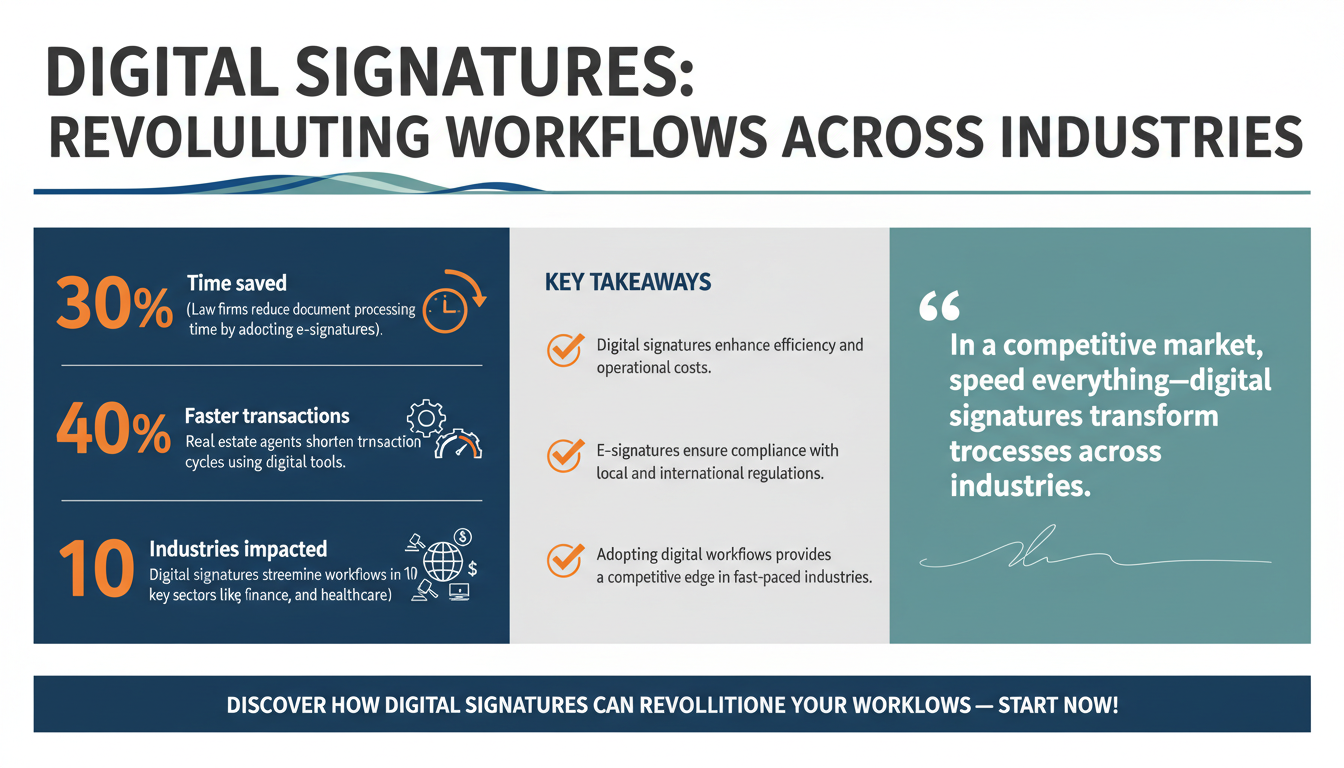
According to a McKinsey study, law firms adopting digital workflows, including e-signatures, saw a 30% reduction in document processing time. This not only improves client satisfaction but also reduces operational costs.

Common Pitfalls:
One common mistake is failing to comply with regional laws regarding digital signatures. Ensure your e-signature solution adheres to jurisdictional requirements to avoid legal disputes.
Key Takeaways:
- E-signatures enhance efficiency in client onboarding and contract management.
- Ensure compliance with local and international digital signature regulations.
2. Real Estate: Accelerating Property Transactions
Real estate transactions involve multiple stakeholders: buyers, sellers, agents, and notaries. This complexity often results in delays. Digital signatures simplify the process by enabling parties to sign documents like purchase agreements, lease contracts, and disclosures remotely and securely.
Key Applications:
- Purchase Agreements: Buyers and sellers can sign contracts digitally, reducing the time to close deals.
- Rental Contracts: Property managers can finalize lease agreements without requiring tenants to visit the office.
- Disclosures: Compliance-related documents can be signed and stored digitally, ensuring audit readiness.
Research by the National Association of Realtors found that digital tools, including e-signatures, reduce transaction cycles by up to 40%. This has become a competitive advantage in today’s real estate market.

Expert Insight:
"In a competitive market, speed is everything. Digital signatures allow agents to close deals faster while providing a seamless experience for clients." – Jane Doe, Real Estate Tech Consultant.
Key Takeaways:
- Digital signatures reduce delays in real estate transactions, offering a competitive edge.
- Focus on secure platforms that protect sensitive client data.
3. Finance: Enhancing Compliance and Customer Onboarding
The finance industry is heavily regulated, requiring meticulous documentation and secure processes. Digital signatures ensure compliance with regulations like KYC (Know Your Customer) and AML (Anti-Money Laundering) while speeding up customer onboarding and loan approvals.
Key Applications:
- Loan Applications: Clients can sign loan agreements remotely, expediting the approval process.
- Account Opening: Digital signatures streamline the process of opening new accounts, especially for online banking.
- Investment Agreements: Financial advisors can finalize contracts with clients securely and efficiently.
According to Forrester Research, financial institutions implementing e-signatures experienced a 25% increase in customer satisfaction and reduced document errors by 50%.

Quick Win:
Start by implementing digital signatures for low-risk processes like internal approvals before expanding to customer-facing applications.
Key Takeaways:
- E-signatures ensure compliance with financial regulations while improving efficiency.
- Adopt secure platforms with robust encryption and audit trails.
4. Healthcare: Simplifying Consent and Documentation
Healthcare providers handle extensive paperwork, from patient consent forms to insurance claims. Digital signatures reduce administrative burdens, allowing providers to focus on patient care while maintaining HIPAA compliance.
Key Applications:
- Patient Consent: Patients can sign consent forms digitally, even before arriving at the clinic.
- Insurance Claims: Providers and insurers can process claims faster with e-signatures.
- Medical Records: Digital signatures ensure the authenticity and integrity of electronic health records (EHRs).
Studies by Health Affairs show that digital tools, including e-signatures, reduce administrative costs by up to 20% in healthcare organizations.

Common Mistake:
Failing to integrate e-signature solutions with existing EHR systems can lead to inefficiencies. Choose platforms that offer seamless integrations.
Key Takeaways:
- Streamline patient and administrative workflows with e-signatures.
- Ensure HIPAA compliance to protect patient data.
5. Human Resources: Accelerating Employee Onboarding
HR departments manage multiple documents, from employment contracts to policy acknowledgments. Digital signatures simplify these processes, ensuring timely completion and secure storage.
Key Applications:
- Offer Letters: Candidates can sign job offers digitally, speeding up the hiring process.
- Onboarding Forms: New hires can complete paperwork remotely, reducing first-day delays.
- Policy Acknowledgments: Employees can sign policy updates digitally, ensuring compliance.
According to SHRM research, companies using digital onboarding tools reduce time-to-productivity by 25%.

Quick Win:
Implement digital signatures for offer letters as a first step toward a fully digital onboarding process.
Key Takeaways:
- E-signatures enhance the candidate experience and reduce paperwork.
- Integrate with HR software for seamless workflows.
6. Education: Facilitating Admissions and Agreements
Educational institutions rely on signed documentation for admissions, consent forms, and faculty contracts. Digital signatures streamline these processes, saving time for administrators, students, and parents.
Key Applications:
- Enrollment Agreements: Students and parents can sign digitally, speeding up the admissions process.
- Field Trip Forms: Teachers can collect parental consent electronically.
- Faculty Contracts: Administrators can finalize contracts with staff more efficiently.
A report by EdTech Magazine highlights that schools using digital tools, including e-signatures, save up to 30 hours per week in administrative tasks.
Key Takeaways:
- Digital signatures enhance efficiency in educational administration.
- Ensure compliance with regional education laws for e-signatures.
FAQs
1. Are digital signatures legally binding?
Yes, digital signatures are legally binding in most countries under regulations like the ESIGN Act, UETA, and eIDAS. Always ensure your chosen platform complies with local laws.
2. How secure are digital signatures?
Digital signatures use encryption and authentication methods to ensure document integrity and signer identity, making them highly secure.
3. Can digital signatures integrate with existing software?
Many e-signature solutions offer integrations with popular software like CRMs, HR platforms, and document management systems, streamlining workflows.
4. What industries benefit most from digital signatures?
While all industries can benefit, sectors like legal, real estate, finance, healthcare, and education see the greatest impact due to their high volume of documentation.
Conclusion
Digital signatures are no longer a luxury—they are a necessity for businesses aiming to stay competitive in 2026 and beyond. By adopting e-signature solutions, organizations across industries can streamline workflows, enhance compliance, and improve customer and employee experiences. Whether you’re in legal, real estate, finance, or education, the use cases outlined here demonstrate the immense value digital signatures bring to modern workflows.
Ready to transform your business processes? Explore our platform features to see how Zignature can help you achieve seamless, secure, and legally binding digital workflows.
To further enhance your digital workflows, explore our sister platforms: Apparatuz for workflow automation, Applicantz for recruitment management, Schedly for scheduling and appointments, Supportly for customer support, and Zatisfied for feedback management. Together, these tools create a comprehensive ecosystem that complements your digital signature strategy.