
Contract management is the cornerstone of legal operations, serving as the foundation for agreements, negotiations, and compliance in virtually every organization. However, traditional contract processes often suffer from inefficiencies, delays, and vulnerabilities that can negatively impact legal teams and their clients. As businesses evolve and demand faster, more secure workflows, digital signatures have emerged as a game-changing solution. By enabling streamlined, secure, and legally compliant processes, digital signatures empower legal teams to handle contracts with unprecedented efficiency.
This article explores seven transformative ways digital signatures can revolutionize contract management for legal professionals, offering not just theoretical insights but actionable strategies, expert-backed data, and real-world applications to help legal teams thrive in 2026 and beyond.
1. Accelerating Contract Turnaround Times
One of the most pressing challenges for legal teams is the time it takes to finalize contracts. Traditional methods often involve cumbersome processes such as printing, scanning, mailing, and manually following up with stakeholders. These inefficiencies can lead to delays of days or even weeks, frustrating clients and slowing down business operations. Digital signatures eliminate these barriers by enabling real-time document signing from virtually any device, anywhere in the world.
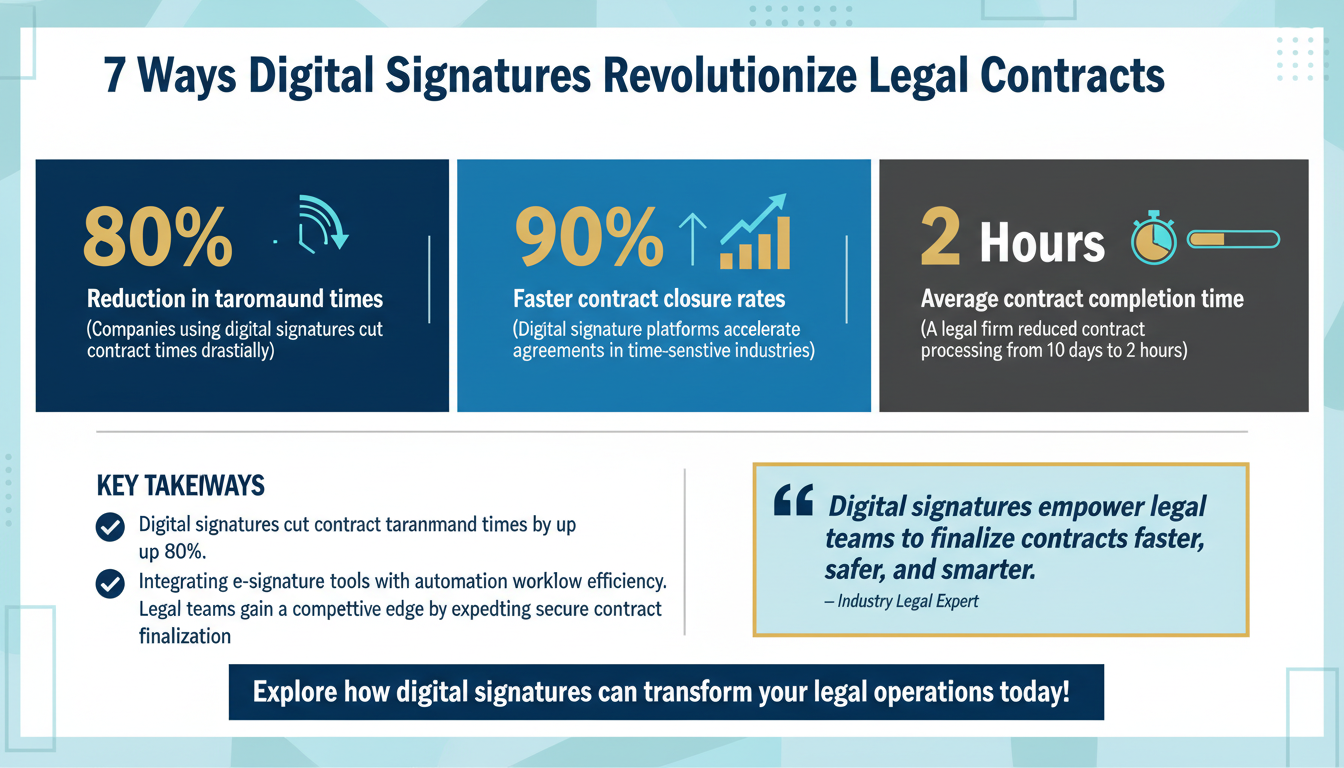
According to a Forrester study, companies that implement digital signature solutions experience an average 80% reduction in document turnaround times. For legal teams, this translates to faster contract execution, improved client satisfaction, and enhanced organizational agility.
Take the example of a mid-size legal firm in Chicago that adopted digital signatures. Their average contract completion time plummeted from 10 days to just 2 hours, enabling them to onboard clients more quickly while allocating more time to high-value tasks such as legal analysis and strategic planning.
Beyond anecdotal evidence, statistics support the efficiency gains brought on by digital signatures. Research from DocuSign shows that digital signature platforms can accelerate contract closure rates by up to 90%, especially in industries like real estate and healthcare, where time-sensitive agreements are critical.
Real-World Applications in Various Industries
Legal teams working in the tech sector often face tight deadlines for licensing agreements and intellectual property documentation. Digital signatures have allowed these teams to reduce delays drastically, enabling faster product launches and smoother partnerships. Similarly, in the real estate industry, legal teams have leveraged digital signatures to speed up lease agreements and property sales, ensuring transactions are completed within hours rather than days.
Pro Tip: Leverage Automation
Integrate digital signature solutions with automation tools to enable seamless workflows. For example, set up automated notifications to remind stakeholders to sign contracts or use pre-built templates to skip repetitive administrative tasks. These small adjustments can significantly reduce turnaround times.
Actionable Tips:
- Analyze your team’s contract workflows and identify bottlenecks where manual processes cause delays.
- Invest in a secure, user-friendly e-signature solution like Zignature.
- Enable automated reminders to ensure all parties sign documents promptly.
- Integrate your e-signature platform with a contract lifecycle management (CLM) tool for seamless operations.
Key Takeaway:
By eliminating manual steps, digital signatures empower legal teams to expedite contract finalization without sacrificing accuracy or security, giving them a competitive edge in negotiations.
2. Enhancing Document Security and Compliance
For legal teams, security and compliance are paramount. Contracts often contain sensitive client information, trade secrets, or financial details that must be protected from unauthorized access or tampering. Traditional wet signatures are vulnerable to forgery, alteration, and loss during transit. Digital signatures address these vulnerabilities by leveraging encryption, authentication protocols, and secure audit trails that ensure documents remain tamper-proof and legally binding.
Research from Gartner indicates that organizations using digital signature solutions reduce security breaches related to contract management by 75%. This is especially critical for industries like healthcare, where compliance with regulations such as HIPAA and GDPR is non-negotiable.
Consider the example of a healthcare provider’s legal department. By implementing digital signatures, they not only enhanced document security but also ensured compliance with stringent data protection laws. This proactive approach reduced the risk of costly data breaches and strengthened client trust.
Building Trust Through Secure Processes
In addition to encryption, digital signature platforms often include verification measures such as biometric authentication or SMS-based identity checks. These added layers help prevent unauthorized access and ensure that signatories are who they claim to be. This is particularly useful in industries like finance, where fraud prevention is critical.
Expert Insight: Audit Trails Are a Game-Changer
Audit trails provided by digital signature solutions track every interaction with a document, offering legal teams an irrefutable record of actions taken. This feature is invaluable in disputes or regulatory reviews, giving legal teams a reliable way to prove compliance.
Actionable Tips:
- Opt for a digital signature solution that offers multi-factor authentication and encryption.
- Ensure the platform complies with regulations such as the ESIGN Act, eIDAS, and GDPR.
- Conduct regular security audits to verify the integrity of your document workflows.
- Educate team members on the importance of using secure digital signature tools instead of free alternatives that lack robust features.
Key Takeaway:
By integrating encrypted digital signatures into contract workflows, legal teams can confidently safeguard sensitive information while maintaining compliance with global regulations.
3. Reducing Errors and Revisions
Errors in contract management—whether due to incorrect data entry, missing signatures, or incomplete fields—can lead to costly disputes, delays, or reputational damage. Traditional manual processes are inherently prone to such mistakes, as they rely on human intervention. Digital signature platforms mitigate these risks by automating critical aspects of contract preparation and execution.
A Statista report reveals that digital tools reduce document errors by up to 90%. Features such as automated field validation, pre-filled templates, and real-time error detection ensure that contracts are complete and accurate before being shared for signature.
For example, legal teams in the real estate industry have leveraged digital signatures to reduce errors in property contracts. By using standardized templates and automated workflows, they’ve minimized disputes and expedited transactions, leading to smoother client experiences.
Checklist: Error-Free Contracts
- Use standardized templates for frequently used contracts.
- Enable automatic error detection features.
- Conduct a final review using built-in validation tools.
- Train team members on common errors to watch for, such as missing fields.
Pro Tip: Continuous Improvement
Regularly analyze completed contracts to identify recurring errors and refine templates or workflows accordingly. This proactive approach reduces mistakes over time and improves efficiency.
Key Takeaway:
Digital signatures streamline workflows, minimizing errors and reducing the need for time-consuming revisions, ultimately saving both time and money for legal teams.
4. Simplifying Cross-Border Transactions
In an increasingly globalized marketplace, legal teams often manage contracts that span multiple jurisdictions. Navigating the complexities of international laws and compliance requirements can be challenging, especially when traditional methods are used. Digital signatures simplify cross-border transactions by providing solutions that comply with global standards such as eIDAS in the European Union and the ESIGN Act in the United States.
According to IDC research, 65% of legal departments now use digital tools to manage international contracts, enabling faster deal closures and ensuring regulatory compliance.
One illustrative example comes from a multinational corporation managing a cross-border merger. By adopting digital signatures, they finalized the agreement within days instead of weeks, ensuring compliance with both EU and U.S. regulations while significantly reducing administrative overhead.
Comparison Table: Traditional vs. Digital Cross-Border Transactions
| Aspect | Traditional Methods | Digital Signatures |
|---|---|---|
| Turnaround Time | Weeks | Days |
| Compliance | Manual checks | Automated compliance verification |
| Cost | High due to courier and admin fees | Lower with streamlined processes |
Expert Insight: Overcoming Jurisdictional Challenges
Digital signatures are recognized as legally binding in most countries, but it’s important to verify local legislation to ensure compliance. Platforms like DocuSign and Adobe Sign offer region-specific features to address this.
Key Takeaway:
Digital signatures enable legal teams to efficiently navigate international compliance requirements, making cross-border transactions faster and less complex.
Conclusion
The adoption of digital signatures is no longer a luxury but a necessity for legal teams striving to optimize contract management. By accelerating turnaround times, enhancing security, reducing errors, and simplifying cross-border transactions, digital signatures empower legal professionals to meet the demands of a fast-paced and increasingly digital world.
As demonstrated through data, expert insights, and real-world examples, the benefits of digital signatures are profound and far-reaching. Legal teams that embrace this technology can expect not only operational efficiency but also improved client satisfaction, reduced risks, and a stronger competitive edge.
Now is the time to invest in the tools and strategies that will position your legal team for success in 2026 and beyond.