
In today’s fast-paced and increasingly digital business environment, the ability to adapt quickly to changing circumstances is critical for success. One of the most significant pain points for legal teams and small-to-medium-sized businesses (SMBs) lies in the management of contracts, particularly when amendments are required. Historically, this process has been tedious, time-consuming, and fraught with opportunities for error. However, the emergence of digital signatures has revolutionized this area, offering a streamlined, secure, and legally compliant solution to an age-old problem.
Digital signatures not only simplify the workflow but also safeguard the integrity of legal documents, enabling businesses to adapt more nimbly to evolving needs. Whether you’re revising employment contracts, renegotiating vendor agreements, or updating client partnership terms, digital signatures empower you to operate with unmatched efficiency and security. This guide will dive deep into how digital signatures transform legal contract amendments, the challenges they overcome, and the steps you can take to implement them effectively in your organization.
Let’s explore how digital signatures can empower your legal team and help your business thrive in 2026 and beyond.
The Traditional Challenges of Amending Legal Contracts
Amending legal contracts has traditionally been a source of frustration for legal teams and businesses alike. The process often involves a series of manual steps, such as printing, mailing, scanning, and filing, each of which adds time, costs, and opportunities for error. These challenges are particularly pronounced for SMBs, which may lack the robust resources and infrastructure of larger enterprises.

Here are some key obstacles associated with traditional contract amendment processes:
1. Manual Workflows
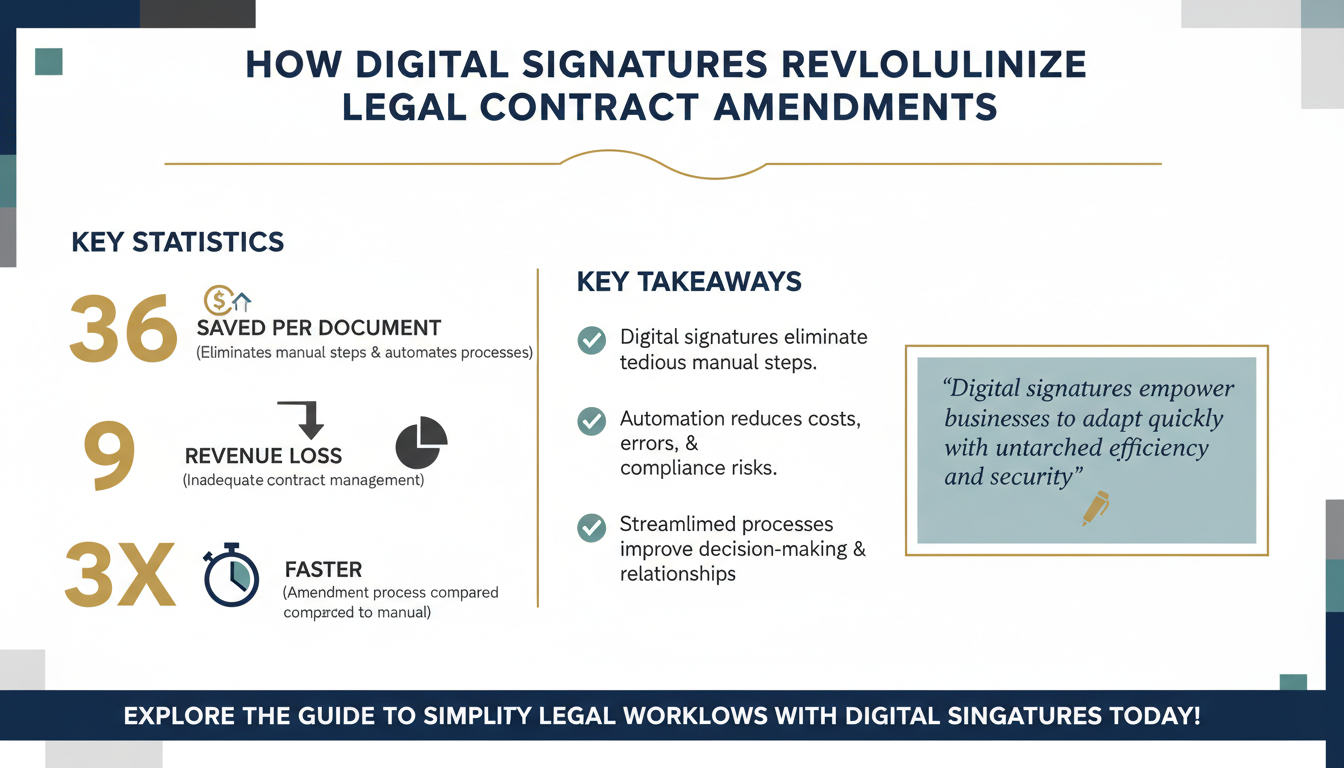
Traditional contract amendments require significant manual intervention. Legal teams often need to print documents, make handwritten edits, mail them to other parties, and await physical signatures. This not only prolongs the process but also incurs costs for printing, postage, and storage. For example, a 2021 study by Forrester Research estimated that businesses could save up to $36 per document by eliminating these manual steps through automation.
Manual workflows also introduce inefficiencies that hinder collaboration. Consider the case of a small logistics company negotiating an annual vendor agreement. Every amendment required weeks of back-and-forth mail exchanges, leading to delays in finalizing terms and impacting operational timelines. Such inefficiencies often result in lost business opportunities and strained relationships with stakeholders.
2. Risk of Human Error
Manual processes are inherently prone to human error. Documents might be misfiled, signatures might be missed, or changes might be overlooked. Such mistakes can lead to disputes, financial losses, or even legal consequences. For instance, a survey by the International Association for Contract and Commercial Management (IACCM) found that inadequate contract management can cost companies as much as 9% of their annual revenue.
Errors in contracts can have severe repercussions. For example, in 2020, a small consulting firm lost a major client due to inconsistencies in amended contract terms, which resulted in a breach of agreement. These errors not only tarnish reputations but also lead to costly legal battles that could have been avoided with a more streamlined workflow.
3. Compliance Complexity
In a globalized business environment, contracts often span multiple jurisdictions, each with its own legal requirements. Ensuring compliance with varying laws and regulations can be both time-consuming and complex. Failure to meet these requirements can render contracts unenforceable, exposing businesses to significant risks.
For instance, a company operating in both the European Union and the United States must navigate the intricacies of eIDAS regulations and the ESIGN Act. Without proper guidance, businesses may inadvertently violate compliance protocols, leading to invalid contracts and regulatory penalties. Digital solutions simplify this process by embedding compliance features directly into the workflow.
4. Lack of Audit Trails
Physical documents rarely provide a comprehensive record of who accessed or modified them and when. This lack of transparency can make it difficult to resolve disputes or verify the authenticity of a document. By contrast, digital solutions often include robust audit trails that record every interaction with a document.
Audit trails are critical for industries like healthcare and finance, where regulatory scrutiny is high. For example, a financial institution amending loan agreements can leverage audit trails to demonstrate compliance with lending regulations and track every change made to the document. This not only reduces legal risks but also builds trust with clients and stakeholders.
These challenges collectively lead to inefficiencies, increased costs, and heightened risks. It’s clear that a more modern, streamlined approach is needed—and that’s where digital signatures come into play.
What Are Digital Signatures, and How Do They Work?
A digital signature is an advanced form of electronic signature that uses cryptographic algorithms to ensure the authenticity, integrity, and non-repudiation of a document. Unlike a simple electronic signature, which could be as basic as a scanned image of a handwritten signature, digital signatures provide a higher level of security and legal validity.

Key Features of Digital Signatures
Here’s a closer look at the core features that make digital signatures indispensable for modern contract management:
- Authentication: Digital signatures verify the identity of the signer through methods like two-factor authentication, password-protected accounts, or certificate-based systems. This ensures that only authorized individuals can sign the document.
- Data Integrity: A digital signature creates a unique cryptographic hash of the document. If the document is altered after signing, the signature becomes invalid, ensuring the integrity of the information.
- Non-Repudiation: Because digital signatures are tied to the signer’s unique credentials, they provide undeniable proof that the signer intended to agree to the terms of the document. This feature reduces the risk of disputes.
- Compliance: Digital signatures comply with international legal frameworks such as the United States’ Electronic Signatures in Global and National Commerce (ESIGN) Act, the European Union’s eIDAS regulation, and others. This ensures their legal enforceability across jurisdictions.
The Process of Applying Digital Signatures
Digital signatures work through a process involving a trusted Certificate Authority (CA), which issues a digital certificate to the signer. When the signer applies their signature to a document, the certificate encrypts the signature, linking it securely to the document. Any subsequent changes to the document invalidate the signature, ensuring tamper-proof security.
This process is particularly beneficial for industries with rigorous compliance needs. For example, in the pharmaceutical sector, digital signatures are used to amend agreements between research partners, ensuring that all changes are securely recorded and meet regulatory standards.
Pro Tip: Selecting the Right Certificate Authority
When choosing a digital signature platform, ensure it uses a trusted Certificate Authority (CA) that complies with global standards like WebTrust or eIDAS. This guarantees the legal validity and security of your signed documents.
Understanding these features is less important than appreciating their practical benefits. By leveraging digital signatures, businesses can significantly reduce the time, cost, and complexity associated with contract management.
How Digital Signatures Simplify Contract Amendments
Contract amendments often involve multiple parties, rounds of review, and numerous signatures. Digital signatures streamline this process, addressing many of the traditional challenges faced by legal teams and SMBs. Here’s how they make a difference:

1. Speed and Efficiency
Digital signatures eliminate the need for printing, scanning, and mailing documents. Contracts can be signed electronically in minutes, regardless of the parties’ physical locations. For example, a 2022 study by DocuSign revealed that businesses using digital signatures reduced document turnaround times by up to 80% compared to traditional methods.
Imagine a marketing agency renegotiating vendor contracts during a busy campaign season. By using digital signatures, the agency can finalize agreements within hours, ensuring uninterrupted operations and faster delivery to clients.
2. Enhanced Security
Encryption ensures that signed documents cannot be tampered with, protecting sensitive information. Additionally, advanced authentication methods, such as biometric scans or secure passwords, ensure that only authorized individuals can sign or access the document. According to a report by the National Institute of Standards and Technology (NIST), digital signatures drastically reduce the risk of fraud compared to traditional signatures.
Security is especially critical in the healthcare industry, where patient data must remain confidential. Digital signatures provide an added layer of protection, ensuring compliance with regulations like HIPAA while maintaining trust with patients and stakeholders.
Comparison: Digital vs. Traditional Signatures
| Aspect | Traditional Signatures | Digital Signatures |
|---|---|---|
| Speed | Days to weeks | Minutes to hours |
| Security | Prone to tampering | Tamper-proof with encryption |
| Compliance | Varies by jurisdiction | Globally recognized frameworks |
| Cost | High (printing, storage) | Low (automation) |
3. Improved Compliance
Most digital signature solutions are designed to comply with international legal standards, ensuring that signed documents are legally binding in multiple jurisdictions. For instance, the eIDAS regulation in the EU and the ESIGN Act in the U.S. provide clear guidelines for the legal validity of digital signatures.
Compliance becomes seamless for businesses operating globally. For example, a multinational corporation managing contracts across Asia, Europe, and North America can rely on digital signature platforms to ensure all agreements meet respective regulatory requirements without additional legal reviews.
Expert Insight: Leveraging Real-Time Collaboration
"Digital signatures combined with collaborative tools like shared dashboards and live chat features can revolutionize contract management," says Sarah Hendrix, a legal tech consultant. "Stakeholders can engage in real-time discussions, reducing bottlenecks and ensuring faster decision-making."
By addressing these key areas, digital signatures transform the contract amendment process into a fast, secure, and compliant workflow.
Case Study: SMB Success with Digital Signature Adoption
Let’s consider the case of Greenfield Realty, a mid-sized real estate firm that faced significant challenges with contract amendments. Before adopting digital signatures, the firm’s legal team spent an average of five days amending agreements due to the inefficiencies of manual workflows.
After implementing a digital signature platform, the firm achieved remarkable improvements:
- Amendment Time Reduced: The time required to amend contracts decreased from five days to less than 24 hours, representing a 75% improvement in efficiency.
- Compliance Ensured: By using a platform compliant with global regulations, the firm eliminated concerns about the legal validity of their contracts.
- Cost Savings: The firm saved $10,000 annually by reducing expenses associated with printing, mailing, and document storage.
This example demonstrates the tangible benefits of digital signature adoption for SMBs, enabling them to operate more efficiently and reduce costs.
Proprietary Framework: The S.A.F.E. Model for Digital Contract Amendments
To help businesses integrate digital signatures into their workflows, we’ve developed the S.A.F.E. model:
- Secure: Choose a reputable platform that ensures encryption and tamper-proof documents.
- Automated: Automate document routing, notifications, and reminders to streamline the signing process.
- Flexible: Select a solution that supports multiple file formats and integrates with existing tools like CRM and document management systems.
- Efficient: Focus on reducing turnaround times and facilitating real-time collaboration among stakeholders.
Checklist: Implementing the S.A.F.E. Model
- Evaluate platforms for compliance features and encryption.
- Configure automated workflows for document approvals.
- Test integrations with existing systems like CRM tools.
- Train staff to maximize efficiency in using the platform.
By following this framework, legal teams and SMBs can maximize the benefits of digital signatures.
Common Mistakes to Avoid When Adopting Digital Signatures
While digital signatures offer numerous advantages, their implementation is not without challenges. Avoid these common pitfalls:
- Choosing Non-Compliant Solutions: Ensure your chosen platform complies with international regulations to avoid legal risks.
- Ignoring Training Needs: Provide comprehensive training to ensure your team understands how to use the platform effectively.
- Overlooking Integration: Select a solution that integrates seamlessly with your existing systems to avoid creating workflow silos.
Expert Insight: Ensuring Seamless Integration
"Integration is often overlooked but absolutely vital," says Tom Reynolds, CTO at LegalTech Solutions. "When digital signatures work hand-in-hand with your contract management software, you can unlock true efficiency."
Addressing these issues proactively can ensure a smoother transition to digital workflows.
FAQ: Frequently Asked Questions About Digital Signatures
- Are digital signatures legally binding? Yes, they are legally binding in most jurisdictions.
- What industries benefit most? Legal, real estate, and healthcare industries are prime beneficiaries.
- How do I choose a digital signature platform? Look for features like compliance with international standards, robust encryption, and user-friendly interfaces.
- Can digital signatures be used for international contracts? Absolutely. Thanks to regulations like eIDAS and ESIGN, digital signatures have cross-border validity.
Conclusion: Empowering Legal Teams and SMBs with Digital Signatures
Digital signatures are reshaping modern legal operations, offering speed, security, and compliance. By adopting these tools, SMBs and legal teams can thrive in a competitive landscape. Whether you’re looking to improve contract turnaround times, enhance collaboration, or ensure regulatory compliance, digital signatures provide a proven, scalable solution.
It’s time to embrace the future of contract management and position your business for success in the digital age.
To further enhance your digital workflows, explore our sister platforms: Apparatuz for workflow automation, Applicantz for recruitment management, Schedly for scheduling and appointments, Supportly for customer support, and Zatisfied for feedback management. Together, these tools create a comprehensive ecosystem that complements your digital signature strategy.