
The world of regulatory compliance is growing ever more complex in 2026. With industries ranging from finance to healthcare facing tighter scrutiny, businesses are under immense pressure to meet stringent compliance standards while maintaining efficiency. Digital signatures have emerged as a game-changing tool, enabling organizations to not only meet these requirements but exceed them. This article dives deep into how digital signatures are revolutionizing regulatory compliance across industries, offering practical solutions, data-driven insights, and actionable strategies.
By the end of this guide, you’ll understand exactly why digital signatures are no longer optional but critical, how they enhance compliance, and how to implement them effectively in your organization. Let’s explore the transformative impact of this technology.
1. Ensuring Data Integrity and Authenticity
Regulatory bodies worldwide require companies to ensure the integrity and authenticity of their documents. Digital signatures use advanced cryptographic techniques to guarantee that a document remains unaltered after it has been signed. This not only ensures compliance but also builds trust with stakeholders.

For instance, digital signatures use public key infrastructure (PKI) to create a unique “fingerprint” for each signed document. If even a single character is altered post-signature, the document becomes invalid. This is particularly crucial in industries like finance, where tampering with a contract can lead to significant legal and financial repercussions.
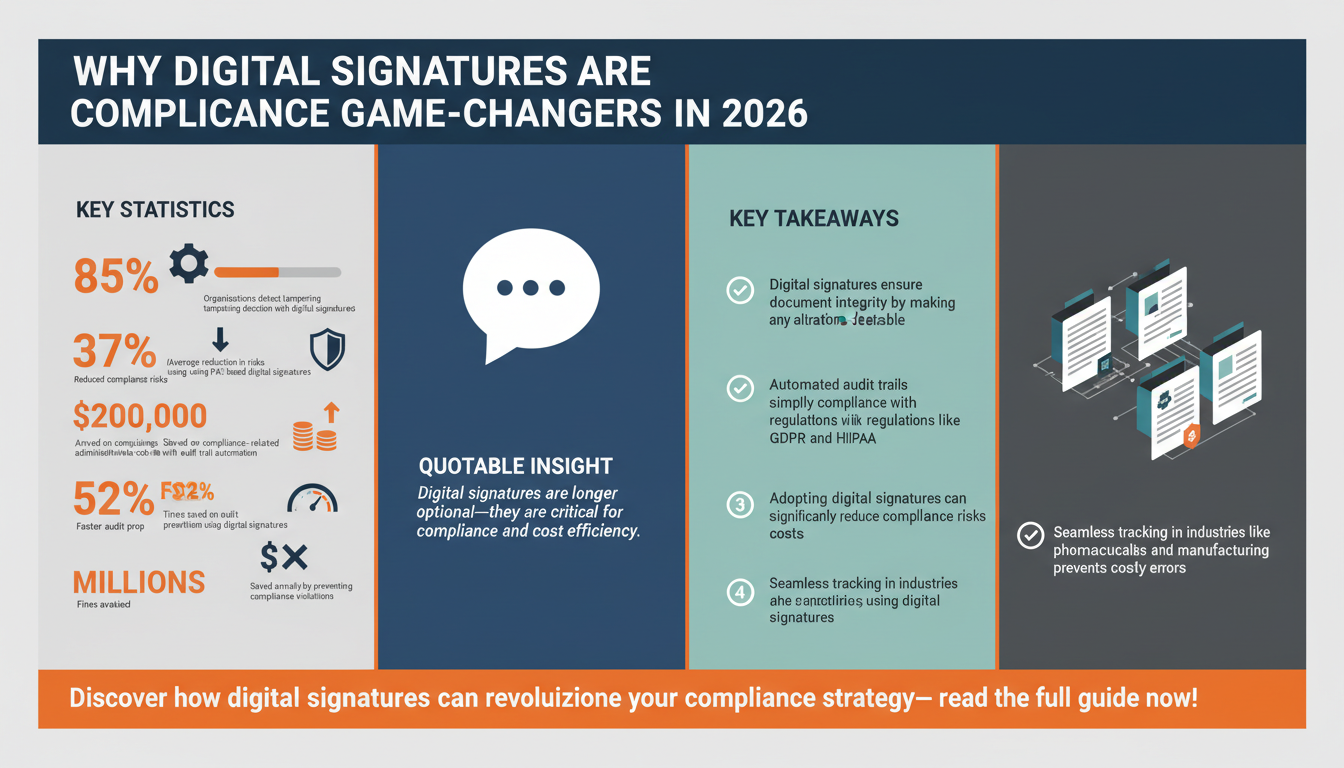
According to Gartner’s 2026 Digital Compliance Report, over 85% of organizations that adopted digital signatures reported a significant improvement in their ability to detect document tampering, reducing compliance risks by 37% on average. This improvement translates into millions of dollars saved annually in potential fines and legal disputes across industries.
Consider a scenario in the pharmaceutical industry: regulatory bodies like the FDA require accurate documentation of clinical trials. A single alteration in trial data could compromise the entire study. By using digital signatures, pharmaceutical companies can ensure that the integrity of their trial reports remains intact, thereby avoiding delays in drug approvals and potential penalties.
Key Takeaway:
- Digital signatures ensure data integrity by making alterations immediately detectable.
- Using PKI-based digital signatures can reduce regulatory compliance risks by over one-third.
2. Streamlining Audit Trails
Audit trails are essential for demonstrating compliance with regulations such as GDPR, HIPAA, and SOX. Traditional paper-based systems make it challenging to track who signed what, when, and where. Digital signatures simplify this process by automatically generating detailed, tamper-proof audit logs.

These logs include information such as the signer’s identity, IP address, timestamp, and even geolocation (if enabled). For example, a healthcare provider using digital signatures can provide regulators with a complete signing history of patient consent forms, ensuring compliance with HIPAA regulations.
A study by Forrester found that organizations leveraging digital signatures reduced audit preparation time by 52%, saving an average of $200,000 annually on compliance-related administrative costs. These savings free up resources for other critical areas, such as employee training and technology upgrades.
Moreover, in industries like manufacturing, where supply chain documentation is critical, digital signatures allow for seamless tracking of compliance at every stage of production. For instance, if a component fails quality standards, manufacturers can trace its origin and certification records within minutes, thanks to robust audit trails.
Key Takeaway:
- Digital signatures provide detailed, tamper-proof audit trails that simplify regulatory reporting.
- Organizations can save significant resources by automating compliance documentation.
3. Enhancing Compliance with Industry-Specific Regulations
Different industries face unique regulatory challenges. For instance, the financial sector must comply with KYC (Know Your Customer) requirements, while the healthcare industry must adhere to HIPAA. Digital signatures provide customizable solutions tailored to these specific needs.

Take the healthcare industry as an example. Digital signatures can be integrated with electronic health record (EHR) systems to ensure that patient data is securely stored and accessed. This not only meets HIPAA requirements but also improves operational efficiency by reducing the time spent on manual documentation.
Similarly, in real estate, digital signatures ensure compliance with e-signature laws like the UETA and ESIGN Act, enabling brokers to finalize contracts faster while maintaining legal validity. As per IDC’s 2026 Industry Study, 72% of organizations reported improved compliance with industry-specific regulations after adopting digital signature solutions.
Another compelling example is the energy sector. Companies must adhere to stringent environmental reporting standards. Digital signatures enable secure submission of compliance reports to regulatory bodies, ensuring that all data remains unaltered and verifiable.
Key Takeaway:
- Digital signatures can be customized to meet industry-specific compliance requirements.
- They improve both efficiency and compliance, particularly in highly regulated sectors.
4. Improving Document Security and Privacy
In 2026, data breaches remain a top concern for businesses, with regulatory penalties for non-compliance reaching record highs. Digital signatures address this issue by providing robust document security and privacy controls.
Encrypted digital signatures ensure that sensitive information is accessible only to authorized parties. Multi-factor authentication (MFA) adds an additional layer of security, ensuring that only verified individuals can sign or access documents. This reduces the risk of unauthorized access or document tampering.
According to Cybersecurity Ventures, companies using digital signature platforms reported a 58% reduction in document-related security breaches. This not only protects sensitive data but also avoids hefty fines under regulations like GDPR and CCPA.
For example, in the legal sector, highly sensitive case files containing confidential client information are often shared among attorneys, clients, and third parties. Using encrypted digital signatures, law firms can ensure that these documents remain secure and unaltered, protecting client confidentiality and maintaining compliance with data protection statutes.
Key Takeaway:
- Digital signatures provide encryption and MFA to ensure document security.
- They significantly reduce the likelihood of data breaches and regulatory penalties.
5. Simplifying Cross-Border Compliance
As businesses operate in an increasingly globalized world, cross-border transactions have become the norm. However, navigating the web of international regulations can be daunting. Digital signatures simplify this process by providing globally recognized, legally binding authentication.
For example, the European Union’s eIDAS regulation ensures that digital signatures are legally recognized across all EU member states. Similarly, countries like the U.S., Canada, and Australia have adopted laws that validate digital signatures for cross-border transactions. This legal standardization eliminates the need for redundant documentation, speeding up international deals.
A report by The World Bank highlights that digital signatures reduced cross-border compliance costs by 43% for multinational corporations in 2026. This cost reduction is especially significant for global supply chains, where delays in customs processing can lead to millions in lost revenue.
Key Takeaway:
- Digital signatures simplify cross-border compliance by adhering to global regulatory standards.
- They reduce costs and streamline international operations.
6. Accelerating Vendor and Supplier Onboarding
Vendor and supplier onboarding is a critical process for industries like manufacturing and retail. Compliance often requires extensive documentation, including contracts, certifications, and tax forms. Digital signatures accelerate this process by enabling instant, secure document exchanges.
For instance, a manufacturing company can use digital signatures to verify supplier certifications in real-time, ensuring compliance with safety and environmental regulations. This reduces delays and minimizes the risk of non-compliance, which is particularly critical in industries with tight production schedules.
McKinsey’s 2026 Vendor Compliance Report found that digital signatures cut onboarding time by 45% while improving compliance accuracy by 32%. These time savings also translate into faster time-to-market for products, giving companies a competitive advantage.
Key Takeaway:
- Digital signatures expedite vendor onboarding while ensuring compliance with regulatory requirements.
- They improve accuracy and reduce onboarding timelines significantly.
7. Supporting Environmental Compliance Goals
In 2026, sustainability is more than a buzzword—it’s a regulatory necessity. Many industries are required to reduce their carbon footprint, and digital signatures play a pivotal role in achieving these goals by eliminating paper-based processes.
For example, a legal firm that transitions to digital signatures can save thousands of sheets of paper annually, directly contributing to its environmental compliance targets. According to EPA research, organizations using digital signatures reduced paper waste by 67%, cutting down on associated carbon emissions and operational costs for printing and storage.
Key Takeaway:
- Digital signatures help organizations meet environmental compliance goals by reducing paper usage.
- They align operational efficiency with sustainability objectives.
8. Reducing Human Errors
Human errors are a significant source of non-compliance, especially in document-heavy industries. Whether it’s a missed signature or an incorrectly dated contract, these mistakes can lead to costly penalties. Digital signatures minimize these risks by automating error-prone processes.
For example, automated workflows in digital signature platforms ensure that all necessary fields are completed before a document can be submitted. This eliminates the risk of incomplete or invalid documents and ensures that all parties have adhered to the required compliance standards.
Research from Harvard Business Review indicates that digital signature solutions reduced document-related errors by 48% in 2026, saving businesses an average of $150,000 annually. Additionally, error reduction improves employee productivity by minimizing the time spent on reviewing and correcting errors.
Key Takeaway:
- Digital signatures significantly reduce human errors, ensuring compliance with regulatory standards.
- They save businesses time and money by automating document validation processes.
9. Enhancing Customer Trust and Transparency
Transparency is a cornerstone of regulatory compliance, particularly in customer-facing industries like finance and real estate. Digital signatures enhance transparency by providing customers with clear, verifiable documentation.
For example, a bank can use digital signatures to provide customers with a detailed record of loan agreements, including timestamps and authentication details. This builds trust and ensures compliance with transparency regulations like the Truth in Lending Act (TILA).
A survey by Accenture found that 68% of customers felt more confident in businesses that used digital signatures, citing improved transparency and security. This increased trust can translate into higher customer retention and loyalty.
Key Takeaway:
- Digital signatures enhance customer trust by improving transparency and security.
- They help businesses comply with customer-focused regulatory requirements.
10. Facilitating Real-Time Compliance Monitoring
Real-time compliance monitoring is critical in dynamic regulatory environments. Digital signatures enable this by integrating with compliance management systems to provide real-time updates on document status and compliance metrics.
For example, a compliance officer can use a digital signature platform to monitor the status of contracts in progress, ensuring that all regulatory requirements are met before finalization. This proactive approach reduces the risk of non-compliance and allows for timely interventions when issues arise.
A report by Deloitte found that real-time compliance monitoring reduced regulatory violations by 29% in 2026, saving organizations millions in potential fines. Furthermore, such monitoring enhances decision-making by providing actionable insights into compliance trends and bottlenecks.
Key Takeaway:
- Digital signatures enable real-time compliance monitoring, reducing regulatory risks.
- They provide compliance officers with actionable insights to prevent violations.
FAQs
1. Are digital signatures legally binding in all industries?
Yes, digital signatures are legally binding across most industries, provided they comply with regulations like the ESIGN Act, UETA, and eIDAS. Always consult legal counsel to ensure compliance with specific laws in your jurisdiction.
2. How secure are digital signatures?
Digital signatures use advanced encryption and multi-factor authentication to ensure security. They are far more secure than traditional wet signatures, as they provide tamper-evident measures and detailed audit trails.
3. Can digital signatures integrate with existing compliance systems?
Yes, most digital signature platforms offer APIs and integrations with compliance management systems, CRM software, and document management tools. This ensures seamless workflows and real-time compliance monitoring.
4. What industries benefit the most from digital signatures?
Highly regulated industries like finance, healthcare, real estate, and manufacturing benefit significantly from digital signatures due to their stringent compliance requirements and document-heavy workflows.
Conclusion
Digital signatures are more than a convenience—they are a necessity for regulatory compliance in 2026. By ensuring data integrity, streamlining audit trails, and enhancing security, they empower organizations to meet stringent requirements efficiently. Whether you’re in healthcare, finance, or any other industry, adopting digital signatures can revolutionize your compliance strategy.
As you implement these strategies, consider leveraging complementary tools like Apparatuz for workflow automation or Zatisfied to gather customer feedback. Together, these solutions create a comprehensive approach to compliance and operational excellence.