
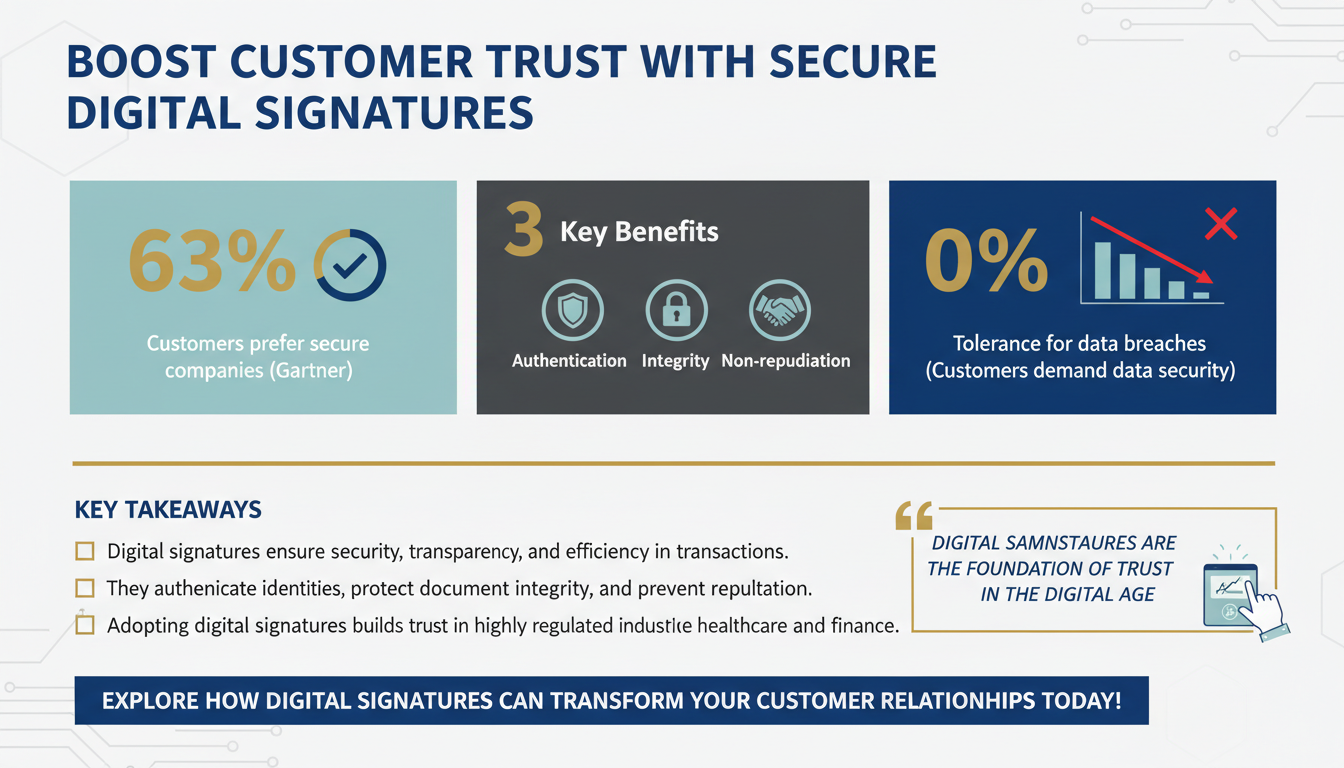
In today’s hyper-competitive market, customer trust has become the cornerstone of business success. Whether you're a small-to-medium-sized business (SMB) or a large enterprise, earning and maintaining the trust of your customers requires you to prioritize security, transparency, and efficiency in every interaction. With the rise of digital transformation, one tool has emerged as a game-changer in this arena: digital signatures.
Digital signatures are more than just a convenient way to finalize agreements—they represent a commitment to security, professionalism, and transparency. By enabling businesses to validate the authenticity of digital documents, ensure legal compliance, and streamline operations, digital signatures help create an environment where customers feel secure and valued. This guide explores how digital signatures enhance customer trust across industries and provides actionable insights on how businesses can integrate them effectively.
From simplifying workflows to meeting stringent security standards, digital signatures are transforming how businesses interact with their customers. By the end of this guide, you’ll understand why adopting digital signatures is not just a technical upgrade—it’s an essential step toward building stronger, trust-based customer relationships.
1. Understanding Digital Signatures and Their Role in Trust
At their core, digital signatures are cryptographic tools designed to authenticate the identity of a signer and ensure the integrity of the signed document. Unlike standard electronic signatures (e.g., images of a handwritten signature), digital signatures rely on Public Key Infrastructure (PKI) to encrypt data, making them far more secure and legally robust.
The trustworthiness of digital signatures stems from three key attributes:
- Authentication: Digital signatures verify the identity of the signer, ensuring that the individual is who they claim to be.
- Integrity: They guarantee that the content of the document has not been altered after it was signed.
- Non-repudiation: Digital signatures provide evidence that prevents the signer from denying their involvement in the transaction.
The Mechanics Behind Digital Signatures
To understand why digital signatures are so reliable, it’s helpful to explore their underlying technology. Digital signatures utilize a pair of cryptographic keys: a private key and a public key. The private key is used to create the signature, while the public key verifies its authenticity. These keys are mathematically linked, making it virtually impossible to forge a signature without access to the private key.
For instance, when a document is signed, the private key generates a unique hash code based on the document's content. This hash code is encrypted and becomes the digital signature. If even a single character in the document is altered, the hash code will change, immediately invalidating the signature. This ensures both the authenticity of the signer and the integrity of the document.
Why Customers Value Digital Signatures
Customers are increasingly concerned about data security and authenticity, especially in industries dealing with sensitive information such as finance, healthcare, and legal services. By adopting digital signatures, businesses send a clear message that they prioritize these concerns. This is especially critical in the digital age, where incidents of data breaches and identity theft are on the rise.
Consider the example of a healthcare provider handling sensitive patient consent forms. Using digital signatures, the organization can ensure compliance with regulations like HIPAA while giving patients peace of mind that their data is secure and the process is transparent. This dual assurance of security and transparency directly builds customer trust.
According to a Gartner study, 63% of customers are more likely to engage with companies that use secure technologies, such as digital signatures, to protect their data. This demonstrates that adopting digital signatures is not just a functional improvement—it’s a strategic move to strengthen customer relationships.

2. The Security Advantage: Why Digital Signatures Inspire Confidence
Security is one of the primary reasons customers trust digital signatures. By leveraging advanced encryption algorithms and secure technologies, digital signatures mitigate risks such as unauthorized access, data breaches, and document tampering. This level of security helps reassure customers that their sensitive information is handled responsibly.
Here are the main security features of digital signatures:
- Encryption: Encrypts data so that only authorized parties can access it, ensuring confidentiality.
- Audit Trails: Provides a detailed log of all actions taken during the signing process, offering full transparency and accountability.
- Compliance: Meets global security standards such as the European Union’s eIDAS Regulation and the United States’ ESIGN Act.
How Encryption Works in Digital Signatures
Encryption is a foundational element of digital signature security. When a document is signed, it is encrypted using the signer’s private key. This encryption ensures that only the intended recipient with the corresponding public key can access the document. If anyone attempts to tamper with the document, the encryption process will detect the changes, rendering the signature invalid.
For example, a financial services firm working with high-stakes contracts can use digital signatures to secure agreements and prevent unauthorized modifications. This not only protects the firm but also demonstrates to clients that their sensitive information is safe.
The Role of Audit Trails in Transparency
Audit trails are another critical feature of digital signature platforms. These detailed logs track every action taken during the signing process, including timestamps, IP addresses, and user identities. This level of transparency is invaluable for industries such as real estate, where legal disputes over contract authenticity are common.
For example, a real estate agency managing lease agreements can use digital signatures to ensure that contracts are tamper-proof. Additionally, the agency can maintain a detailed audit trail for legal accountability. This transparency not only meets regulatory requirements but also builds credibility with clients, who feel reassured that their agreements are secure and trustworthy.
According to a Forrester report, businesses that implement secure digital signature platforms experience a 45% reduction in document fraud cases. This statistic highlights the tangible impact of digital signatures on mitigating fraud and enhancing trust.

3. Legal Validity: Building Trust Through Compliance
Legal compliance is another crucial factor in fostering trust. Digital signatures are recognized as legally binding in most jurisdictions around the world, provided they meet specific regulatory requirements. This legal standing eliminates ambiguity and reassures customers that their agreements are enforceable.
For instance, the European Union’s eIDAS Regulation establishes that digital signatures have the same legal validity as handwritten signatures. Similarly, the United States’ ESIGN Act and Uniform Electronic Transactions Act (UETA) provide a robust framework for the enforceability of digital signatures.
By aligning with these regulations, businesses can demonstrate their commitment to legal and ethical standards, which is critical for earning customer trust. A financial institution, for example, can use digital signatures for loan agreements, ensuring customers that their contracts are secure, compliant, and legally valid.
Global Regulatory Frameworks
Regulatory frameworks for digital signatures vary by region, but they share common principles of authenticity, integrity, and non-repudiation. These frameworks ensure that digital signatures meet the highest standards of security and legal enforceability. For businesses operating globally, understanding and complying with these regulations is essential for building trust with international customers.
For example, an e-commerce company selling to customers in both the EU and the US can use a digital signature platform that complies with both eIDAS and ESIGN. This dual compliance not only streamlines operations but also reassures customers that their transactions are protected by robust legal standards.
When businesses proactively communicate their adherence to these laws, they enhance their reputation and foster long-term loyalty. Customers are more likely to trust a company that prioritizes legal compliance and ethical practices.

4. Speed and Efficiency: A Key Driver of Customer Satisfaction
In an era defined by instant gratification, customers value businesses that can deliver fast and efficient services. Digital signatures enable companies to meet these expectations by drastically reducing the time required to complete agreements. What once took days or weeks with traditional paperwork can now be accomplished in mere minutes.
This speed translates directly into improved customer experiences. For example, an HR department onboarding new employees can use digital signatures to finalize employment contracts remotely. This streamlined process saves time for both the company and the new hires, creating a positive first impression for new employees.
Similarly, e-commerce platforms can use digital signatures to facilitate quick and seamless order confirmations, which is especially valuable during peak shopping seasons. Data from McKinsey reveals that businesses adopting digital workflows, including digital signatures, experience a 25-30% improvement in process efficiency. This operational agility not only enhances customer satisfaction but also strengthens trust by showcasing a commitment to innovation.

To further enhance your digital workflows, explore our sister platforms: Apparatuz for workflow automation, Applicantz for recruitment management, Schedly for scheduling and appointments, Supportly for customer support, and Zatisfied for feedback management. Together, these tools create a comprehensive ecosystem that complements your digital signature strategy.