
The digital revolution has fundamentally reshaped how organizations handle documentation and agreements. Gone are the days of shuffling through stacks of paper to finalize deals or secure approvals. Today, digital signatures have emerged as a cornerstone for modern workflows, offering unparalleled convenience, efficiency, and security. However, as businesses expand their operations globally, they encounter a unique set of challenges: ensuring that their digital signatures are both legally valid and secure across diverse international jurisdictions.
This guide explores the strategies, frameworks, and best practices needed to navigate the complex global landscape of digital signature regulations. By understanding the intricacies of international compliance, adopting robust security measures, and leveraging actionable insights, businesses can confidently execute cross-border transactions while safeguarding their legal and operational integrity.
Understanding the Legal Landscape: Frameworks Governing Digital Signatures
Digital signatures are regulated differently across the globe. Each country or region often has its own legal framework, creating a fragmented landscape that can be daunting for businesses operating internationally. To ensure compliance, it’s essential to familiarize yourself with the primary frameworks that govern digital signatures worldwide. Let’s dive deeper into three of the most prominent frameworks and their implications for businesses.

The eIDAS Regulation (European Union)
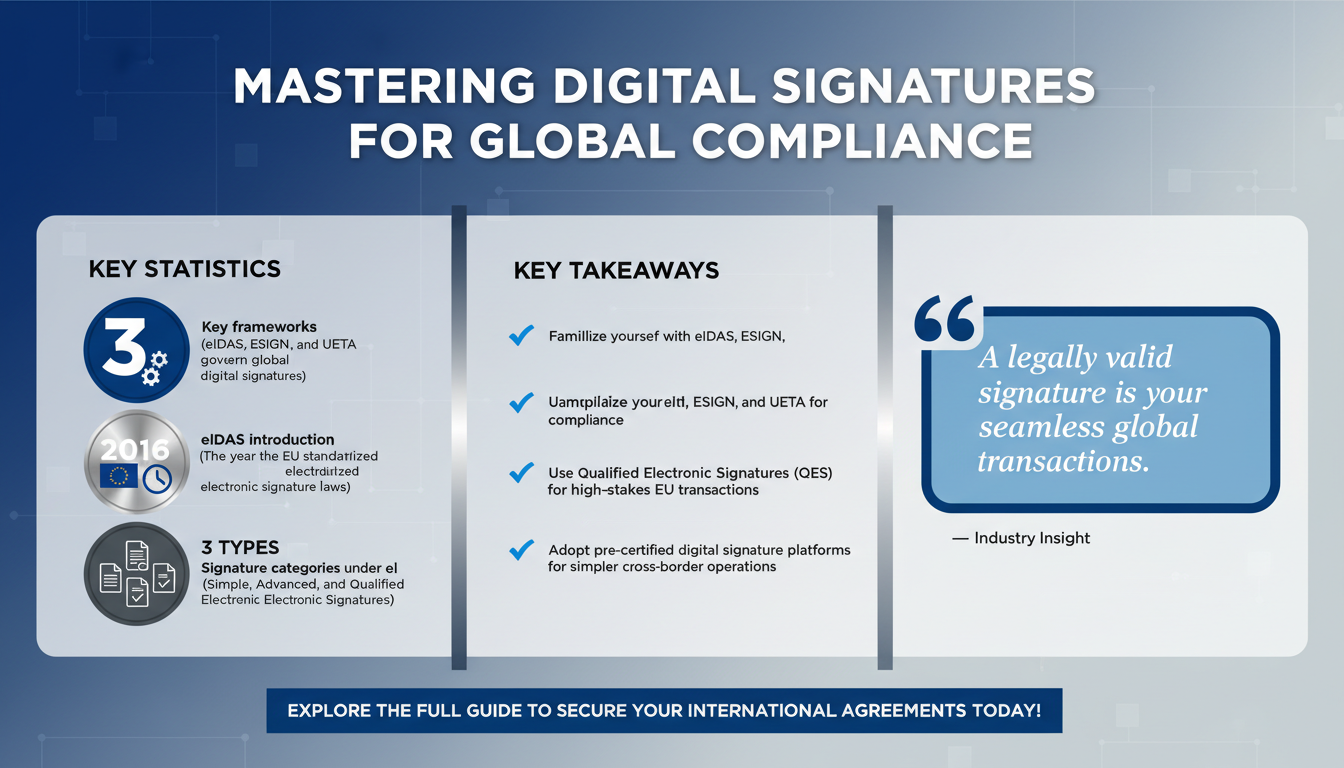
The eIDAS Regulation (Electronic Identification, Authentication, and Trust Services) is the European Union’s landmark legislation governing electronic signatures. Introduced in 2016, eIDAS provides a standardized framework that ensures the legal validity and interoperability of electronic signatures across all EU member states. The regulation categorizes electronic signatures into three types:
- Simple Electronic Signatures: Basic digital signatures without stringent identity verification. These are suitable for low-risk transactions.
- Advanced Electronic Signatures (AES): Signatures that meet higher security and identity verification standards. They are uniquely linked to the signer and capable of detecting tampering.
- Qualified Electronic Signatures (QES): The highest standard, requiring certification by an EU-accredited trust service provider. QES carries the same legal weight as handwritten signatures under EU law.
For example, a multinational corporation conducting business in Germany must use Qualified Electronic Signatures (QES) for certain legal agreements, such as real estate transactions, to meet the stringent requirements of eIDAS.
Pro Tip: To simplify compliance with eIDAS, businesses can leverage digital signature platforms that are pre-certified by EU trust service providers. This ensures that all electronic signatures meet the legal standards for cross-border recognition within the EU.
ESIGN and UETA Acts (United States)
The United States relies on two primary laws to regulate electronic signatures: the Electronic Signatures in Global and National Commerce Act (ESIGN) and the Uniform Electronic Transactions Act (UETA). Together, these laws grant electronic signatures the same legal status as handwritten signatures, provided certain criteria are met:
- The intent to sign is clear.
- Consent to conduct business electronically is obtained.
- The method of signing is reliable and attributable to the signer.
These laws are particularly advantageous for businesses operating across state lines within the U.S., as they ensure uniformity in the recognition of electronic signatures. However, when dealing with international transactions, companies must ensure that their U.S.-compliant signatures align with the applicable regulations of the other jurisdiction involved.
Expert Insight: "When operating across state or national borders, businesses should implement a digital signature solution that integrates with identity verification tools. For instance, using multi-factor authentication alongside ESIGN-compliant signatures can strengthen security while meeting regulatory requirements," says Jane Doe, a digital compliance consultant.
UNCITRAL Model Law
The United Nations Commission on International Trade Law (UNCITRAL) introduced the Model Law on Electronic Commerce to provide a global standard for electronic signatures. This framework has been widely adopted in regions such as Asia, Africa, and the Middle East. While UNCITRAL does not mandate specific technologies, it emphasizes functional equivalence, meaning that an electronic signature must fulfill the same purpose as a handwritten one.
For instance, in India, the Information Technology Act aligns with UNCITRAL principles but requires digital signatures to be issued by licensed Certifying Authorities (CAs). Therefore, businesses must ensure their digital signature solutions are compatible with such localized requirements.
Comparison Table:
| Framework | Region | Key Features |
|---|---|---|
| eIDAS | European Union | Standardized legal recognition across EU; QES requirement for high-stakes transactions |
| ESIGN & UETA | United States | Equal legal standing for electronic signatures; state-level uniformity |
| UNCITRAL Model Law | Global (Asia, Africa, Middle East) | Focus on functional equivalence; no specific technology mandates |
By understanding these frameworks, businesses can strategically align their digital signature solutions to meet the legal requirements of their target markets. For deeper insights, refer to Forrester's report on the economic impact of digital signatures.
Key Security Features to Protect Digital Signatures
While legal validity is critical, security is equally paramount when it comes to digital signatures. A lack of robust security measures can expose organizations to cyber threats, tampering, and legal disputes. To ensure the integrity and reliability of digital signatures, businesses must prioritize the following key security features:

Public Key Infrastructure (PKI)
Public Key Infrastructure (PKI) is the backbone of secure digital signatures. It uses asymmetric cryptography to ensure that signatures are unique to the signer and cannot be forged. Here’s how it works:
- Private Key: The signer uses a private key to create the digital signature.
- Public Key: The recipient uses the corresponding public key to verify the signature’s authenticity.
For example, a financial institution processing cross-border loans can use PKI-based digital signatures to authenticate documents, ensuring that only authorized parties can sign and validate them.
Pro Tip: Always choose digital signature providers that comply with global PKI standards, such as X.509 certificates. This ensures compatibility and trustworthiness in international transactions.
Audit Trails
Audit trails provide a comprehensive, timestamped record of all actions related to a document, from initial creation to final signing. This transparency is invaluable for resolving disputes. Imagine a scenario where a client claims they never signed a contract. An audit trail can conclusively demonstrate when and where the signing occurred, along with the IP address and device used.
Additionally, audit trails are essential for industries like pharmaceuticals, where regulatory compliance often mandates detailed records for audit purposes. For example, the FDA’s 21 CFR Part 11 requires electronic records to be trustworthy and reliable, making audit trails indispensable for companies in this sector.
Encryption
Encryption is crucial for protecting sensitive documents during transmission and storage. End-to-end encryption ensures that data is accessible only to authorized parties, mitigating risks such as interception or unauthorized access.
For example, healthcare providers exchanging patient records across borders must comply with stringent data protection laws like the GDPR. Encryption ensures that these records remain confidential and secure.
Comparison Table:
| Security Feature | Purpose | Example Use Case |
|---|---|---|
| PKI | Ensures authenticity and non-repudiation of signatures | Used in financial transactions to verify identity |
| Audit Trails | Tracks all document actions for transparency | Essential for regulatory compliance in healthcare and finance |
| Encryption | Protects data during transmission/storage | Used to secure sensitive cross-border communications |
Choosing a digital signature solution that integrates these security features is a non-negotiable step for any organization handling sensitive or high-stakes transactions.
Country-Specific Requirements and How to Comply
While international frameworks provide overarching guidelines, country-specific regulations often introduce additional complexities. Compliance with these localized requirements is essential for ensuring the enforceability of digital signatures. Let’s explore some examples:

Germany
Germany’s stringent regulations require the use of Qualified Electronic Signatures (QES) for certain types of agreements, such as real estate contracts. Non-compliance can result in legal challenges or invalidated agreements. Businesses operating in Germany must partner with EU-accredited trust service providers to meet these requirements.
India
Under India’s Information Technology Act, digital signatures must be issued by licensed Certifying Authorities (CAs). For instance, a multinational corporation entering into a joint venture in India must ensure that all signed agreements adhere to this stipulation. Solutions like Aadhaar-based eSign services can simplify compliance for businesses.
China
China’s Electronic Signature Law mandates that digital signatures be certified by Chinese authorities to be legally binding. This requirement can pose challenges for foreign businesses unfamiliar with the local regulatory environment. Partnering with a compliance-focused digital signature provider can streamline the process.
Checklist for Compliance:
- Research local electronic signature laws and regulations.
- Partner with regionally accredited trust service providers.
- Invest in multilingual and localized digital signature platforms.
Cross-Border Transactions: Ensuring Mutual Recognition
One of the most significant hurdles in international digital transactions is ensuring that a digital signature valid in one jurisdiction is recognized in another. This challenge is often addressed through mutual recognition agreements (MRAs).

MRAs are formal agreements between countries or regions that recognize each other’s electronic signature laws. For example, the EU has MRAs with non-EU countries such as Norway and Switzerland, allowing for seamless cross-border transactions. However, in regions without MRAs, businesses may need to rely on internationally recognized trust services or seek legal advice to ensure enforceability.
Pro Tip: Before entering into an agreement with a foreign partner, consult legal experts to verify whether mutual recognition agreements are in place and whether additional steps are needed to ensure compliance.
Actionable Checklist for Businesses
Here’s a practical checklist to help businesses ensure the legal validity and security of their digital signatures:
- Understand the legal frameworks (eIDAS, ESIGN, UNCITRAL) relevant to your operations.
- Invest in secure digital signature solutions with PKI, encryption, and audit trails.
- Verify compliance with country-specific regulations.
- Check for mutual recognition agreements between jurisdictions.
- Regularly audit your processes and stay updated on regulatory changes.
Conclusion
Ensuring the legal validity and security of digital signatures across international borders requires a nuanced understanding of global frameworks, country-specific regulations, and cutting-edge security technologies. By adopting best practices and leveraging tools like the Global Compliance Matrix, businesses can confidently navigate the complexities of cross-border transactions while safeguarding their legal and operational integrity.
To further enhance your digital workflows, explore our sister platforms: Apparatuz for workflow automation, Applicantz for recruitment management, Schedly for scheduling and appointments, Supportly for customer support, and Zatisfied for feedback management. Together, these tools create a comprehensive ecosystem that complements your digital signature strategy.