
Manual document management has long been a staple of business operations, but in the fast-paced digital era of 2026, its inefficiencies are becoming increasingly costly. Small and medium-sized businesses (SMBs) often underestimate the true impact of managing paper-based processes, from wasted time and operational delays to security risks and compliance challenges. These issues are not merely inconveniences—they represent significant financial, environmental, and legal burdens that can hinder business growth. Digital signature solutions offer a transformative alternative, enabling SMBs to streamline workflows, reduce costs, enhance security, and improve compliance. This article delves deeply into the hidden costs of manual document management and highlights actionable steps SMBs can take to adopt digital signatures effectively. It’s not just a strategic move—it’s a necessity for thriving in today’s competitive landscape.
The Operational Inefficiencies of Manual Document Management
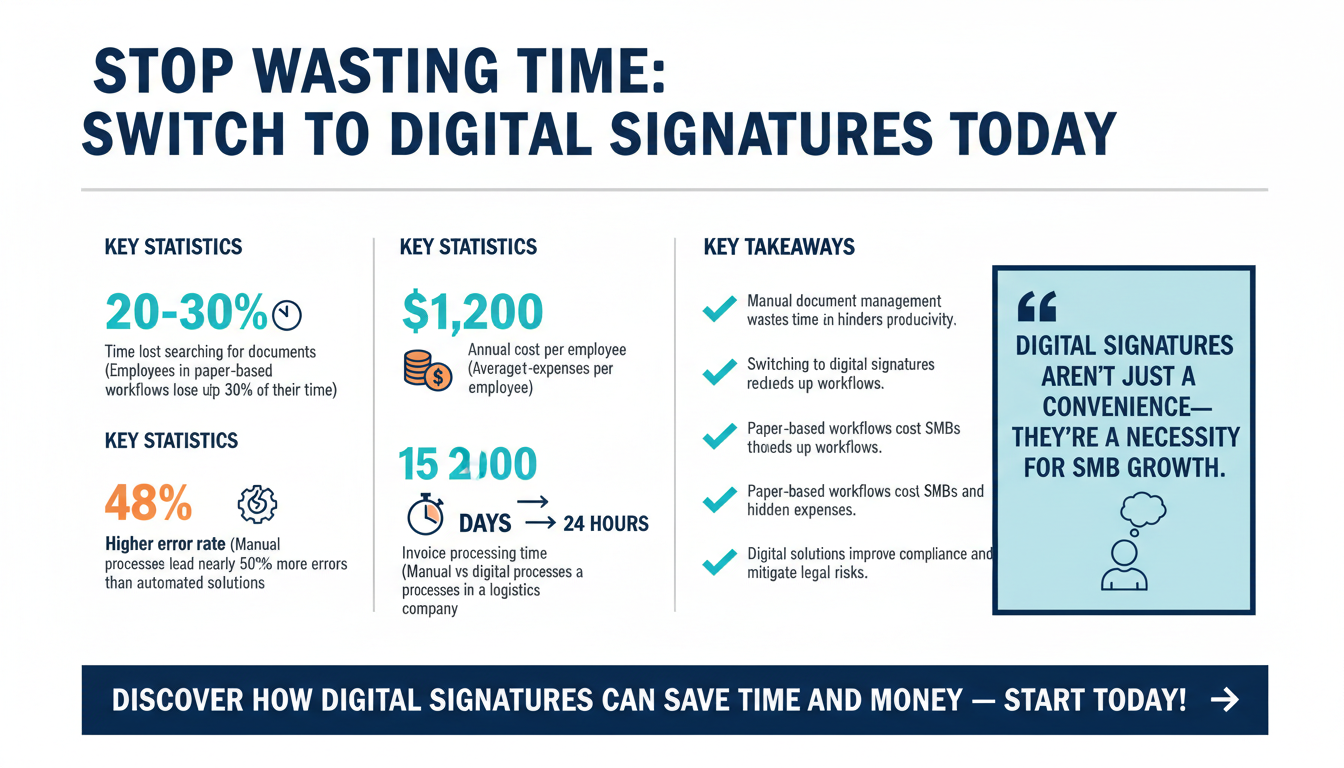
One of the most significant hidden costs of manual document management is operational inefficiency. Paper-based processes require substantial time and resources to manage, as employees spend hours printing, scanning, copying, filing, and retrieving physical documents. According to a McKinsey report, employees in traditional paper-based workflows spend 20-30% of their time searching for documents, leading to lost productivity.

Consider the approval workflows in industries like real estate or healthcare, where manual signatures often require physical presence or courier services. For example, a real estate firm might lose weeks waiting for contracts to be signed by multiple parties across different locations. This delay can jeopardize deals, frustrate clients, and tarnish professional relationships. Meanwhile, healthcare providers managing paper-based patient records risk slowing down critical care delivery, impacting lives and trust.
Moreover, manual processes are prone to human errors. Misfiled documents, duplicate entries, and illegible handwriting can disrupt workflows, leading to costly mistakes. Research from Gartner reveals that companies employing manual processes experience a 48% higher rate of errors compared to those leveraging automation solutions. These errors not only waste time but can also result in legal repercussions if critical information is mishandled.
Real-world examples illustrate these inefficiencies vividly. A logistics company reported that manual invoice processing delayed payments by an average of 15 days, directly impacting cash flow. By switching to digital signatures, the company reduced processing time to just 24 hours, freeing up resources and accelerating revenue cycles.
Key Takeaway: Operational inefficiencies from manual document management are not just productivity hurdles—they translate directly into financial losses. Digital signatures eliminate these bottlenecks, enabling faster and more accurate processes, ultimately driving business success.
The Financial Costs of Paper-Based Workflows
While paper itself may seem inexpensive, the cumulative costs of paper-based workflows are staggering. SMBs incur expenses for printers, copiers, ink, paper, storage space, and maintenance. According to Forrester Research, the average company spends $1,200 per employee annually on document-related expenses.

Storage costs are another overlooked expense. Filing cabinets, document warehouses, and physical storage facilities require significant investment, especially for industries like healthcare and legal that must retain records for extended periods. A study by Business Insider found that companies spend up to $20,000 annually on physical storage for every 1,000 square feet.
The financial burden extends further into opportunity costs. Delayed approvals, misplaced documents, and slow turnaround times can mean lost revenue opportunities. For instance, a finance firm waiting on paper-based contracts might miss critical investment windows, resulting in substantial financial losses. Similarly, marketing agencies relying on manual workflows for campaign approvals risk missing deadlines, which can damage client trust and result in lost contracts.
Digital signature solutions dramatically reduce these costs. By eliminating paper usage, courier fees, and physical storage needs, SMBs can save up to 70% on document-related expenses. Additionally, faster processing times enable businesses to seize opportunities more promptly, boosting revenue potential.
Key Takeaway: Paper-based workflows are deceptively expensive, with costs adding up across operational, storage, and opportunity categories. Digital signatures offer SMBs a cost-effective alternative, saving both money and time while unlocking new growth avenues.
Security Risks in Manual Document Management
Manual document management is rife with security vulnerabilities. Physical documents can be lost, stolen, or damaged, compromising sensitive information. In 2025 alone, the Statista Physical Security Report revealed that 20% of data breaches involved stolen or misplaced physical records.

Moreover, paper documents are difficult to track and audit. Unauthorized access can go unnoticed, and there’s no clear trail to identify who accessed or modified a document. For industries like healthcare and finance, this lack of transparency can lead to compliance violations under regulations such as HIPAA or GDPR.
Digital signatures, on the other hand, provide robust security features, including encryption, audit trails, and identity verification. Solutions like Zignature ensure that every signed document is tamper-proof and legally binding, significantly reducing the risk of fraud or unauthorized modifications.
In a notable case study, a legal firm dealing with sensitive contracts transitioned to digital signatures after experiencing a breach involving misplaced legal documents. Post-adoption, the firm reported a 95% reduction in unauthorized access incidents and gained greater visibility into document workflows.
Key Takeaway: Security risks in manual document management are not worth the gamble. Digital signatures offer SMBs peace of mind with cutting-edge security protocols and compliance guarantees, protecting both customer trust and regulatory standing.
The Environmental Impact of Paper-Based Processes
Manual document management takes a toll on the environment. Paper production contributes to deforestation, greenhouse gas emissions, and water pollution. According to the EPA, paper production is the third-largest industrial polluter globally, responsible for 12% of emissions.
SMBs that rely heavily on paper workflows also generate significant waste. From discarded drafts to outdated records, the average office worker uses 10,000 sheets of paper annually, according to GreenBiz. This waste ends up in landfills, exacerbating environmental challenges.
Switching to digital signatures aligns businesses with sustainability goals. By eliminating paper usage, SMBs can significantly reduce their carbon footprint while promoting eco-friendly practices. Digital solutions also offer long-term scalability, allowing businesses to grow without increasing resource consumption.
A practical example comes from a multinational company that adopted digital workflows, reducing its paper consumption by 85% within a year. The move saved over 10,000 trees annually and reduced waste disposal costs by 40%.
Key Takeaway: Paper-based processes are environmentally unsustainable. SMBs can contribute to a greener future by adopting digital signature solutions and demonstrating their commitment to corporate social responsibility.
Compliance Challenges and Legal Risks
Manual document management often exposes SMBs to compliance risks. Paper trails are difficult to maintain, and misplaced or incomplete records can result in legal penalties. For instance, non-compliance with industry regulations like SOX, GDPR, or HIPAA can lead to fines ranging from $10,000 to $1 million, according to Forbes.
Digital signatures simplify compliance by automating record-keeping and ensuring documentation meets regulatory standards. Solutions like Zignature provide audit trails, timestamping, and identity verification, making it easier for SMBs to demonstrate compliance during audits.
In a healthcare setting, a clinic using manual records struggled to meet HIPAA audit requirements due to missing files. After implementing digital signatures, the clinic achieved full compliance and reduced audit preparation time by 80%.
Key Takeaway: Compliance risks are a serious concern for SMBs. Digital signatures help mitigate these risks by providing secure, automated solutions tailored to industry standards.
Adoption Barriers and Misconceptions
Despite the clear benefits of digital signatures, some SMBs hesitate to adopt them due to misconceptions about cost, complexity, and integration. Many believe that digital solutions are expensive or require significant IT expertise, but this is far from accurate.
Modern platforms like Zignature are designed with SMBs in mind, offering affordable pricing and user-friendly interfaces. Integration with existing tools, such as CRM or ERP systems, is seamless and requires minimal technical knowledge. Additionally, cloud-based solutions eliminate the need for extensive hardware investments.
To overcome these barriers, SMBs should prioritize education and pilot programs. Demonstrating the tangible ROI of digital signatures can help stakeholders see the value of transitioning from manual workflows.
Key Takeaway: Misconceptions should not deter SMBs from reaping the benefits of digital signatures. The solutions are accessible, affordable, and easy to implement.
How to Transition to Digital Signatures
Switching from manual document management to digital signatures is a straightforward process when approached strategically. Here’s a step-by-step framework for SMBs:
- Assess Current Workflows: Identify areas where manual processes cause delays or inefficiencies.
- Select a Digital Signature Solution: Choose a platform like Zignature that aligns with your security, compliance, and integration needs.
- Train Your Team: Provide training sessions to familiarize employees with the new system.
- Integrate with Existing Tools: Connect the platform with your CRM, ERP, or other business systems.
- Monitor and Optimize: Use analytics to track adoption rates and refine workflows as needed.
Key Takeaway: Transitioning to digital signatures is a manageable process with significant long-term benefits for SMBs.
FAQ: Common Questions About Digital Signatures
Are digital signatures legally binding?
Yes, digital signatures are legally binding under laws like the ESIGN Act (US) and eIDAS Regulation (EU).
How secure are digital signatures?
Digital signatures use encryption, identity verification, and audit trails to ensure document security.
Can digital signatures be integrated with existing software?
Most solutions, including Zignature, offer seamless integration with CRM, ERP, and other tools.
What industries benefit the most from digital signatures?
Industries like legal, healthcare, real estate, and finance see significant efficiency gains.
How much can SMBs save by switching?
SMBs can save up to 70% on document-related costs by eliminating paper-based workflows.
Conclusion
The hidden costs of manual document management—lost productivity, financial waste, security risks, environmental impact, and compliance challenges—make it clear that paper-based workflows are no longer viable for SMBs. Digital signatures offer a transformative solution, enabling businesses to streamline operations, reduce expenses, and enhance security while supporting sustainability. Platforms like Zignature make the transition seamless and affordable, empowering SMBs to thrive in a digital-first world.
To further optimize your workflows, consider complementing digital signature solutions with tools like Apparatuz for workflow automation, Applicantz for recruitment management, Schedly for scheduling, Supportly for customer support, and Zatisfied for feedback management. Together, these solutions can create a comprehensive ecosystem for SMB success.