
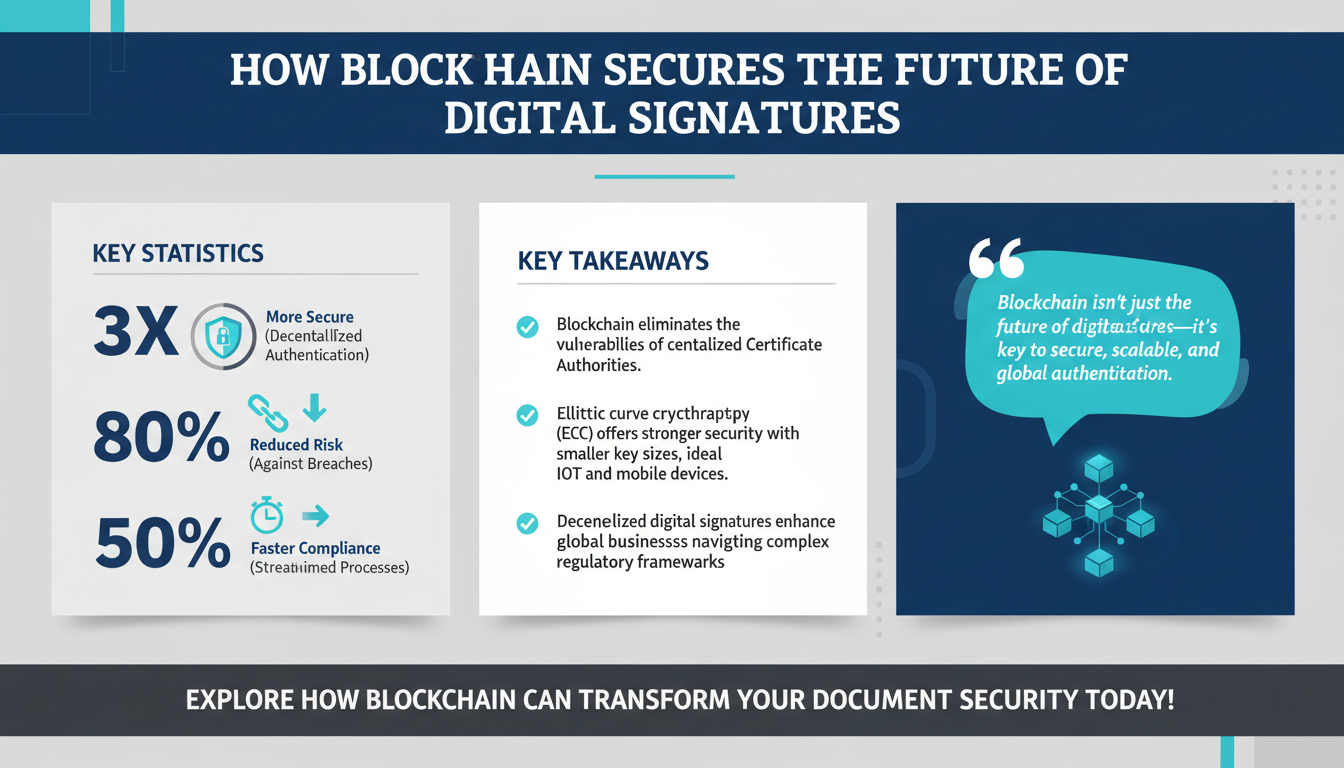
In today’s digital-first world, the ability to authenticate documents securely and efficiently is more critical than ever. From signing multimillion-dollar contracts to verifying compliance with government regulations, digital signatures have become an indispensable component of modern business operations. However, as cyber threats evolve and global commerce expands, traditional digital signature systems are proving inadequate to meet the growing demand for security, scalability, and legal compliance. Enter blockchain technology: a revolutionary tool poised to transform how digital signatures are created, stored, and authenticated.
This article delves into the evolution of secure digital signatures through blockchain technology, explaining how decentralized systems are addressing the limitations of traditional approaches. By enhancing security, streamlining compliance, and enabling global scalability, blockchain-based digital signatures are not just the future—they are the necessity for businesses striving to stay ahead in the 21st century.
Understanding Digital Signatures: The Foundation of Modern Document Authentication
Digital signatures are the digital equivalent of handwritten signatures or stamped seals, providing assurance that a document is authentic and unaltered. They utilize Public Key Infrastructure (PKI), a cryptographic system that creates a pair of keys: a public key shared with others and a private key kept secret by the signer. When a document is signed digitally, the private key encrypts the signature, and recipients can use the public key to verify its authenticity.

The Mechanics Behind Digital Signatures
Digital signature technology relies heavily on cryptographic algorithms such as RSA and elliptic curve cryptography (ECC). RSA, one of the earliest algorithms used for digital signatures, operates by generating a pair of keys based on large prime numbers. ECC, on the other hand, offers equivalent security with much smaller key sizes, making it more efficient for devices with limited computational power, such as smartphones and IoT devices. Both algorithms ensure that the digital signature is unique to the document and the signer, providing robust protection against forgery.
To further illustrate, consider the process of signing a digital contract. Once the signer applies their digital signature, the system generates a hash of the document—a unique digital fingerprint. This hash is then encrypted using the signer’s private key to create the signature. If anyone attempts to tamper with the document, the hash will no longer match during verification, signaling a breach in authenticity.
Challenges with Traditional Systems
While digital signatures have proven effective in many applications, they are not without flaws. Traditional systems often rely on centralized Certificate Authorities (CAs) to issue and manage keys, creating potential vulnerabilities. If a CA is compromised, the entire trust chain is at risk. Cases like the DigiNotar breach in 2011, where hackers infiltrated a CA and issued fraudulent certificates, highlight the risks of centralized systems.
Additionally, these systems can be cumbersome to scale, particularly for multinational organizations navigating complex regulatory environments. For example, global corporations often need to adhere to varying digital signature laws across different jurisdictions, leading to inefficiencies and increased costs.
Case Study: Healthcare Industry Challenges
The healthcare industry exemplifies these challenges. For instance, compliance with the Health Insurance Portability and Accountability Act (HIPAA) in the United States requires meticulous oversight of patient data. Traditional digital signature systems often involve manual checks and balances, increasing the likelihood of human error. Similarly, the General Data Protection Regulation (GDPR) in the European Union imposes stringent requirements for data security and privacy, which can be difficult to meet with legacy systems.
Blockchain technology offers a compelling alternative by decentralizing the authentication process. This eliminates the need for centralized authorities, reducing the risk of fraud and enhancing document integrity. The technology also streamlines compliance processes, making it easier for organizations to meet regulatory requirements without sacrificing efficiency.
How Blockchain Technology Enhances Security in Digital Signatures
Blockchain is a decentralized ledger technology that records transactions in a secure, immutable, and transparent manner. Each transaction is stored in a “block,” which is linked to the previous block, forming a chain. This structure makes it nearly impossible to alter or delete data without detection.

Decentralized Verification: Eliminating Single Points of Failure
When applied to digital signatures, blockchain eliminates the need for intermediaries like CAs. Instead, the verification process is distributed across a network of nodes, each of which maintains a copy of the blockchain. This decentralized approach significantly enhances security by removing single points of failure. Even if one node is compromised, the integrity of the blockchain remains intact.
According to a report by Gartner, blockchain-based systems are up to 40% more secure than traditional digital signature platforms. This is due to their cryptographic protections and decentralized architecture, which ensure that all transactions are tamper-proof. Additionally, blockchain’s ability to timestamp every transaction creates a verifiable audit trail, making it easier to meet compliance requirements.
Applications in High-Stakes Industries
A notable application of blockchain digital signatures can be seen in smart contracts. These blockchain-based agreements automatically execute actions when predefined conditions are met. For example, in international trade, a blockchain-powered smart contract can release payment to a supplier once goods are delivered and verified. This ensures transparency and reduces the risk of disputes.
Furthermore, blockchain enhances security in industries where document authenticity is paramount, such as real estate. By storing property titles and transaction records on a blockchain, stakeholders can verify ownership and transaction history without relying on centralized databases, which are vulnerable to hacking and manipulation.
Pro Tip: For industries like healthcare and finance, where compliance and data integrity are critical, implementing blockchain-based digital signatures can mitigate risks associated with human error and centralized systems.
The Role of Smart Contracts in Blockchain-Based Digital Signatures
Smart contracts are one of the most transformative applications of blockchain technology. These self-executing agreements use blockchain to automate workflows, ensuring that all parties adhere to the terms without requiring intermediaries. By integrating digital signatures into smart contracts, businesses can achieve unparalleled efficiency, security, and reliability.

Automating Complex Processes
Consider the example of a rental agreement. Traditionally, this process involves multiple steps: drafting the contract, obtaining signatures, verifying compliance, and ensuring payment. With blockchain-based smart contracts, the entire process can be automated. Once the tenant digitally signs the agreement, the contract can automatically trigger actions such as releasing funds to the landlord or granting access to the property. This eliminates the need for manual intervention, reducing the likelihood of errors and delays.
Cost Savings and Scalability
According to Deloitte, adopting blockchain-enabled smart contracts can reduce operational costs by up to 30%. This cost-saving potential makes smart contracts particularly appealing to industries like e-commerce, logistics, and supply chain management, where speed and accuracy are critical.
Moreover, smart contracts facilitate global scalability. Unlike traditional systems that often struggle with cross-border transactions, blockchain operates seamlessly across jurisdictions. This is especially valuable for multinational enterprises dealing with complex regulatory landscapes. For instance, a global retailer could use blockchain to manage contracts with suppliers in different countries, ensuring compliance with local laws while maintaining a unified system of record.
Blockchain’s Impact on Regulatory Compliance and Legal Validity
One of the most significant advantages of blockchain digital signatures is their ability to simplify compliance with stringent regulations. The technology’s immutable nature ensures that all transactions are recorded transparently, providing a reliable audit trail for legal and regulatory purposes.

Legal Endorsements of Blockchain
The European Union’s eIDAS regulation, which governs electronic identification and trust services, explicitly recognizes blockchain as a valid means of electronic identification. Similarly, the United States’ ESIGN Act and UETA provide legal backing for blockchain-based digital signatures. These endorsements pave the way for widespread adoption, particularly in industries where compliance is non-negotiable, such as healthcare and finance.
Overcoming Scalability and Energy Challenges
However, early blockchain systems faced challenges related to scalability and energy consumption. For example, Bitcoin’s blockchain can process only about seven transactions per second, making it unsuitable for enterprise-grade applications. Recent advancements, such as Layer 2 solutions and proof-of-stake mechanisms, have addressed these limitations. According to Forrester, modern blockchain platforms can now handle up to 10,000 transactions per second, making them viable for high-volume use cases.
Expert Insight: Companies should explore emerging blockchain platforms like Ethereum 2.0 or Solana for applications requiring high transaction throughput and energy efficiency.
Proprietary Framework: The 4D Model for Blockchain Digital Signatures
To help organizations navigate the adoption of blockchain digital signatures, Zignature has developed the 4D Model, which outlines four critical dimensions of implementation:
- Decentralization: Transitioning from centralized systems to blockchain-based platforms eliminates single points of failure, enhancing security and reliability.
- Document Integrity: Blockchain’s cryptographic protections ensure that documents remain tamper-proof throughout their lifecycle.
- Data Transparency: The immutable nature of blockchain provides a clear audit trail, simplifying compliance and legal verification.
- Deployment Scalability: Advanced protocols like Layer 2 enable blockchain systems to handle high transaction volumes, making them suitable for enterprise applications.
By following the 4D Model, businesses can systematically assess their readiness for blockchain adoption and implement solutions tailored to their specific needs. For example, a financial institution might prioritize document integrity and compliance, while an e-commerce platform might focus on scalability and decentralization.
Common Mistakes to Avoid When Implementing Blockchain Digital Signatures
While blockchain offers transformative potential, successful implementation requires careful planning. Here are some common pitfalls to avoid:
- Underestimating Scalability Requirements: Failing to account for transaction volume can lead to performance bottlenecks, particularly in high-growth industries.
- Neglecting User Training: Blockchain systems often involve a steep learning curve for non-technical teams. Comprehensive training is essential to ensure smooth adoption.
- Ignoring Regional Compliance: Regulatory requirements vary across jurisdictions. Businesses must ensure adherence to local laws to avoid legal complications.
Steps for Successful Implementation
To mitigate these risks, organizations should start with pilot programs to test scalability and identify potential challenges. Partnering with blockchain experts can also provide valuable insights and guidance, ensuring a smoother transition.
Checklist for Deployment
- Conduct a thorough risk assessment of current systems.
- Select a blockchain platform that aligns with scalability needs.
- Train staff on blockchain basics and digital signature management.
- Implement pilot programs before full-scale deployment.
- Continuously monitor performance and compliance metrics.
FAQs: Addressing Questions About Blockchain Digital Signatures
What makes blockchain digital signatures more secure?
Blockchain decentralizes the verification process, eliminating single points of failure and ensuring tamper-proof authentication.
Are blockchain digital signatures legally valid?
Yes, jurisdictions such as the EU (eIDAS regulation) and the US (ESIGN Act) recognize blockchain-based digital signatures as legally valid.
How can small businesses benefit from blockchain digital signatures?
Blockchain simplifies compliance, reduces costs, and enhances security, making it an ideal solution for small and medium-sized enterprises.
Conclusion: Preparing for the Future of Blockchain Digital Signatures
Blockchain technology is transforming secure document authentication, offering unmatched security, transparency, and scalability. By adopting blockchain digital signatures, businesses can not only enhance operational efficiency but also future-proof their processes against emerging challenges. As regulations evolve and digital transformation accelerates, blockchain is set to become the gold standard for secure document authentication.
To further enhance your digital workflows, explore our sister platforms: Apparatuz for workflow automation, Applicantz for recruitment management, Schedly for scheduling and appointments, Supportly for customer support, and Zatisfied for feedback management. Together, these tools create a comprehensive ecosystem that complements your digital signature strategy.