
The financial services industry is the backbone of global commerce, requiring accuracy, efficiency, and compliance at every step. Yet, the traditional handling of financial documents often leads to errors—some minor, others catastrophic. For finance teams, these errors can mean lost revenue, regulatory fines, or damaged credibility. Enter electronic signatures (e-signatures), a transformative solution that not only streamlines workflows but also dramatically reduces risks of errors in financial document transactions. In this guide, we'll explore how e-signatures can revolutionize financial processes, mitigate mistakes, and ensure compliance while improving efficiency.

The Cost of Errors in Financial Document Transactions
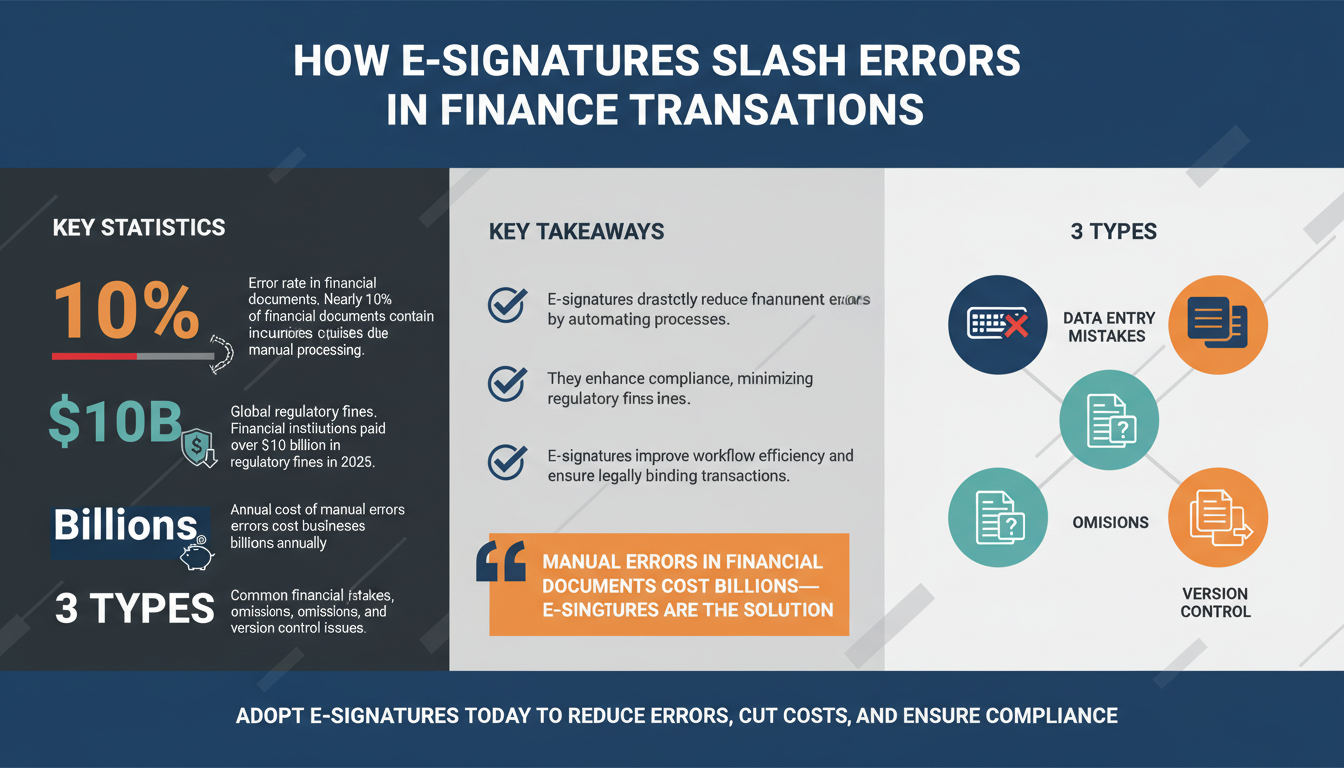
Errors in financial document transactions are more than an inconvenience—they're a direct threat to a business's bottom line. According to a McKinsey study, manual processing errors cost businesses billions annually, with nearly 10% of all financial documents containing inaccuracies. These errors are often caused by illegible handwriting, missing signatures, or overlooked details, all of which compromise the integrity of transactions.
Furthermore, regulatory fines add another layer of risk. In an era of stringent compliance requirements like Sarbanes-Oxley and GDPR, even a single error can result in penalties. For example, Forbes reported that regulatory fines for financial institutions exceeded $10 billion globally in 2025. E-signatures alleviate these risks by ensuring documents are complete, time-stamped, and legally binding.
Errors also erode trust. Clients and stakeholders expect flawless execution, particularly in high-stakes transactions like mergers, acquisitions, or loan agreements. A single oversight can tarnish a company's reputation, making it harder to retain clients or attract new business.
Types of Errors in Financial Transactions
To understand the impact of e-signatures, it's essential to identify the common types of errors in financial document transactions. These include:
- Data Entry Mistakes: Incorrect manual input of financial figures can lead to discrepancies in reports and contracts.
- Omissions: Missing fields, such as unchecked boxes or unsigned sections, can invalidate documents.
- Version Control Issues: Using outdated document versions can result in conflicting terms or conditions.
Each of these errors poses unique challenges, but e-signature platforms address them effectively through automation and validation features.
Pro Tip:
Track error trends in your organization by maintaining a log of document issues over time. This can help identify areas where e-signature implementation could have the greatest impact.
Key Takeaway:
- Manual errors cost businesses billions and damage credibility.
- E-signatures eliminate common causes of document inaccuracies.
- Enhanced compliance reduces regulatory fines and risks.

How E-Signatures Reduce Common Errors
E-signatures utilize advanced technology to address the most frequent causes of errors in financial document transactions. Below are some of the ways they achieve this:
1. Eliminating Handwriting Issues
Traditional signatures often suffer from illegibility or inconsistency, especially when documents span multiple pages or signatories. E-signatures provide clear, standardized signatures that are digitally embedded, ensuring uniformity and readability.
For instance, in a mortgage agreement with multiple parties, inconsistent handwriting can lead to disputes or delays in processing. E-signatures eliminate this issue by providing a uniform digital signature that is visually identical across all documents.
2. Minimizing Missing Fields and Incomplete Forms
Finance teams often deal with complex forms requiring multiple fields to be filled. E-signature platforms integrate field validation, preventing users from submitting incomplete documents. For example, Zignature's smart document validation features ensure all mandatory fields are completed before submission.
Additionally, platforms can highlight sections that require attention, such as blank fields or unchecked boxes. This feature is particularly useful in high-stakes documents like tax filings or loan applications, where incomplete forms can cause significant delays.
3. Timestamp and Audit Trails
A key feature of e-signature platforms is the automatic generation of timestamps and audit trails. These records provide a detailed history of the document's lifecycle, including when it was signed, who signed it, and any modifications made. This eliminates disputes over timing or authenticity.
For example, during a financial audit, having a comprehensive audit trail can provide proof of compliance with regulatory requirements, saving both time and legal expenses.
Expert Insight:
"The integration of timestamps and audit trails in e-signature platforms is a game-changer for finance teams. It not only enhances transparency but also acts as a safeguard against fraud or unauthorized modifications," says Dr. Emily Carter, a compliance expert at FinTech Solutions.
Key Takeaway:
- E-signatures eliminate handwriting issues and unclear signatures.
- Field validation ensures forms are complete and accurate.
- Timestamps and audit trails enhance transparency.

Compliance and Security Features That Prevent Errors
Financial transactions are subject to strict regulatory standards, and e-signatures help finance teams stay compliant while reducing errors. Here's how:
1. Ensuring Legal Validity
E-signatures are legally recognized under frameworks like the ESIGN Act in the U.S. and eIDAS in the EU. These laws mandate that electronic signatures carry the same weight as handwritten ones, provided they meet specific requirements. This ensures that financial documents signed electronically are admissible in court.
Consider the scenario of a cross-border merger involving parties in the U.S. and Europe. With e-signatures meeting both ESIGN and eIDAS standards, companies can finalize agreements without legal discrepancies, saving time and reducing risks.
2. Advanced Encryption Techniques
Security breaches in financial transactions can result in devastating consequences. Leading e-signature platforms use advanced encryption methods, ensuring that sensitive information remains confidential. For example, Zignature employs AES-256 encryption to safeguard client data.
This level of encryption is equivalent to the standards used by banks and government institutions, providing an additional layer of assurance for financial teams handling sensitive information.
3. Multi-Factor Authentication (MFA)
MFA adds an extra layer of protection by requiring users to verify their identity through multiple methods, such as passwords, SMS codes, or biometric scans. This drastically reduces the risk of unauthorized access.
For example, a financial institution requiring MFA before document signing ensures that only authorized personnel can execute high-stakes transactions, reducing the likelihood of fraud or human error.
Comparison Table: Traditional vs. E-Signature Security Features
| Feature | Traditional Signatures | E-Signatures |
|---|---|---|
| Encryption | None | AES-256 Encryption |
| Audit Trails | Manual, prone to errors | Automated and secure |
| MFA | Not available | Available |
Key Takeaway:
- E-signatures are legally valid under global frameworks like ESIGN and eIDAS.
- Encryption protects sensitive financial data from breaches.
- MFA ensures secure and authenticated transactions.

Streamlining Workflow Automation with E-Signatures
The integration of e-signatures into financial workflows offers unparalleled efficiency. According to Gartner research, companies that adopt e-signature technology experience a 50% improvement in document turnaround times.
Here’s how e-signatures fit into workflow automation:
1. Integration with Financial Software
E-signature platforms like Zignature can be seamlessly integrated into financial software systems such as QuickBooks or SAP. This ensures that signed documents are automatically stored and indexed, reducing the risk of misplacement or duplication.
For example, a tax consultancy firm integrated e-signatures with its SAP system to simplify client onboarding. The result? A 40% reduction in processing time and a significant decrease in administrative errors.
2. Automated Notifications and Reminders
Finance teams often struggle with chasing signatories for approvals. E-signature platforms send automated reminders to relevant parties, speeding up the signing process and reducing delays.
For instance, a real estate agency used automated reminders to finalize lease agreements, cutting the average approval time from five days to just 24 hours.
3. Real-Time Tracking
E-signature solutions provide real-time tracking, allowing finance teams to monitor the status of documents. This transparency ensures that errors are caught before they escalate.
Key Takeaway:
- E-signatures integrate seamlessly with financial software.
- Automated reminders eliminate bottlenecks in approval workflows.
- Real-time tracking enhances transparency and accountability.

Proprietary Framework: The Error-Free E-Signature Workflow for Finance Teams
To help finance teams implement e-signatures effectively, we’ve developed the "Error-Free E-Signature Workflow Framework." This 4-step methodology ensures seamless implementation and error prevention:
Step 1: Identify High-Risk Documents
Evaluate which financial documents are prone to errors (e.g., contracts, loan applications, audit reports). Focus on digitizing these first.
For example, a multinational corporation began its e-signature journey by digitizing its vendor contracts, reducing processing errors by 75% in just six months.
Step 2: Implement Validation Rules
Use validation rules within your e-signature platform to flag incomplete fields or missing attachments.
Step 3: Train Staff on Best Practices
Conduct training sessions to familiarize staff with e-signature tools, emphasizing compliance and security features.
Pro Tip: Use role-specific training modules to address the unique needs of different departments within your finance team.
Step 4: Monitor and Optimize
Continuously monitor document workflows and optimize processes based on analytics provided by the e-signature platform.
Key Takeaway:
- Focus on high-risk documents first.
- Leverage validation rules to prevent errors.
- Training and optimization are crucial for long-term success.
Real-World Examples: E-Signatures in Action
Let’s examine how businesses are using e-signatures to reduce errors:
Case Study: Loan Processing
A mid-sized bank reduced loan application errors by 65% after integrating e-signatures. Automated validation ensured no fields were left incomplete, while audit trails provided transparency during regulatory audits.
Additionally, clients appreciated the convenience of signing documents digitally, increasing customer satisfaction by 20%.
Case Study: Corporate Mergers
During a high-profile merger, a Fortune 500 company utilized e-signatures to manage over 500 documents. This streamlined the workflow, eliminating manual errors and saving an estimated $500,000 in processing costs.
Key Takeaway:
- E-signatures reduce errors in high-stakes transactions like loans and mergers.
- Automation saves time and money while ensuring compliance.
FAQs About E-Signatures for Financial Document Transactions
Are e-signatures legally binding for financial transactions?
Yes, e-signatures are legally binding under frameworks like the ESIGN Act and eIDAS. They carry the same legal weight as handwritten signatures.
How secure are e-signatures?
Leading platforms use AES-256 encryption, MFA, and audit trails to ensure security.
Can e-signatures integrate with my financial software?
Yes, most e-signature platforms integrate seamlessly with tools like QuickBooks, SAP, and Oracle.
What industries benefit most from e-signatures?
Industries like finance, real estate, healthcare, and legal see the greatest benefits.
How quickly can I implement e-signatures in my workflows?
Implementation typically takes 1-2 weeks with proper training and software integration.
Conclusion: Transform Your Financial Workflows Today
E-signatures have revolutionized financial document transactions, reducing errors, increasing efficiency, and ensuring compliance. For finance teams, the ability to streamline processes while maintaining accuracy is invaluable. By adopting e-signatures, you’re not just modernizing your workflows—you’re safeguarding your business’s reputation and bottom line.
Ready to transform your financial workflows? Explore our platform features or contact our team to get started today!
To further enhance your digital workflows, explore our sister platforms: Apparatuz for workflow automation, Applicantz for recruitment management, Schedly for scheduling and appointments, Supportly for customer support, and Zatisfied for feedback management. Together, these tools create a comprehensive ecosystem that complements your digital signature strategy.