
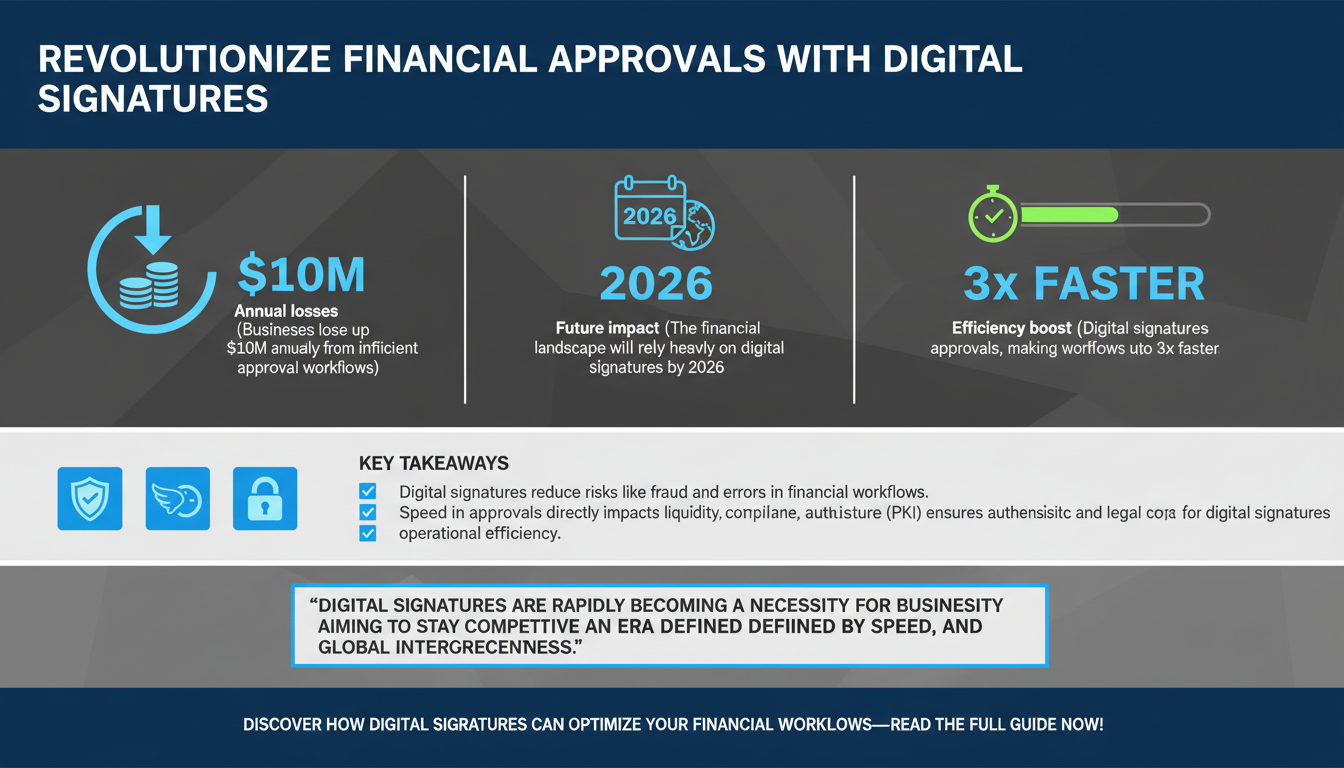
In 2026, the financial landscape is evolving at lightning speed, driven by technological innovation and the demand for faster, more secure processes. For CFOs and finance teams, managing approvals and authorizations has historically been a bottleneck filled with inefficiencies, risks, and delays. But digital signatures are changing the game. This article dives deep into how digital signatures are revolutionizing financial workflows, offering a practical, step-by-step guide tailored specifically for CFOs and finance professionals.
Introduction: The High Stakes of Financial Approvals
Financial approvals are the lifeblood of any business—their speed and accuracy directly impact liquidity, compliance, and operational efficiency. Without timely and accurate approvals, businesses risk delayed payments to vendors, missed opportunities for investments, and even regulatory fines. Traditional methods, such as paper-based approvals or electronic PDFs with manual signatures, have proven inadequate in today’s fast-paced, globalized economy. The inefficiencies in these processes not only waste resources but also expose organizations to risks such as fraud and errors.

A study from Gartner reveals that businesses lose up to $10 million annually due to inefficiencies in financial approval workflows. Consider the ripple effect: delayed approvals can lead to strained vendor relationships, missed deadlines, and diminished trust across stakeholders. For CFOs, who are under constant pressure to optimize operations and enhance financial transparency, these challenges are increasingly untenable.
Digital signatures offer a solution by automating and securing the approval process, ensuring that finance teams can handle larger volumes of transactions without compromising accuracy or compliance. This technology isn’t just a convenience—it’s rapidly becoming a necessity for businesses aiming to stay competitive in an era defined by speed, security, and global interconnectedness.
Why Speed Matters
In the financial world, speed is often the difference between success and failure. For instance, approving a vendor payment on time ensures uninterrupted supply chains, while delays can halt production altogether. Similarly, rapid approvals for investment opportunities allow businesses to capitalize on favorable market conditions before they disappear. Digital signatures enable CFOs to streamline these critical processes, ensuring that their organizations can act swiftly and decisively.
More than just a tool for efficiency, digital signatures represent a paradigm shift. They enable organizations to move away from outdated, error-prone processes and embrace streamlined workflows that prioritize agility and security. Let’s explore how CFOs and finance professionals can leverage this transformative technology to overcome traditional barriers and achieve unparalleled results.
What Are Digital Signatures and How Do They Work?
Digital signatures are cryptographic tools that provide authenticity, integrity, and non-repudiation for electronic documents. Unlike simple electronic signatures, which may involve manually signing a PDF or typing a name, digital signatures are backed by public key infrastructure (PKI) technology to ensure that the document has not been tampered with and that the signer is verified. This makes them legally binding under global regulations, including the eIDAS Regulation in Europe and the U.S. ESIGN Act.

Understanding PKI Technology
Public Key Infrastructure (PKI) is the backbone of digital signatures. It uses a pair of cryptographic keys: a public key and a private key. The private key is known only to the signer, while the public key is available to anyone needing to verify the signature. When a signer creates a digital signature, they use their private key to encrypt the document’s hash. The recipient then uses the signer’s public key to decrypt this hash and verify the document’s authenticity and integrity.
This robust process ensures that digital signatures cannot be forged or tampered with, making them far superior to traditional methods. For example, in a financial transaction involving multiple stakeholders, the PKI system guarantees that every signature is uniquely tied to its signer and that the document remains unchanged throughout the workflow.
Legal Recognition of Digital Signatures
One of the most significant advantages of digital signatures is their legal validity. Globally recognized regulations such as the U.S. ESIGN Act and the European Union’s eIDAS Regulation provide a framework for their use, making them enforceable in courts of law. This is particularly important for CFOs handling cross-border transactions, as it ensures that signed documents are accepted across jurisdictions. For example, a U.S. company entering a contract with a European vendor can confidently use digital signatures, knowing they are legally binding under both sets of regulations.
According to Forrester, organizations that adopt digital signatures reduce document processing time by 80% and cut approval delays by 50%. These statistics highlight the urgency for CFOs and finance teams to embrace this technology to remain competitive.
The Benefits of Digital Signatures for Financial Approvals
Digital signatures bring transformative benefits to financial approvals, addressing pain points that CFOs and finance teams know all too well. Below are some of the most compelling advantages:

1. Enhanced Security
Financial documents often contain sensitive information, such as tax IDs, bank account details, proprietary transaction data, and contract terms. Digital signatures use advanced encryption to safeguard this data, ensuring that unauthorized parties cannot access, modify, or delete it. In addition, PKI-based signatures provide a secure audit trail, which is crucial for regulatory compliance.
A report by IDC highlights that businesses using digital signatures experience a 73% reduction in data breaches compared to those relying on manual methods. This is particularly important for CFOs dealing with sensitive financial transactions such as investment approvals or international payments.
Pro Tip: Implement Multi-Factor Authentication
To further enhance security, incorporate multi-factor authentication (MFA) into your digital signature workflows. MFA requires users to verify their identity using two or more methods, such as a password and a biometric scan. This extra layer of security reduces the risk of unauthorized access, making your financial processes even more secure.
2. Speed and Efficiency
Manual approval processes are notoriously slow, often requiring multiple rounds of printing, scanning, and physical delivery of documents. Digital signatures eliminate these inefficiencies, enabling real-time approvals that can be completed in minutes rather than days. For example, a multinational corporation reduced its average approval time from 10 days to 24 hours after implementing digital signature technology. This speed not only improves operational efficiency but also enhances decision-making capabilities by providing CFOs with timely access to critical information.
Expert Insight: Automation is Key
Pair digital signatures with workflow automation tools to maximize efficiency. Automation platforms can route documents to the appropriate signatories, issue reminders for pending approvals, and archive signed documents automatically. This reduces manual effort and ensures that approvals are completed without delays.
3. Compliance and Audit Readiness
Regulatory scrutiny has increased significantly in recent years, with laws such as SOX, GDPR, and FINRA imposing strict requirements on financial workflows. Digital signatures provide an automated audit trail that tracks every step of the approval process, including timestamps, signer identity, and document integrity. This simplifies audits and reduces the risk of penalties, ensuring that CFOs can confidently demonstrate compliance during regulatory reviews.
Checklist: Features to Look for in Digital Signature Solutions
- PKI-based encryption for enhanced security
- Integration with ERP and accounting software
- Automated audit trails for compliance
- Multi-factor authentication capabilities
- Support for global regulations (eIDAS, ESIGN Act, etc.)
4. Cost Savings
Switching to digital signatures eliminates costs associated with printing, scanning, courier services, and physical storage of documents. According to a study by Nucleus Research, companies save an average of $30 per document by adopting digital signature solutions. For organizations processing thousands of documents annually, these savings can be substantial.
5. Scalability
As businesses grow, managing approvals across multiple departments, regions, and countries can become increasingly complex. Digital signatures provide a scalable solution that adapts to the needs of growing organizations, allowing CFOs to maintain control and visibility over approval workflows.
Case Study: Scaling Approvals in a Global Enterprise
A global enterprise with offices in 15 countries implemented digital signatures to streamline its financial approval process. Initially, the company faced challenges with coordinating approvals across different time zones and languages. By adopting a digital signature platform that supported multi-language interfaces and real-time collaboration, the enterprise reduced approval times by 60% and improved transparency across teams.
Challenges CFOs Face Without Digital Signatures
Despite their benefits, many CFOs and finance teams still rely on outdated methods for approvals. These approaches introduce several challenges:

1. Increased Risk of Fraud
Paper-based approvals are vulnerable to forgery and unauthorized alterations, leading to potential financial fraud. A study by ACFE found that manual processes account for 45% of fraud cases in corporate finance. CFOs must prioritize secure solutions to mitigate these risks.
2. Delays in Decision-Making
Traditional workflows often result in bottlenecks, especially when approvals require multiple signatories across different departments or locations. These delays can impact critical transactions, such as vendor payments or investment disbursements, creating cascading effects on operational efficiency.
3. Lack of Transparency
Manual processes make it difficult to track the status of approvals, leading to confusion and errors. CFOs need real-time visibility into workflows to make informed decisions and allocate resources effectively.
Implementing Digital Signatures: A Step-by-Step Guide
To successfully implement digital signatures in financial approval workflows, CFOs should follow these steps:
Step 1: Assess Current Workflows
Evaluate your organization's existing approval processes to identify inefficiencies and bottlenecks. Common issues include delays in routing documents, lack of visibility into approval statuses, and high costs associated with physical document management.
Step 2: Select the Right Solution
Choose a digital signature platform that integrates seamlessly with your existing tools, such as ERP systems or document management software. Look for features like multi-factor authentication, audit trails, and compliance certifications. Platforms like Zignature offer tailored solutions for finance teams.
Step 3: Train Your Team
Provide training sessions to ensure that employees understand how to use the digital signature platform. Focus on security protocols and compliance requirements to maximize effectiveness.
Step 4: Pilot and Scale
Start with a pilot program for a specific workflow, such as vendor payments or investment approvals. Evaluate the results and refine your approach before scaling the solution across other processes.
Conclusion: The Future of Financial Approvals with Digital Signatures
Digital signatures are not just a trend—they are a necessity for organizations navigating the complexities of modern finance. By adopting this technology, CFOs and finance teams can unlock unprecedented efficiency, security, and compliance in their workflows. As businesses continue to explore new ways to optimize operations, digital signatures stand out as a transformative solution capable of meeting the demands of today's fast-paced, interconnected economy.
To further enhance your digital workflows, explore our sister platforms: Apparatuz for workflow automation, Applicantz for recruitment management, Schedly for scheduling and appointments, Supportly for customer support, and Zatisfied for feedback management. Together, these tools create a comprehensive ecosystem that complements your digital signature strategy.