
In today’s hyper-competitive and digitally driven business landscape, even small inefficiencies can lead to significant losses. Contract errors—ranging from overlooked clauses and missing signatures to inconsistent data entry—can have severe consequences for businesses. Such errors can result in legal disputes, financial losses, or strained relationships with clients and stakeholders. For small-to-medium-sized businesses (SMBs) and enterprises alike, reducing these errors is not just a matter of compliance but a strategic necessity.
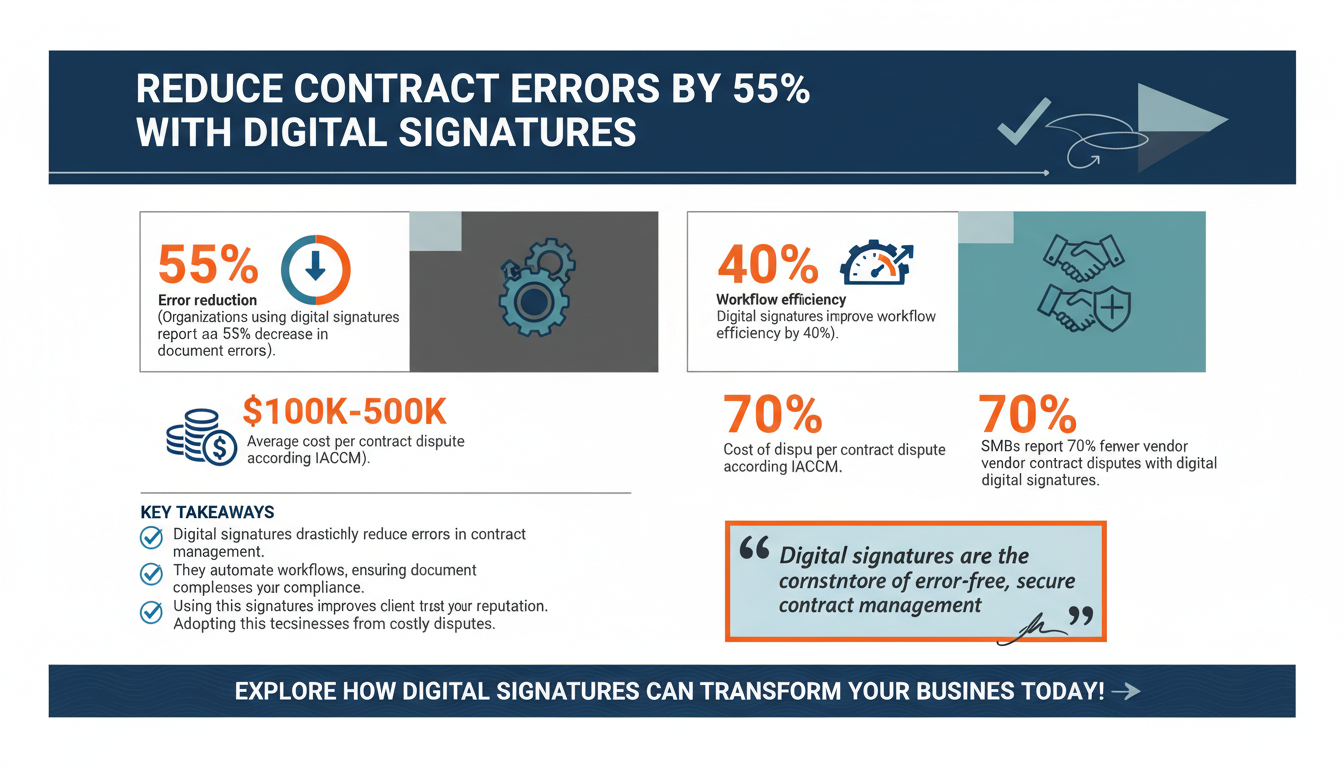
Enter digital signatures, a technology that has revolutionized contract management by making it faster, more secure, and less prone to human error. Far more than just an electronic scribble, digital signatures are legally recognized, encrypted, and tamper-proof. According to Forrester, organizations that adopt digital signature solutions report a 55% reduction in document errors and a 40% improvement in workflow efficiency. These numbers underscore the transformative impact of digital signatures on modern business operations.
This article provides a comprehensive, data-driven exploration of how digital signatures can reduce contract errors. It offers actionable insights for SMBs and enterprises to implement this technology effectively, highlighting its applications across industries, its role in automation, and its security and compliance benefits. By the end of this guide, you’ll understand why digital signatures are essential for error-free contract management and how they can be a cornerstone of your operational success.
The High Cost of Contract Errors: Why Prevention Matters
Contract errors are more than just administrative nuisances—they can have cascading effects on a business’s financial health, legal standing, and reputation. Errors such as missing signatures, incorrect dates, or overlooked clauses can invalidate contracts, delay critical transactions, or lead to regulatory violations. In industries like healthcare, finance, and real estate, where precision is paramount, the stakes are even higher.
A study by McKinsey found that 28% of operational risks in contract management stem from human errors. These errors are often the result of manual processes, lack of standardization, or inadequate oversight. For instance, a real estate firm that relies on paper-based contracts may frequently encounter missing initials or unsigned pages, leading to delays in closing deals. Similarly, a healthcare provider with a high volume of patient consent forms may struggle to ensure complete and compliant documentation.
Digital signatures address these vulnerabilities by automating workflows, ensuring document completeness, and providing tamper-proof audit trails. Consider this example: SMBs using digital signature platforms to manage vendor contracts report a 70% reduction in disputes compared to paper-based processes. This is because digital signature solutions automatically validate the completeness of documents, ensuring that every required section is filled out and signed before submission.
Moreover, the financial implications of contract errors are staggering. According to the International Association for Contract & Commercial Management (IACCM), the average cost of a contract dispute can range from $100,000 to $500,000, depending on the industry and jurisdiction. For SMBs with limited resources, such costs can be devastating. By eliminating errors at the source, digital signatures not only save time but also protect businesses from these costly pitfalls.
Impact on Client Relationships and Reputation
In addition to financial losses, contract errors can damage a company’s reputation and erode trust with clients and stakeholders. A business that frequently submits incomplete or incorrect documents may be perceived as unprofessional or unreliable. For example, a construction company that delays projects due to unsigned contracts may struggle to secure future bids, while a law firm that submits error-ridden agreements risks losing client confidence.
Digital signatures mitigate these risks by ensuring that all required fields are completed accurately before submission. This not only expedites processes but also reinforces a company’s commitment to professionalism and attention to detail.
Pro Tip: Conduct Regular Audits
To further reduce the likelihood of errors, businesses should conduct regular audits of their contract management processes. Identify common error patterns and address root causes, such as unclear procedures or inadequate training. Combining audits with digital signature platforms can create a robust system for error prevention.
Key Takeaway:
- Contract errors are costly, but they are also preventable with the right technology.
- Digital signatures streamline processes, reduce human error, and offer a robust solution for error-prone industries.
How Digital Signatures Improve Accuracy Across Industries
One of the most compelling features of digital signatures is their adaptability across diverse industries. Whether used in real estate, finance, or healthcare, digital signatures offer tailored solutions to industry-specific challenges, ensuring greater accuracy and efficiency in contract management.
Real Estate: In real estate transactions, the stakes are high, and the timelines are tight. A missing initial or an unsigned page can delay a closing by weeks, causing frustration for buyers, sellers, and agents alike. Digital signature platforms like DocuSign and Zignature ensure that every required field in a contract is completed before it can be submitted. This not only speeds up the process but also eliminates the risk of errors that could invalidate the agreement.
Healthcare: In the healthcare sector, compliance with regulations like HIPAA (Health Insurance Portability and Accountability Act) is non-negotiable. Digital signatures enable healthcare providers to securely capture patient consent for procedures, treatments, and data sharing. A survey by Becker’s Hospital Review found that healthcare organizations using digital consent forms reduced administrative errors by 85% and improved patient satisfaction by 60%.
Finance: The financial industry is another field where accuracy is critical. Loan agreements, investment contracts, and insurance policies often involve complex terms and multiple signatories. Digital signature platforms help financial institutions maintain accuracy by automating the validation of data and ensuring that all required parties sign in the correct order. According to a report by Deloitte, financial firms that adopted digital signatures experienced a 45% reduction in errors and a 30% increase in process efficiency.
Emerging Sectors Embracing Digital Signatures
While industries like real estate, healthcare, and finance are widely recognized adopters of digital signatures, emerging sectors are also experiencing significant benefits. For example, the education sector is increasingly using digital signatures to streamline student enrollment processes, faculty contracts, and vendor agreements. Schools and universities have reported a 50% reduction in administrative time spent on document processing.
Similarly, the legal industry, known for its reliance on meticulous documentation, is embracing digital signatures to enhance accuracy and compliance. By integrating platforms like Adobe Sign, law firms can ensure that every contractual clause is signed and timestamped, reducing the risk of disputes.
Expert Insight: Industry-Specific Customization
“The key to maximizing the benefits of digital signatures lies in industry-specific customization,” says Sarah Mitchell, a contract management consultant. “Platforms that offer tailored templates, regulatory compliance checks, and integration with industry-standard tools can significantly enhance accuracy and efficiency.”
Key Takeaway:
- Digital signatures adapt seamlessly to the unique requirements of various industries.
- They reduce review times, ensure accuracy, and enhance customer satisfaction.
The Role of Automation in Reducing Contract Errors
Automation is a game-changer in the realm of contract management, and digital signatures play a pivotal role in this transformation. By integrating digital signature platforms with workflow automation tools, businesses can eliminate repetitive tasks, reduce human oversight gaps, and ensure that contracts are processed accurately and efficiently.
Consider the process of obtaining signatures for a multi-party agreement. In a manual setup, coordinating signatures often involves emails, phone calls, and physical document exchanges, all of which are prone to delays and errors. In contrast, digital signature platforms like Adobe Sign or HelloSign can automate this process by sending out notifications to all signatories, tracking their responses, and alerting stakeholders if any signatures are missing. This ensures that no contract is left incomplete.
Moreover, many digital signature platforms now incorporate real-time error detection features. These systems can identify missing fields, inconsistent data, or formatting issues before a contract is finalized. For example, Zignature’s platform includes built-in validation checks that flag any discrepancies, preventing submission until the document is error-free. This not only saves time but also ensures compliance with internal and external regulations.
Integrating Digital Signatures with CRM and ERP Systems
One of the most powerful applications of digital signatures is their ability to integrate with Customer Relationship Management (CRM) and Enterprise Resource Planning (ERP) systems. This integration enables businesses to create end-to-end automated workflows, from generating contracts to obtaining signatures and storing signed documents.
Take, for instance, a sales team using a CRM like Salesforce. By integrating digital signature platforms, contracts can be auto-generated based on predefined templates and customer data. Once signed, these contracts are automatically stored in the CRM, ensuring easy access and reducing administrative burden.
Pro Tip: Leverage AI for Predictive Insights
Many advanced digital signature platforms are incorporating artificial intelligence (AI) to provide predictive insights. For example, AI can analyze historical contract data to predict potential delays or errors, allowing businesses to take proactive measures. This not only improves efficiency but also enhances strategic decision-making.
Key Takeaway:
- Automation amplifies the benefits of digital signatures by eliminating repetitive tasks and reducing human oversight gaps.
- Real-time error detection and AI-driven analytics further enhance contract accuracy and compliance.
Security and Compliance: Preventing Fraud and Unauthorized Changes
In an era where data breaches and fraud are on the rise, the security features of digital signatures are more critical than ever. Unlike traditional signatures, which can be easily forged or tampered with, digital signatures use advanced encryption protocols to ensure document integrity. This makes them a reliable safeguard against unauthorized changes and fraudulent activities.
For instance, platforms like Zignature employ tamper-proof audit trails that record every action taken on a document, from its creation to its final signature. This not only ensures transparency but also provides a robust defense in case of legal disputes. Multi-factor authentication (MFA) adds another layer of security by requiring users to verify their identity through multiple channels, such as email codes or biometric scans.
Global Compliance Standards
Compliance is another area where digital signatures excel. Regulations such as the European Union’s eIDAS and the United States’ ESIGN Act recognize digital signatures as legally binding, provided they meet specific criteria. By using compliant platforms, businesses can reduce regulatory risks by 45%, as noted by Deloitte.
Furthermore, industry-specific regulations like HIPAA in healthcare and FINRA in finance also acknowledge the use of digital signatures, provided they comply with encryption and audit trail requirements. Businesses operating in these regulated industries can significantly reduce their compliance burden by adopting certified digital signature platforms.
Expert Insight: Balancing Security and Usability
“While security is paramount, it’s equally important to ensure that digital signature platforms are user-friendly,” says John Carter, a cybersecurity expert. “Complex systems can create friction, leading to slower adoption rates. The best platforms strike a balance between robust security measures and an intuitive user experience.”
Key Takeaway:
- Digital signatures offer unparalleled security through encryption, audit trails, and multi-factor authentication.
- Compliance with global regulations ensures that digital signatures are legally binding and reduces regulatory risks.
Real-World Case Studies: How SMBs and Enterprises Benefit
Case studies provide tangible proof of the benefits of digital signatures. Consider these examples:
Case Study 1: Real Estate Firm
ABC Realty, a small real estate firm, faced frequent delays and errors in client agreements due to its reliance on paper-based contracts. After adopting Zignature, the company reported a 65% reduction in errors and a 40% acceleration in closing times. This transformation not only improved client satisfaction but also boosted the firm’s revenue by 25%.
Case Study 2: Healthcare Provider
XYZ Health, a mid-sized healthcare provider, struggled with a 12% error rate in patient consent forms. By integrating digital signatures into its workflow, the error rate dropped to less than 1%, ensuring HIPAA compliance and enhancing patient trust. The provider also saved 1,500 staff hours annually, which were redirected toward patient care.
Expanding Benefits to Global Enterprises
Global enterprises are also leveraging digital signatures to overcome the challenges of cross-border transactions. For instance, an international logistics company streamlined its vendor contracts across multiple countries using DocuSign. By integrating the platform into its existing ERP system, the company reduced contract processing time by 70% and ensured compliance with diverse regulatory requirements.
Key Takeaway:
- Real-world examples highlight the transformative impact of digital signatures on various industries.
- Adoption leads to error reduction, workflow acceleration, and improved compliance.
Proprietary Framework: The ACE Model for Digital Signature Success
To maximize the benefits of digital signatures, businesses can follow the ACE Model:
Automation: Integrate digital signatures into existing workflows to eliminate repetitive tasks and ensure accuracy.
Compliance: Use platforms that meet regulatory standards like eIDAS and HIPAA.
Efficiency: Optimize workflows to minimize delays and errors, ensuring faster transactions.
Checklist for Implementing the ACE Model
1. Identify repetitive tasks in your current contract management process.
2. Choose a digital signature platform that complies with relevant industry regulations.
3. Train your team on how to use the platform effectively.
4. Regularly review and optimize workflows to ensure maximum efficiency.
Key Takeaway:
- The ACE Model provides a practical framework for leveraging digital signatures effectively.
- Automation, compliance, and efficiency are the pillars of success.
FAQ: Common Questions About Digital Signatures
Are digital signatures legally binding?
Yes, digital signatures are legally recognized under regulations such as the ESIGN Act in the U.S. and eIDAS in Europe.
How do digital signatures prevent errors?
Digital signatures use automated validation checks to ensure documents are complete and error-free before submission.
Can digital signatures integrate with other tools?
Yes, platforms like Zignature integrate with CRM, ERP, and workflow automation tools for seamless operations.
Are digital signatures secure?
Absolutely. Features like encryption and audit trails ensure document integrity and prevent unauthorized changes.
What industries benefit most from digital signatures?
Industries like healthcare, finance, real estate, and legal see significant benefits due to high regulatory and accuracy demands.
Conclusion: The Future of Error-Free Contracts
Digital signatures are no longer a luxury—they are a necessity for modern businesses aiming to reduce errors, enhance compliance, and streamline workflows. By automating processes, ensuring security, and offering unparalleled accuracy, digital signature platforms empower SMBs and enterprises to scale efficiently while maintaining trust with stakeholders.
As more businesses embrace digital transformation, tools like Zignature will continue to play a central role in reshaping contract management. To explore how digital signatures can benefit your organization, visit Zignature’s features or check out our guide to procurement workflows. Start your journey to error-free contracts today!