
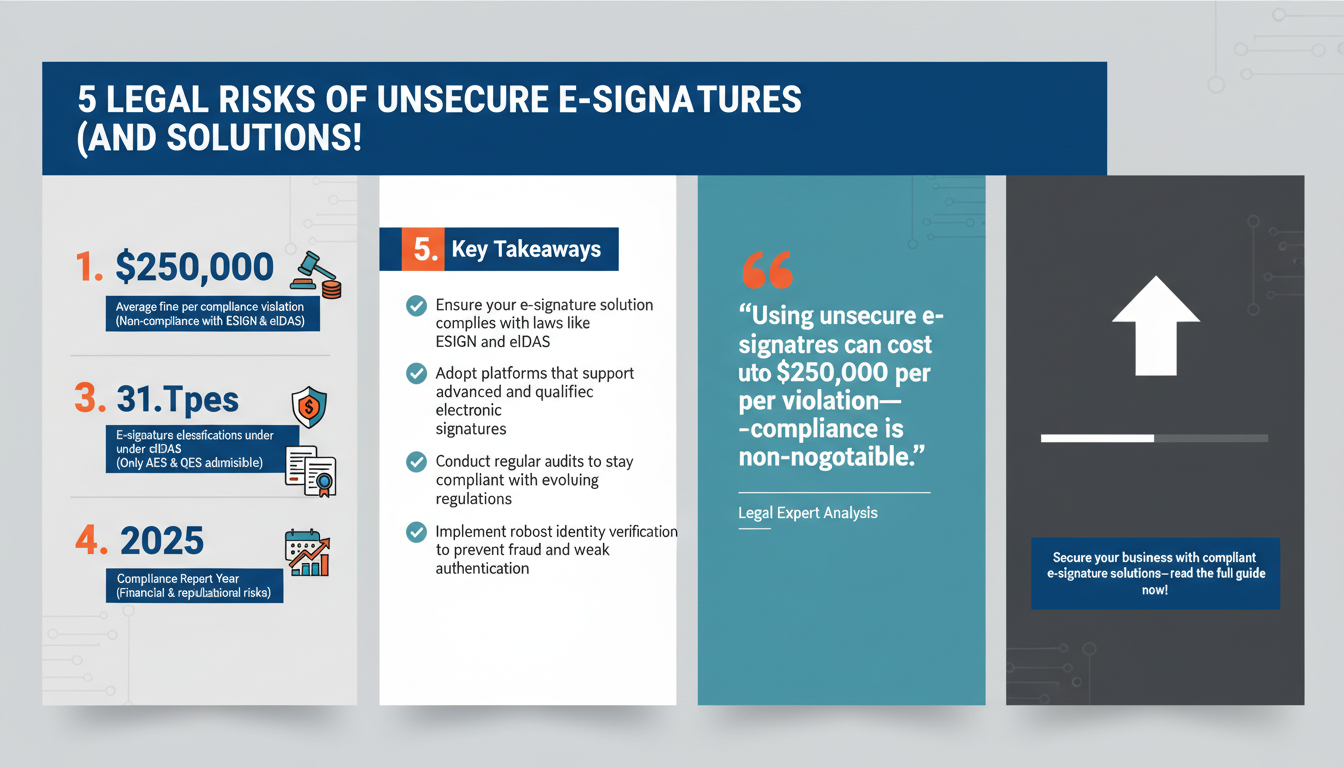
In the fast-paced digital world of 2026, electronic signatures (e-signatures) have become a cornerstone of modern business operations. Whether you’re signing contracts, approving vendor agreements, or onboarding new employees, e-signatures provide a seamless, paperless method to authenticate documents quickly and efficiently. The technology has revolutionized how businesses handle agreements, enabling faster workflows and reducing operational costs. However, with great convenience comes significant responsibility. Not all e-signature solutions are created equal, and using unsecure digital signatures can expose your organization to serious legal and financial risks. These risks range from compliance issues to data breaches, fraud, and invalid contracts, all of which can jeopardize your company's reputation and bottom line.
This comprehensive guide explores the five most critical legal risks associated with unsecure digital signatures and offers actionable strategies to mitigate them effectively. By understanding these risks and implementing the right solutions, you can safeguard your business operations, enhance data security, and reduce exposure to legal disputes. Whether you’re a small business owner or the head of compliance at a multinational corporation, this article will provide you with the tools and knowledge needed to navigate the complexities of e-signature technology.
1. Lack of Compliance with E-Signature Laws
Legal compliance is one of the most fundamental requirements for electronic signatures to be considered valid and enforceable. Major regulations like the U.S. ESIGN Act and the European Union’s eIDAS Regulation establish clear guidelines that e-signatures must meet to hold up in court. For example, the ESIGN Act mandates that electronic signatures must demonstrate intent to sign, be attributed to the signer, and maintain a reliable record-keeping process. Similarly, the eIDAS Regulation categorizes e-signatures into three types: simple electronic signatures, advanced electronic signatures (AES), and qualified electronic signatures (QES). Only AES and QES are typically admissible in high-stakes legal proceedings.
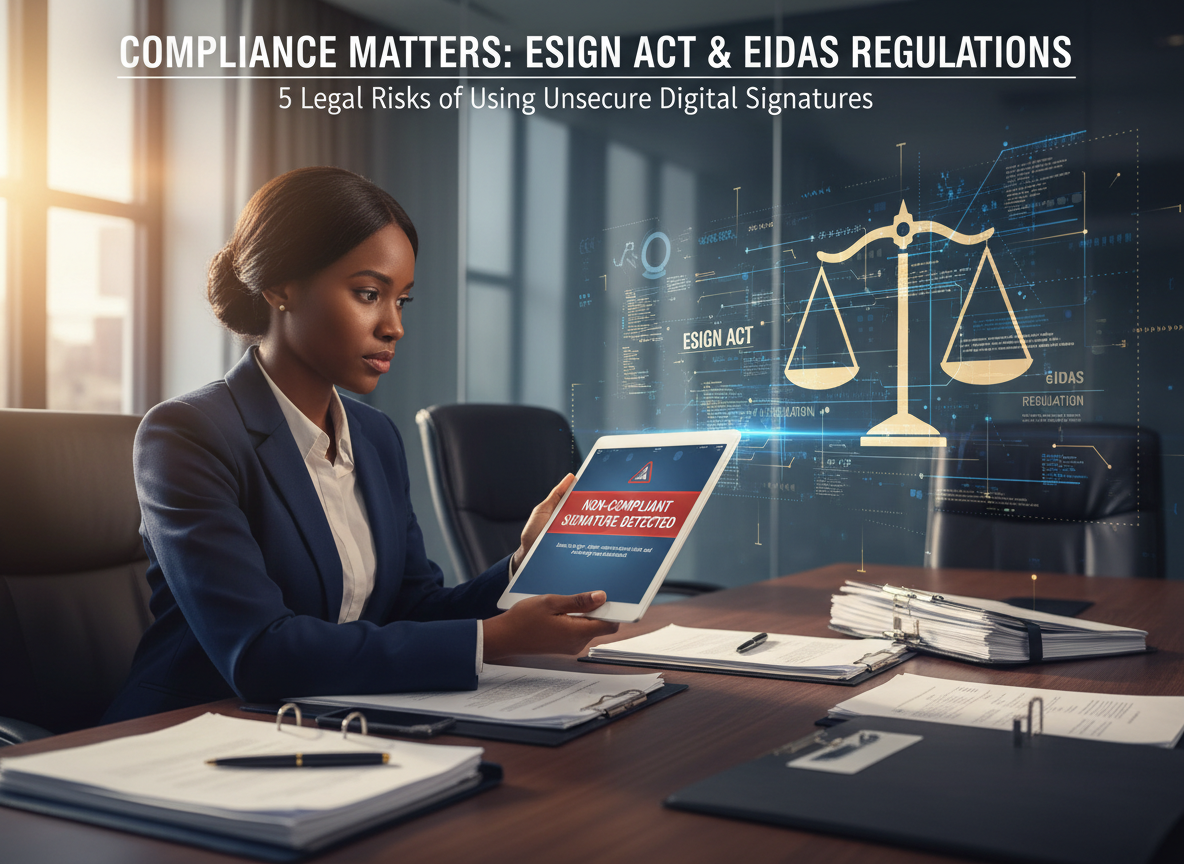
If your digital signature solution fails to meet these regulatory standards, the agreements you sign may be deemed invalid, exposing your organization to legal disputes. Non-compliance can also lead to severe financial penalties. For example, according to Deloitte’s 2025 Compliance Report, companies failing to adhere to e-signature regulations face an average fine of $250,000 per violation. Beyond financial penalties, the reputational damage from non-compliance can be equally devastating, as customers and partners may lose trust in your company’s ability to manage important agreements securely.
Real-World Example: In 2024, a European manufacturing firm faced a legal dispute when a major vendor challenged the validity of their digital signatures under eIDAS. The company’s reliance on a solution that lacked advanced encryption and identity verification led to a $1.2 million settlement and damaged its reputation in the industry.
How to Avoid This Risk:
- Select an e-signature solution that complies with ESIGN, eIDAS, and other relevant regional laws.
- Ensure your platform supports advanced or qualified electronic signatures and integrates robust identity verification protocols.
- Conduct regular audits of your e-signature processes to ensure compliance with evolving regulations.
By prioritizing compliance, your organization can avoid costly penalties and ensure that signed agreements remain legally enforceable across jurisdictions.
2. Weak Authentication and Fraud Risk
Authentication is the backbone of any secure e-signature solution. Without strong authentication measures, digital signatures become vulnerable to forgery and fraud. For example, if an unauthorized individual gains access to your e-signature platform, they could sign fraudulent contracts or approve unauthorized transactions, potentially leading to significant financial losses and legal challenges.
According to Gartner’s 2025 Authentication Risk Report, 67% of data breaches are tied to compromised credentials or weak authentication protocols. Industries like healthcare and finance, where sensitive data is frequently exchanged, face heightened risks due to regulatory requirements under laws such as HIPAA and GDPR. Weak authentication mechanisms can also lead to non-compliance with these regulations, compounding the legal risks.
Real-World Example: In 2025, a financial services firm experienced a phishing attack where hackers exploited weak authentication in their e-signature system. The breach resulted in $3 million in fraudulent transactions and regulatory fines under GDPR.
How to Avoid This Risk:
- Implement multi-factor authentication (MFA) for all e-signature processes to verify the identity of signers.
- Choose e-signature solutions with fraud detection features, such as IP tracking, geolocation monitoring, and timestamping.
- Train employees to recognize and report phishing attempts and other cybersecurity threats.
By enhancing authentication protocols, you can significantly reduce the risk of fraud and unauthorized access to your e-signature system.
3. Data Breaches and Lack of Encryption
Data breaches are a growing concern for organizations worldwide, particularly when using unsecure digital signature solutions. Signed documents often contain sensitive information, such as financial records, personal identification data, or proprietary business details. If these documents are intercepted during transmission or stored without proper encryption, they become easy targets for cybercriminals.
The consequences of a breach can be severe. In 2025 alone, over 4,100 data breaches were reported globally, affecting more than 22 billion records, according to IBM’s 2025 Data Breach Report. The average cost of a data breach has risen to $4.45 million, with legal fees, regulatory fines, and reputational damage contributing to this figure.
Real-World Example: A healthcare provider in the U.S. faced a class-action lawsuit in 2025 after a data breach exposed patient records contained in unencrypted e-signature documents. The incident led to $5 million in settlements and loss of patient trust.
How to Avoid This Risk:
- Ensure your e-signature solution uses end-to-end encryption to protect data during transmission and storage.
- Select platforms that comply with industry encryption standards, such as AES-256.
- Conduct regular penetration testing to identify vulnerabilities in your e-signature system.
By investing in encryption and cybersecurity measures, you can protect sensitive data and avoid the costly consequences of a breach.
4. Invalid Contracts Due to Improper Implementation
Even secure e-signature systems can fail if they are improperly implemented. Common mistakes include failing to timestamp signatures, omitting audit trails, or neglecting tamper-proof seals. These errors can make it difficult to prove the authenticity of signed documents in court, potentially invalidating contracts and leading to legal disputes.

Courts often scrutinize the validity of e-signatures during litigation. Without supporting documentation, such as identity verification logs, timestamps, or tamper-proof seals, the authenticity of a signed agreement may be challenged. According to Law.com’s 2025 Legal Tech Report, 23% of e-signature-related disputes stem from insufficient documentation to prove authenticity.
Real-World Example: In 2025, a real estate firm lost a legal battle over a property sale because their e-signature system failed to generate a proper audit trail for the signed contract. The dispute cost the firm $800,000 and delayed the transaction by several months.
How to Avoid This Risk:
- Use an e-signature platform that automatically generates detailed audit trails, including timestamps, IP addresses, and signer verification steps.
- Ensure tamper-proof seals are applied to prevent unauthorized alterations to signed documents.
- Educate your team on best practices for implementing e-signature workflows to avoid common mistakes.
Proper implementation ensures the validity of your contracts and reduces the risk of disputes arising from technical errors.
5. Cross-Border Legal Challenges
In today’s interconnected global economy, cross-border transactions are increasingly common. However, the legal enforceability of e-signatures can vary widely between jurisdictions. While the ESIGN Act and eIDAS Regulation provide robust frameworks in the U.S. and EU, other regions may have different standards or lack clear regulatory guidance.
For example, some countries require qualified electronic signatures (QES) for legal enforceability, while others accept simpler forms. Navigating this patchwork of regulations can be complex, particularly for multinational organizations. According to BCG’s 2025 Report on Cross-Border Transactions, 15% of multinational companies have faced disputes due to differing e-signature standards.
Real-World Example: A U.S.-based tech company faced delays in a major partnership deal with an Asian firm due to differences in e-signature requirements. The dispute required extensive legal consultation and added $500,000 in administrative costs.
How to Avoid This Risk:
- Work with an e-signature provider that offers compliance solutions tailored to multiple jurisdictions.
- Consult legal experts to understand the enforceability of e-signatures in each region where you operate.
- Adopt a flexible e-signature solution that supports both advanced and qualified electronic signatures.
By addressing cross-border legal challenges proactively, you can streamline international transactions and avoid costly disputes.
Conclusion
While digital signatures offer unparalleled convenience and efficiency, using unsecure solutions can expose your organization to significant legal risks. From compliance failures and fraud to data breaches and cross-border challenges, the consequences of inadequate e-signature security are too severe to ignore. By choosing a secure, compliant e-signature platform and implementing robust security measures, your business can thrive in the digital age without compromising its integrity.
Ready to secure your business? Explore Zignature’s advanced features to see how we can help you stay compliant and protected in every transaction.
To further enhance your digital workflows, explore our sister platforms: Apparatuz for workflow automation, Applicantz for recruitment management, Schedly for scheduling and appointments, Supportly for customer support, and Zatisfied for feedback management. Together, these tools create a comprehensive ecosystem that complements your digital signature strategy.