
Compliance audits are a cornerstone of business operations in today’s regulatory landscape. They ensure that companies adhere to legal, financial, and ethical standards while safeguarding their reputation. However, traditional audit processes often involve tedious paperwork, manual verification steps, and high operational costs, leaving organizations vulnerable to inefficiencies and errors. This is particularly challenging for small and mid-sized businesses (SMBs) and enterprises operating in highly regulated industries like healthcare, finance, and legal services.
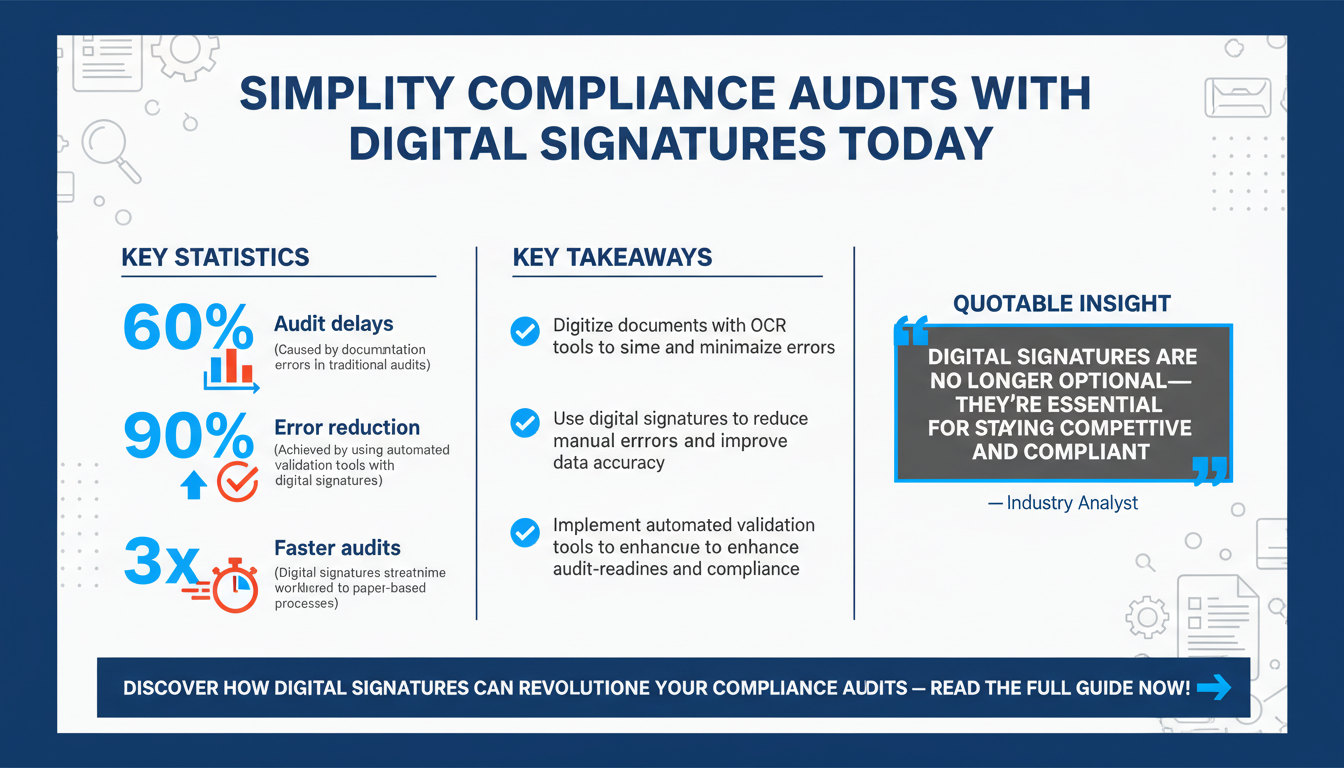
Enter digital signatures—a game-changing technology that not only accelerates audit processes but also ensures security, accuracy, and compliance. Digital signatures have evolved to be more than just an electronic alternative to handwritten signatures; they are now a critical tool for streamlining workflows, reducing costs, and enhancing data security. As regulatory requirements grow increasingly complex, leveraging digital signatures is no longer optional—it’s essential for businesses aiming to stay competitive and compliant.
In this comprehensive guide, we’ll explore how digital signatures simplify compliance audits for SMBs and enterprises. We’ll cover the challenges of traditional audits, the mechanics of digital signature technology, key benefits, actionable steps for implementation, common pitfalls to avoid, and real-world success stories.
1. Understanding Compliance Audit Challenges
Compliance audits are designed to evaluate whether an organization adheres to the regulatory frameworks and operational standards that govern its industry. These audits may focus on financial records, legal documentation, data security practices, or industry-specific regulations like HIPAA (Health Insurance Portability and Accountability Act) for healthcare or GDPR (General Data Protection Regulation) for businesses operating in Europe.
For SMBs and enterprises, the audit process is often fraught with challenges that can lead to inefficiencies, delays, and even penalties for non-compliance. Let’s break down the core challenges of traditional audits:
1.1 Document Overload
Auditors frequently need to sift through mountains of paperwork, including contracts, invoices, legal agreements, and compliance reports. In a typical audit, it’s not uncommon for businesses to process hundreds or even thousands of pages of documentation. Managing physical documents can be overwhelming, especially for SMBs with limited administrative resources.
Example: A mid-sized manufacturing company undergoing an ISO 9001 audit might need to provide detailed records of quality management processes, employee training logs, and supplier agreements. With paper-based workflows, assembling this information can take weeks.
Pro Tip: Digitizing documents in advance using optical character recognition (OCR) tools can help businesses reduce preparation time and minimize errors during audits.
1.2 Manual Errors
Human error is one of the biggest risks in traditional audits. Handwritten signatures can be illegible or incomplete, and physical documents are prone to being misplaced. Errors such as missing pages or incorrect data entries can delay the audit process and raise red flags about compliance.
Statistics: A report by PwC found that 60% of compliance delays are caused by documentation errors, underscoring the need for more robust systems.
Expert Insight: According to industry professionals, implementing automated validation tools alongside digital signature platforms can reduce human error rates by up to 90%, ensuring audit-readiness.
1.3 Security Risks
Paper-based workflows are inherently vulnerable to security breaches. Documents can be lost, stolen, or damaged, compromising sensitive information. Additionally, unauthorized access to physical files is harder to track, leaving businesses exposed to data breaches and compliance violations.
Real-World Incident: In 2020, a healthcare provider faced a $1.5 million fine after patient records were stolen from an unsecured filing cabinet. Such incidents highlight the importance of secure document management systems.
1.4 Time-Consuming Approvals
Traditional audits often involve multiple layers of approval, requiring signatures from managers, executives, and external stakeholders. Coordinating these approvals manually can lead to significant delays, especially when parties are geographically dispersed.
Case Study: A financial services firm reported that it took an average of 10 business days to collect signatures for compliance reports using manual processes. By adopting digital signatures, they reduced this timeline to just 48 hours.
2. What Are Digital Signatures and How Do They Work?
Digital signatures are a secure, electronic method of signing documents that guarantee the authenticity, integrity, and non-repudiation of the signed content. Unlike scanned handwritten signatures, which can be easily forged, digital signatures rely on cryptographic algorithms to provide a higher level of security and verification.
2.1 The Technology Behind Digital Signatures
Digital signatures operate using public key infrastructure (PKI), a framework that employs a pair of cryptographic keys: a private key and a public key. Here’s how the process works:
- Encryption: When a document is signed, the signer’s private key encrypts the signature and links it to the document. This creates a unique digital fingerprint.
- Verification: The recipient of the document uses the signer’s public key to decrypt the signature and verify its authenticity. Any alteration to the document after signing would invalidate the signature.
- Audit Trail: Most digital signature platforms generate an audit trail, recording timestamps, IP addresses, and other metadata to ensure traceability.
Example: In a financial audit, a CFO can digitally sign quarterly reports using a secure platform. The audit trail provides proof of when and where the signature was applied, ensuring accountability.
2.2 Legal and Regulatory Standards
Digital signatures are recognized as legally binding under regulations such as the Electronic Signatures in Global and National Commerce (ESIGN) Act in the United States, the Uniform Electronic Transactions Act (UETA), and the eIDAS Regulation in the European Union. These standards ensure that digital signatures have the same legal validity as handwritten signatures, provided they meet specific criteria for authenticity and integrity.
Case Study: A global software company faced frequent delays in contractual agreements due to legal requirements for handwritten signatures. By transitioning to an eIDAS-compliant digital signature platform, they shortened their contract approval process by 65% while ensuring full regulatory compliance.
2.3 Types of Digital Signature Solutions
Digital signature platforms come in various forms, each catering to different business needs. Common types include:
- Cloud-Based Solutions: Platforms like DocuSign and Adobe Sign offer cloud integration, allowing users to sign documents from anywhere.
- On-Premises Solutions: These are suitable for organizations with stringent data privacy requirements, enabling localized storage and management.
- Industry-Specific Solutions: Platforms tailored for sectors like healthcare and finance come preconfigured with compliance features for regulations like HIPAA and FINRA.
Comparison Table:
| Solution Type | Best For | Key Features |
|---|---|---|
| Cloud-Based | Remote teams, SMBs | Accessibility, scalability, real-time tracking |
| On-Premises | Enterprises, high-security industries | Local data storage, customizable security protocols |
| Industry-Specific | Regulated sectors | Preloaded compliance templates, industry certifications |
3. Key Benefits of Digital Signatures in Compliance Audits
Digital signatures offer transformative benefits for compliance audits. Let’s explore these advantages in detail:
3.1 Improved Efficiency
Digital signatures eliminate the need for manual document handling, enabling faster approvals and streamlined workflows. Documents can be signed, tracked, and stored digitally, significantly reducing processing times.
Statistics: A study by Deloitte found that businesses using digital signature solutions reduced document processing times by 80% on average.
3.2 Enhanced Security
The cryptographic algorithms behind digital signatures ensure that documents remain tamper-proof. Additionally, features like multi-factor authentication (MFA) and secure cloud storage add layers of security, protecting sensitive information during audits.
3.3 Cost Savings
Traditional audits often incur high costs for printing, shipping, and storage of physical documents. Digital signatures eliminate these expenses, offering a more sustainable and budget-friendly solution.
Example: A pharmaceutical company saved $250,000 annually by transitioning its clinical trial documentation to digital signatures, reducing paper and courier costs.
Checklist:
- Assess current document-related costs, including storage and shipping.
- Calculate potential savings from adopting digital signatures.
- Identify additional cost-saving opportunities, such as reduced administrative overhead.
3.4 Regulatory Compliance
Digital signature platforms are designed to comply with global standards, ensuring that documents meet the necessary legal and regulatory requirements. This is especially critical for businesses operating across multiple jurisdictions.
Case Study: An international logistics firm adopted a digital signature solution to comply with customs regulations in over 50 countries, reducing delays and penalties.
3.5 Environmental Impact
By reducing the reliance on paper-based processes, digital signatures contribute to sustainability initiatives. Companies adopting this technology report lower carbon footprints and improved eco-friendly practices.
Expert Insight: "Sustainability is not just a buzzword; it's a competitive advantage. Companies using digital signatures are leading the charge in eco-conscious operations, which resonates strongly with today's consumers." — Sustainability Consultant, GreenTech Solutions.
4. Step-by-Step Guide to Simplifying Compliance Audits with Digital Signatures
To fully leverage the benefits of digital signatures, follow these actionable steps:
Step 1: Evaluate Your Current Workflow
Begin by identifying pain points in your existing audit processes. Common issues include delayed approvals, misplaced documents, and lack of transparency in workflows.
Checklist:
- Map out your current audit workflow.
- Identify bottlenecks and inefficiencies.
- Determine areas where digital signatures can provide immediate improvements.
Step 2: Choose the Right Digital Signature Platform
Select a platform that offers robust security, compliance with global regulations, and integration with your existing systems. Popular options include DocuSign, Adobe Sign, and Zignature.
Pro Tip: Look for platforms that offer free trials or demos to ensure compatibility with your business needs before committing to a subscription.
Step 3: Digitize Your Documents
Convert paper-based records into digital formats using document management software. Ensure that all critical files are securely stored and easily accessible.
Step 4: Automate Workflows
Set up automated workflows to route documents through necessary approval stages. This ensures real-time tracking and reduces bottlenecks.
Expert Insight: "Automation is the backbone of modern audits. Pair digital signatures with workflow automation tools to unlock unparalleled efficiency." — Audit Specialist, ComplianceWorks.
Step 5: Monitor and Optimize
Use analytics tools provided by your digital signature platform to monitor the efficiency of your audit processes. Identify areas for improvement and refine your workflows accordingly.
5. Common Mistakes to Avoid
While digital signatures offer immense value, businesses must avoid common pitfalls such as underestimating training needs, choosing incompatible solutions, and ignoring regulatory requirements. By addressing these issues upfront, organizations can ensure a smoother transition.
5.1 Lack of Employee Training
One of the most common mistakes is failing to provide adequate training to employees who will be using digital signature platforms. Without proper guidance, staff may struggle to adapt, leading to inefficiencies.
Pro Tip: Organize workshops or webinars to train employees on the new system and address any concerns they may have.
5.2 Compatibility Issues
Choosing a platform that doesn’t integrate seamlessly with your existing systems can lead to disruptions. Always ensure that your chosen solution is compatible with your document management and enterprise resource planning (ERP) tools.
6. Case Study: How Digital Signatures Transformed Compliance for a Healthcare SMB
A healthcare SMB used digital signatures to streamline patient consent forms, achieving an 80% reduction in processing times, improved HIPAA compliance, and enhanced data security. This highlights the potential of digital signatures in regulated industries.
6.1 Streamlining Patient Consent
Before adopting digital signatures, the healthcare SMB struggled with slow approval processes for patient consent forms, which delayed treatments. Digital signatures enabled patients to sign forms remotely, speeding up service delivery.
6.2 Enhancing Data Security
With sensitive patient information at stake, the SMB implemented encryption-based digital signatures to ensure that consent forms were tamper-proof and accessible only to authorized personnel.
7. Expert Insights: The Future of Compliance Audits
Industry experts predict that AI-driven digital signature platforms will revolutionize compliance audits by enabling auto-verification and real-time discrepancy detection. Gartner forecasts that 75% of businesses will adopt such technologies by 2026, underscoring the need for early adoption.
7.1 AI-Powered Audits
Artificial intelligence is poised to take compliance audits to the next level. AI-enabled platforms can analyze large datasets, identify anomalies, and suggest corrective actions, reducing the burden on human auditors.
7.2 Blockchain Integration
Blockchain technology is another emerging trend that could enhance the security and traceability of digital signatures. By recording signatures on a decentralized ledger, businesses can achieve unprecedented levels of transparency.
Conclusion
Digital signatures are a vital tool for simplifying compliance audits, offering improved efficiency, security, and cost savings. For SMBs and enterprises navigating complex regulatory landscapes, adopting this technology is not just a smart decision—it’s a necessity. By following best practices and leveraging the right tools, businesses can optimize their operations and stay ahead in an increasingly regulated world.
To further enhance your digital workflows, explore our sister platforms: Apparatuz for workflow automation, Applicantz for recruitment management, Schedly for scheduling and appointments, Supportly for customer support, and Zatisfied for feedback management. Together, these tools create a comprehensive ecosystem that complements your digital signature strategy.