
As the world increasingly shifts towards digital solutions, the finance and legal sectors are no exception. Digital signatures stand at the forefront of this transformation, offering unparalleled security and efficiency for document management. The adoption of digital signatures is not just a trend but a necessity for professionals aiming to keep pace with technological advancements while ensuring compliance and security. This comprehensive guide explores the critical aspects of digital signatures, tailored specifically for finance and legal professionals, highlighting the benefits, implementation strategies, and potential pitfalls to avoid.
The Rise of Digital Signatures in Finance and Legal Sectors
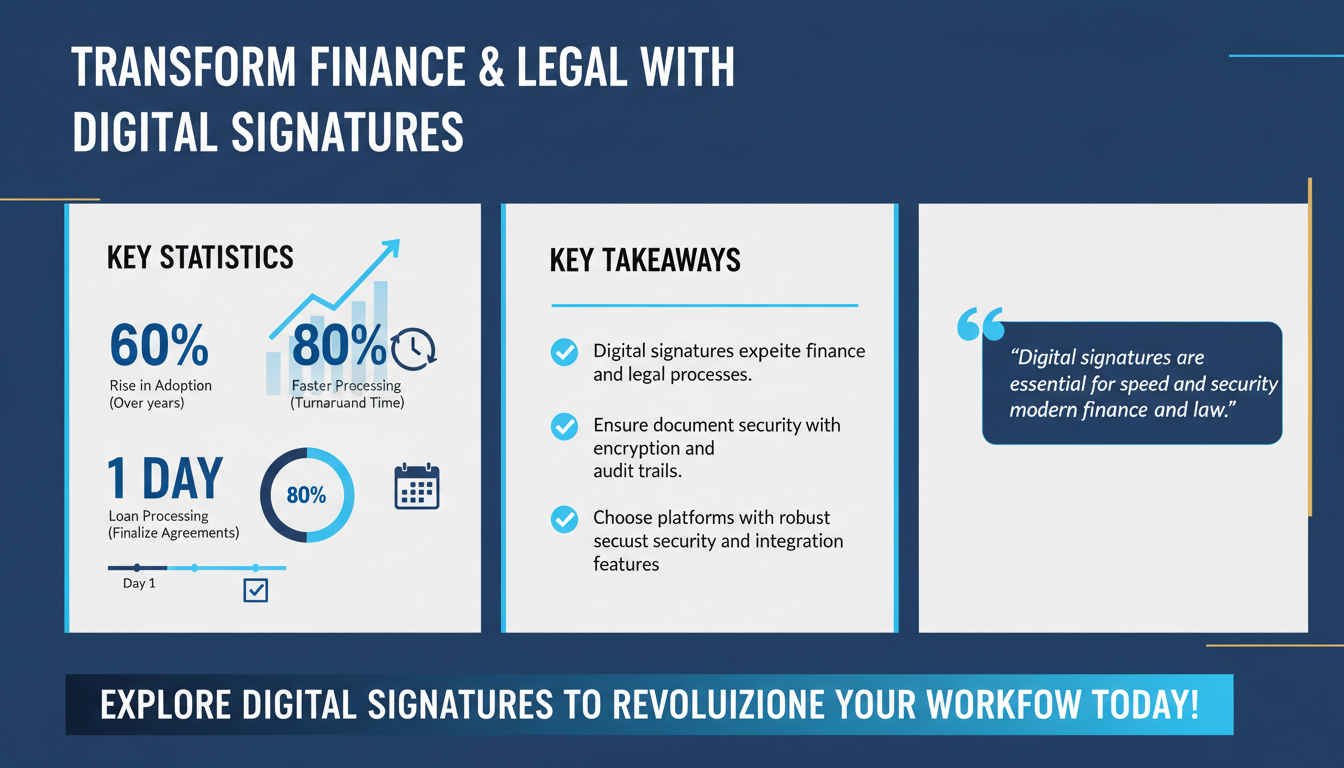
The transition from traditional paper signatures to digital ones marks a significant evolution in how transactions are conducted in finance and legal industries. According to a Forbes article, the use of digital signatures in these sectors has increased by over 60% in the last three years. This surge is driven by the need for speed, security, and cost-effectiveness.

Finance professionals have embraced digital signatures as a means to expedite processes such as loan approvals, investment transactions, and client agreements. Digital signatures reduce the turnaround time significantly, enhancing client satisfaction and operational efficiency. For instance, a bank that once required a week to process a loan agreement can now finalize it within a day, thanks to digital verification.
In the legal sector, the adoption of digital signatures ensures the integrity and authenticity of documents. As legal professionals often deal with sensitive client information, the security features of digital signatures, such as encryption and audit trails, provide an added layer of protection against fraud and data breaches. A law firm that employs digital signatures can securely manage client contracts across different jurisdictions, ensuring compliance with varying legal standards.
Both sectors benefit from the seamless integration of digital signatures into existing workflows, reducing the dependency on physical paperwork and minimizing the risks associated with manual document handling. This integration is not only an efficiency booster but also a step towards sustainable business practices by reducing paper usage.
Case Studies: Success Stories in Adoption
Consider the case of a multinational financial institution that implemented digital signatures to streamline its global operations. By adopting a digital approach, the firm reduced its documentation turnaround time by 80%, enabling faster decision-making across various departments. Similarly, a legal firm specializing in international trade law integrated digital signatures into its workflow, which allowed seamless cross-border collaboration and compliance with international legal standards.
Pro Tip: Leveraging Digital Signature Platforms
Choosing the right platform is crucial for maximizing the benefits of digital signatures. Opt for solutions that offer robust security features, user-friendly interfaces, and seamless integration capabilities. Platforms like DocuSign or Adobe Sign are highly regarded in the industry for their comprehensive offerings.
- Key Takeaway: Digital signatures enhance efficiency and security, leading to faster transaction times and reduced risk of fraud.
Understanding the Technology Behind Digital Signatures
To fully leverage the benefits of digital signatures, it is essential to understand the underlying technology. Digital signatures utilize cryptographic algorithms to ensure the authenticity and integrity of documents. The process involves creating a unique digital fingerprint, or hash, of the document, which is then encrypted using the signer's private key.

According to Gartner, the cryptographic techniques used in digital signatures are virtually unbreakable, making them one of the most secure methods for signing documents. This technology not only verifies the signer's identity but also ensures that the document has not been altered after signing. For example, if a contract is modified after signing, the digital signature will indicate the tampering, alerting stakeholders to the issue immediately.
The use of Public Key Infrastructure (PKI) is central to digital signatures. PKI involves a pair of keys—a private key for signing and a public key for verification. This dual-key mechanism ensures that only the intended recipient can access the signed document, maintaining confidentiality. Furthermore, digital signatures provide a timestamp, adding a layer of non-repudiation, which prevents signers from denying their involvement at a later stage. This feature is particularly beneficial in legal and financial transactions, where accountability is crucial.
Expert Insight: The Role of PKI in Digital Security
Public Key Infrastructure is a foundational technology that supports the security and reliability of digital signatures. Experts recommend regularly updating and managing PKI certificates to prevent unauthorized access and breaches. Organizations are encouraged to implement automated certificate management solutions to streamline this process.
Real-World Application: Multinational Corporations
Consider the case of a multinational corporation that requires secure communications across various subsidiaries. Implementing digital signatures ensures that each signed document, whether a merger agreement or a financial statement, is verified and authenticated, maintaining its legal standing across borders.
- Key Takeaway: Understanding cryptography and PKI is crucial for leveraging digital signatures' full potential in securing documents.
Benefits of Digital Signatures for Finance Professionals
Digital signatures offer myriad benefits for finance professionals, transforming how transactions are processed and managed. One of the most significant advantages is the acceleration of transaction times. With digital signatures, processes that traditionally took days or even weeks can now be completed in a matter of hours.

A study by McKinsey highlights that financial institutions implementing digital signatures have reported a 70% reduction in processing times. This dramatic improvement not only enhances customer satisfaction but also allows financial professionals to allocate resources more effectively. For instance, banks can now reallocate staff from administrative duties to more strategic tasks, such as customer relationship management and product development.
Cost reduction is another compelling benefit. By eliminating the need for physical document handling, storage, and transportation, organizations can significantly reduce operational costs. Additionally, digital signatures help minimize errors associated with manual data entry, further reducing costs related to corrections and rework. An investment firm, for example, can save thousands of dollars annually on printing and courier services alone.
Moreover, digital signatures enhance compliance with financial regulations. By providing an audit trail and ensuring document integrity, digital signatures help financial institutions meet stringent regulatory requirements, such as those outlined in the Financial Regulatory Framework. This compliance is crucial for avoiding penalties and maintaining the institution's reputation in a competitive market.
Checklist: Key Benefits for Finance Professionals
- Accelerated transaction processing times
- Substantial cost reductions
- Enhanced regulatory compliance
- Improved error reduction and data accuracy
Pro Tip: Maximizing Efficiency with Automation
Finance professionals can further enhance efficiency by integrating digital signature platforms with existing financial software systems. Automating repetitive tasks such as document routing and approval processes can free up valuable time for strategic financial planning and analysis.
- Key Takeaway: Digital signatures accelerate transaction times, reduce costs, and enhance regulatory compliance for finance professionals.
Benefits of Digital Signatures for Legal Professionals
In the legal realm, digital signatures offer distinct advantages that streamline processes and enhance document security. One of the primary benefits is the ability to maintain a high level of document integrity and authenticity, which is crucial in legal proceedings.

According to a study by Law.com, 85% of legal professionals reported increased efficiency in contract management after adopting digital signatures. This efficiency stems from the ability to sign and manage legal documents electronically, reducing the need for physical meetings and paperwork. A contract lawyer who manages multiple clients can now efficiently coordinate and finalize agreements without the logistical challenges of in-person meetings.
Digital signatures also enhance collaboration among legal teams. With the ability to sign documents remotely, legal professionals can collaborate across different locations without the logistical challenges of coordinating in-person meetings. This capability is particularly beneficial in multinational legal practices, where time zones and geographical distances often pose challenges.
Moreover, digital signatures help legal firms uphold client confidentiality. The encryption and audit trails associated with digital signatures ensure that sensitive client information remains secure, mitigating the risk of unauthorized access. A law firm specializing in intellectual property, for instance, can confidently handle sensitive patent documentation, knowing that their clients' innovations are protected.
Expert Insight: Enhancing Client Trust through Security
Legal professionals emphasize the importance of building client trust through secure document handling. Digital signatures provide a reliable method for maintaining confidentiality, which is paramount in fostering long-term client relationships. Firms are encouraged to communicate their security measures to clients to build confidence in their digital processes.
Comparison Table: Traditional vs. Digital Signatures in Legal Practices
| Aspect | Traditional Signatures | Digital Signatures |
|---|---|---|
| Document Handling | Manual, paper-based | Automated, electronic |
| Security | Vulnerable to tampering | Encrypted and tamper-proof |
| Efficiency | Time-consuming | Quick and efficient |
- Key Takeaway: Digital signatures streamline legal processes, improve collaboration, and uphold client confidentiality.
Implementing Digital Signatures: Best Practices
Implementing digital signatures effectively requires a strategic approach that aligns with organizational goals and compliance requirements. The first step is to assess the current document management workflow and identify areas where digital signatures can add the most value.
According to Accenture, organizations should conduct a thorough needs analysis to determine the specific requirements of their digital signature solution. This analysis should consider factors such as document volume, security needs, and integration capabilities with existing systems. For example, a company with high-volume contract processing might prioritize scalability and user-friendliness in its digital signature solution.
Once the needs are identified, selecting a digital signature solution that meets these requirements is crucial. Key features to consider include security protocols, user-friendliness, and scalability. It is also essential to ensure that the solution complies with relevant industry standards, such as the ISO 32000-2 standards for digital signatures.
Step-by-Step Breakdown: Implementing Digital Signatures
- Needs Assessment: Evaluate current workflows and document management processes.
- Solution Selection: Choose a digital signature platform that aligns with organizational requirements.
- Integration Planning: Develop a plan for integrating the solution with existing systems.
- Training and Support: Provide comprehensive training and establish support mechanisms.
- Ongoing Evaluation: Regularly assess the effectiveness and efficiency of the digital signature implementation.
Pro Tip: Involve Stakeholders Early
Involving key stakeholders during the planning and implementation phases can ensure that all perspectives are considered, leading to a smoother transition. Regular feedback loops can help address concerns and optimize the system's usage across departments.
- Key Takeaway: A strategic approach, including needs analysis, solution selection, and training, is essential for successful digital signature implementation.
Ensuring Security and Compliance with Digital Signatures
Security and compliance are paramount when implementing digital signatures, especially in heavily regulated industries such as finance and law. Digital signatures must comply with legal frameworks such as the Electronic Signatures in Global and National Commerce (ESIGN) Act and the eIDAS Regulation in the EU.
To ensure compliance, it is critical to work with digital signature providers that offer solutions in line with these regulations. Providers should offer robust authentication methods, such as multi-factor authentication, to verify the identity of signers. For instance, incorporating biometric verification can add an extra layer of security for high-stakes document signing.
Data protection is another critical aspect of security. Digital signature solutions should include encryption and secure storage features to protect sensitive information. An audit trail feature is also essential, as it provides a detailed record of the signing process, which is vital for legal and regulatory scrutiny. A hedge fund, for example, can rely on these features to maintain transparency and accountability in its client interactions.
Checklist: Security and Compliance Measures
- Implement multi-factor authentication for signer verification
- Ensure encryption of all sensitive documents
- Conduct regular audits and compliance checks
- Maintain detailed audit trails for transparency
Pro Tip: Regular Training on Compliance
Regular training sessions on compliance and security protocols can help keep staff informed about the latest regulations and security threats. These sessions should be part of the organization's broader risk management strategy.
- Key Takeaway: Ensuring compliance with regulations and implementing robust security measures are essential for protecting digital signatures.
Overcoming Common Challenges in Digital Signature Implementation
While digital signatures offer numerous benefits, their implementation is not without challenges. One common issue is resistance to change, as some staff may be accustomed to traditional signing methods. Overcoming this resistance requires effective change management strategies, including clear communication of the benefits and providing comprehensive training.
Another challenge is ensuring that the digital signature solution integrates seamlessly with existing systems. According to PwC, organizations should prioritize solutions that offer compatibility with their current document management systems to avoid disruptions.
Technical issues, such as system downtime or software glitches, can also pose challenges. It is crucial to work with reputable providers that offer reliable solutions and responsive support to address any technical issues promptly. A global bank, for instance, might choose a provider known for robust infrastructure and 24/7 customer support.
Finally, ensuring user adoption is a critical factor in successful implementation. Organizations should engage users early in the process, gathering feedback and addressing concerns to foster a sense of ownership and acceptance of the new system. A company might conduct user satisfaction surveys and focus groups to fine-tune the implementation process based on employee input.
Change Management Strategies
- Communicate benefits clearly to all stakeholders
- Provide comprehensive training sessions
- Establish feedback mechanisms for continuous improvement
- Highlight success stories to encourage adoption
Pro Tip: Pilot Testing
Before full-scale implementation, consider running a pilot test with a small group of users. This approach allows for identifying potential issues and making necessary adjustments before a wider rollout, ensuring a smoother transition for the entire organization.
- Key Takeaway: Effective change management, seamless integration, and user engagement are key to overcoming implementation challenges.
Future Trends in Digital Signatures
The landscape of digital signatures is continually evolving, with new trends and technologies shaping the future of this essential tool. One emerging trend is the integration of artificial intelligence (AI) to enhance the capabilities of digital signatures. AI can automate the verification process, further reducing processing times and enhancing accuracy. For example, AI can analyze past signing patterns to predict and prevent fraudulent activities.
Blockchain technology is another trend gaining traction. According to TechCrunch, blockchain offers a decentralized and tamper-proof method for managing digital signatures, further enhancing security and transparency. By recording each transaction in an immutable ledger, blockchain ensures that every signature is both verifiable and secure.
The rise of mobile digital signatures is also noteworthy. As more professionals work remotely, the demand for mobile-friendly digital signature solutions has increased. This trend is expected to continue, with providers focusing on enhancing mobile integration and user experience. Imagine a financial analyst reviewing and signing reports from a smartphone while on the go, maintaining productivity regardless of location.
Finally, the focus on sustainability is driving organizations to adopt digital signatures as part of their eco-friendly initiatives. By reducing paper usage and associated waste, digital signatures contribute to a more sustainable business model, aligning with global efforts to combat climate change. Companies that adopt digital signatures can significantly lower their carbon footprint and promote environmental responsibility.
Emerging Technologies: AI and Blockchain
Artificial intelligence and blockchain are set to redefine the digital signature landscape. AI's ability to detect anomalies and predict fraud enhances security, while blockchain's decentralized nature provides an unalterable record of all signature transactions, ensuring both parties' trust.
Pro Tip: Stay Updated on Technological Advances
To remain competitive, organizations should keep abreast of technological developments in digital signatures. Regularly review white papers, attend industry conferences, and engage with technology partners to explore new advancements that can improve your digital workflows.
- Key Takeaway: AI, blockchain, mobile integration, and sustainability are key trends shaping the future of digital signatures.
Frequently Asked Questions (FAQs)
1. Are digital signatures legally binding?
Yes, digital signatures are legally binding and recognized in many jurisdictions, provided they meet specific legal requirements such as those outlined in the ESIGN Act and eIDAS Regulation.
2. How do digital signatures enhance security?
Digital signatures use cryptographic algorithms to ensure document integrity and authenticate the signer's identity. Features like encryption, audit trails, and multi-factor authentication further enhance security.
3. Can digital signatures be used for all types of documents?
Digital signatures are versatile and can be used for a wide range of documents, including contracts, agreements, and financial transactions. However, it's essential to ensure compliance with industry-specific regulations.
4. What is the difference between an electronic and a digital signature?
An electronic signature is a broad term encompassing any electronic process that signifies agreement, while a digital signature is a specific type of electronic signature that uses cryptography for enhanced security.
5. How can I choose the right digital signature solution for my organization?
Consider factors such as security features, integration capabilities, compliance with legal standards, and user-friendliness when selecting a digital signature solution.
Conclusion
Digital signatures are revolutionizing the finance and legal sectors by enhancing security and efficiency in document management. As professionals in these fields continue to embrace digital transformation, understanding and implementing digital signatures effectively is crucial to staying competitive. By leveraging the insights and best practices outlined in this guide, finance and legal professionals can harness the full potential of digital signatures to streamline operations, reduce costs, and ensure compliance.
As you embark on this journey, consider complementing your efforts with tools like Apparatuz for workflow automation, Applicantz for recruitment processes, Schedly for scheduling, and Supportly for customer support. Together, these solutions provide a comprehensive approach to digital efficiency and security, empowering your organization to thrive in the digital age.